Close
Back


From now on you can download videos from our website
If you would also like to subscribe to the newsletter and receive our latest updates, click on the button below.
Enter the email address you registered with and we will send you a code to reset your password.
The password must be at least 12 characters long, no spaces, include upper/lowercase letters, numbers and symbols.
Click the button to return to the page you were on and log in with your new password.
President Dan, dear Nicușor,
Thank you for hosting this summit of B9 and Nordic Allies.
And thank you President Nawrocki, dear Karol, for co-chairing, but also for Poland’s role in founding this group.
The B9 is firmly anchored in NATO and the transatlantic relationship.
And today’s meeting of strong and committed NATO Allies, from the Black Sea, to the Baltic, to the Arctic, demonstrates our unity and determination.
To stand together.
And to defend against any threat, from any direction.
Russia remains, indeed, as you said, the most significant and direct threat to NATO.
And it continues its ruthless war of aggression against Ukraine.
We cannot let down our guard.
We will always do what is necessary to defend every inch of NATO territory.
We have significantly strengthened our deterrence and defence in the High North and along the eastern flank.
But we need to do more given the dangers we face.
That means our militaries having the resources, the forces, and the capabilities they need.
That means spending more.
And I welcome the huge leaps in defence investment by Poland, by Romania, and the other Allies here today.
At the NATO Summit in The Hague last year, Allies agreed to commit 5% of GDP to defence.
Cash is crucial.
But this year’s Summit in Ankara will also be about combat-ready capabilities, and significantly scaling up our defence industries.
NATO is – and will always be – a transatlantic Alliance.
But we need a stronger Europe in a stronger NATO, through increased defence spending and defence production.
And with European Allies taking more responsibility for their own conventional defence, backed by American power.
Our continued strong support for Ukraine will also be a priority at the Ankara Summit.
And today we discussed with President VolodymyrZelenskyy what more we can do to help in its fight for freedom.
A strong Ukraine today, and a strong Ukraine for the future, is how Russian aggression can be stopped.
The war isn’t waiting for us.
The time for action is now.
Ukraine is backed by many, many friends.
And I count on those friends to do more.
Through the PURL initiative, which is getting urgently needed American firepower to Ukraine.
And through other ways.
We need to dig deep, and continue to provide the support Ukraine needs.
Because Ukraine’s security is our security.
As a proud European and a proud advocate of the transatlantic bond, I know that only through NATO we can keep one billion people safe, on both sides of the Atlantic.
President Dan, dear Nicușor.
President Nawrocki, dear Karol.
Thank you both for your leadership, for your commitment to our shared security.
We are all stronger and safer when we stand together in NATO.
Thank you.
Ramona Avramescu, Romanian Television: So, my question is for both Presidents and General Secretary: in the final statement of the summit, you speak about the decision to build NATO 3.0 by promoting a stronger, more powerful Europe. Can you explain completely what does it mean, from the perspective of a transatlantic relationship? Is it an acknowledgement of the fact that the United States won't involve any longer in the security of Europe? And how can NATO remain so powerful in such conditions, especially that there are states that are quite far away from that 5% taken in The Hague.
NATO Secretary General Mark Rutte
NATO 3.0 means a stronger Europe in a stronger NATO. And a stronger Europe in a stronger NATO means with United States both nuclear, but also conventional. But the Europeans taking more responsibility for their own conventional defence. We are seeing it here today. I mean, I think, still think that one of the biggest foreign policy successes of President Trump has been the Summit in The Hague. At that summit, we concluded that all nations in NATO, all allies, are at that famous 2% we agreed to in Wales in 2014. And many of them were not on 2% at the beginning of last year. They all were there when we had the summit. And then we agreed to, over the coming years, move to 5% defence spending, because we need to do this. It equalizes our spending with the US. But it is particularly necessary to make sure we in Europe and in the US and in Canada, can defend ourselves against any adversary.
And what we are seeing here today is countries going beyond 5%. Countries even moving to that 5% before 2035, so, I was really encouraged. But we have to be honest, sometimes in NATO, we have our discussions, and since a couple of months, of course, we know that there was some disappointment in the United States when it came to the reaction of some Allies regarding Iran and the war against Iran by the US and Israel. But I would say that clearly Allies have heard the message. They have heard the message. And that is on two fronts, first of all, when it comes to living up to all the commitments, previous commitments, bilateral commitments, to basing requests.
We are seeing massively all over NATO in Europe that countries are doing what they promised before in these bilateral agreements. And evidence is here in Romania. I mean, when I landed here yesterday, I could see the refuelling aircraft here at Bucharest airport from the United States, which is clearly a sign that also Romania is doing its part in terms of living up to those commitments. And then when it comes to the Strait of Hormuz, next phase, what we are now seeing is the American initiative, the British-French initiative. They are all, of course, very much in line with each other, making sure that for that next phase, we have what is needed to do the demining to make sure that the strait stays open. We heard today the Italians sending an extra two demining, mine-hunter ships to close to the theatre, not yet in the Strait of Hormuz, obviously not now, but at least close to theatre, so that they can be active there when necessary. And this is following on many initiatives, the Czechs with radar, the Germans, Lithuanians, the Dutch,the Belgians. We have seen the French and others. And yesterday, some clear commitments coming out of this French-British meeting with 40 countries participating. So, my message to the United States is the Europeans heard the message, they are following up. We are really working together on this.
Question for President Nawrocki and President Dan and Secretary General Rutte, starting from a statement made by Dmitri Peskov in the past few hours about the beginnings of some negotiation for an armistice in Ukraine, conditioned on the withdrawal of Ukrainian troops and military from the Russian area. And he means by that withdrawing to the current front line, and given the presence of President Zelenskyy here today, what is the formula that NATO support will embrace to continue supporting Ukraine in the coming period, what is the perspective of the states in the eastern flank and NATO in regards to this maximal demand?
NATO Secretary General Mark Rutte:
It was Putin starting this war in 2014 and then the full-scale invasion in February 2022. It has been the American president who broke the deadlock with President Putin in February last year. And I think that was extremely important, starting to engage with the Russians. Is there a way out of this conflict? In the meantime, we have to make sure that Ukraine has what it needs to stay in the fight as strong as possible. That includes essential US support still flowing into Ukraine, paid for by European Allies, and all the other support Europeans and the US are providing. When it comes eventually to a moment where a deal can be struck. I mean, Putin has to play ball, and at the moment he is not. He has to be willing to play ball, to engage really in peace negotiations. And again, I commend the US efforts to get that done. And if that moment comes, obviously, it is up to the Ukrainian government to decide on what they want to do in terms of a compromise and what it will be. For us here, it is important that you make sure that post a peace deal or a long-term cease fire, preferably of course a full peace deal, that the Russians will never, ever try to attack again. And that is why this concept of security guarantees is so crucial, which we agreed in Paris under the leadership of President Macron early January, with US and Allies from all over Europe and Canada in the room. So basically, we have that now hammered out 90 to 95% and that is crucial, so that the Russians know that if there is a deal or a long-term cease fire, they can never try to do this again because the reaction will be devastating. That's crucial. But at the moment, I must say the ball is clearly in Putin's court. He has to play ball. He is not doing that yet. Let's see what happens. And the Ukrainians, in the meantime, are maintaining the fight, doing well on the front line, but obviously they did not ask for this, and many people have been killed because of Putin in Ukraine.
Television Republic: I would like to ask whether you talked about the possible increase of American presence along eastern flank. I'm of course asking in the context of the information that some American troops will be withdrawn from Germany. You had a representative of the American administration at the B9 summit. I'd like to ask you, Presidents, whether you raised this topic, and what other countries of the region are thinking about it. And a question to Secretary General, is there a possibility that these troops, American troops, are relocated to Poland instead of withdrawing them from Europe? Would you support such an idea?
NATO Secretary General Mark Rutte: When you look at the US presence in Europe, it is still vast and massive and there is a clear commitment in the United States to stay involved in the conventional defence of also the European parts of NATO. Let's not forget that NATO is there not only to defend Europe, but as indeed the Norwegian foreign minister said today, the defence of the US mainland starts in Norway. And why does it start in Norway? Because this very consequential port with the big, huge nuclear submarines with nuclear warheads on the Russian side are just over the border with Norway, and we have to, collectively, make sure that they don't post a threat to United States. So, we are in this because all of us need to be secure, one billion people on both sides of the Atlantic. We know that we are investing now more in Europe. We have always known that the United States, over time, has to pivot more towards Asia. What we have to make sure of, and the US agrees on this, the Europeans agree on this, that whilst we are doing this, the overall level of deterrence and defence stays strong. Europeans stepping up the US over time, step by step, being able to pivot more towards other priorities, which are also our priorities. Because we have every interest in a safe Indo-Pacific. We work closely together with the Indo-Pacific partners. And of course, we have every interest in Iran having a degraded, massively degraded nuclear capability and long-range missile capability. So, we are all in this, all together. And obviously it is a sovereign decision of the United States, where they will bring their troops, how they will do that, but we do this in close consultation.
I have a question for all the participants, but mostly for Secretary General Rutte and the Polish President because you talked recently with President Trump, and I wanted to ask you if you see the risk that President Trump starts to think about Allies in a different way, in terms of the countries who are doing more, who are helping the US, who are more friendly to the US, and if there is a risk of fragmentation in terms inside NATO [on] from this perspective, and what would this approach mean for the countries on the Eastern flank ? Thank you.
NATO Secretary General Mark Rutte: As I said after I had met the President a couple of weeks ago in the White House, there is a disappointment. And the disappointment had to do with two things: one is that there was a general feeling that not all the commitments when it comes to use of bases in Europe had been fully implemented and fully acted upon, and I was able I think to address that fact and showing that massively in Europe, these bilateral agreements are being honoured. And I just mentioned the example of Bucharest airport and the refuelling aircraft from the US, which is very much visible there. But there is also the other issue: in this next phase of Hormuz, how can Allies, how can friends, from NATO countries, but also in the Indo-Pacific, how can they help? And this is about pre-positioning, making sure that you are there when the moment comes to be helpful to do that. And this is now exactly what is happening. So, that's why I'm saying both on the bases, using the bases, but also when it comes to pre-positioning these assets, including as I mentioned mine-hunters, other key capabilities like radar, divers, etc, what we are seeing is that it is done, and that the Allies in NATO, the French, United States, have heard the message. So, I think that is important. And then the overall picture is positive. Because when you look at the Summit in The Hague, and what is happening now, we are clearly now working hard to get to the 5%. As I said, some countries are speeding up even beyond the 5% and speeding up in terms of getting there before 2035. Let me again mention Germany, which is second biggest Ally and the biggest Ally in Europe, spending over 150 billion, twice as much as in 2021, by 2029, as much as the French and the Brits combined in 2029. And the US sees this, the US recognized this, and this makes NATO stronger. But when it comes to the countries who are directly, basically facing our adversaries, because they are, let's say on the front line, or at the border, or whatever name you give it, here you need to do three things: one, this overall spending and ramping up the spending is crucial, of course, for all of us, but also for the countries who have those geographic positions. Second, what we need to do, all 32 Allies, is to make sure we produce more. And not only produce more, we also have to innovate. And here, clearly it is Ukraine giving us a lot of insights of in modern warfare, particularly when it comes to drones and anti-drone technology. And when you look at countries like Romania and others, but also Poland and the Baltic countries, we all are faced with this drone threat and therefore we need also the counter-drone technology. Ukraine can play a big role here. We need cost effective solutions for threats from the sky. We cannot continue taking out $20,000 costing drones with 3 or 4 million costing missiles. Here, Ukraine can help again. So, money, making sure that the money is translated into concrete capabilities through our defence industrial base, and then finally, getting ourselves organized. And that's exactly what we have been doing over the past year. With first Baltic Sentry, then with Eastern Sentry, and now with Arctic Sentry. Making sure that when it comes to all these areas within NATO, from the High North of the Black Sea, in the Baltic Sea, in the Arctic, that we bring all our assets together. Therefore, exactly being able to define the gaps which are still there, then filling those gaps. This is what is happening all over NATO territory. So, I would say on all of this, the US is very supportive and very positive. But I started with a disappointment, and I think what my message will be to all our friends is that that message has been heard and acted upon.
I hope you still have patience for one more question for all three of you, NATO 3.0 is the rising star of summit today, while President Trump, when departing for China, said, once again, the US did not need NATO anymore. The B9 statement is the first official Summit document that contains the 3.0 constant, with decrease of the conventional role of the US in Europe and an increase of European role, will this continue and exist in the Ankara Summit declaration?
NATO Secretary General Mark Rutte: Yes, is the short answer, because this is the logical next step. So, we had the Summit in The Hague, we had to address this urgent issue of spending, and the fact that for years, not only was there no equality between what the US is spending on defence and overall Europe was doing, but there was also this issue that we had to spend more because of the capabilities we need. And there is a very serious process in NATO which came to a conclusion last June at the level of defence ministers: what are the capabilities we need to defend ourselves, 360° degree against any adversary, of course Russia being a particular adversary, and any threat from any direction. And that's basically the ballpark figure of being able to defend ourselves is this famous 3.5%. It was somewhere between 3.4 - 3.7 ballpark 3.5, plus the defence related spending bringing us to the 5%. That was the Summit in The Hague. NATO 3.0 is the logical next step of a European part of NATO taking more and more care and responsibility for its own conventional defence, and therefore making it possible for the by far biggest Ally we have, the United States, which has to take care of multiple theatres, to pivot more, for example, towards Asia. Over time, because overall we want of course collectively, with the US, to prevent a gap in our deterrence and defence to emerge. So, whilst Europe is stepping up, the US can, over time, step by step, pivot more towards other priorities which are also, by the way, our priorities but of course, the US having a specific role there. And that's exactly what is happening. And I think we can thank President Trump, for the fact that the whole of the Alliance is on 2%, that we agreed in The Hague on 5%, being very clear now when it comes to Iran. Again, my message is: the Europeans heard you, they are following up the bases when it comes to pre-positioning now for the next phase in the Strait of Hormuz. So, I'm cautiously optimistic when it comes to the Ankara Summit.




NATO Secretary General Mark Rutte with Karol Nawrocki, President of Poland and Nicușor Dan, President of Romania
NATO Secretary General Mark Rutte with Petr Pavel, President of Czechia
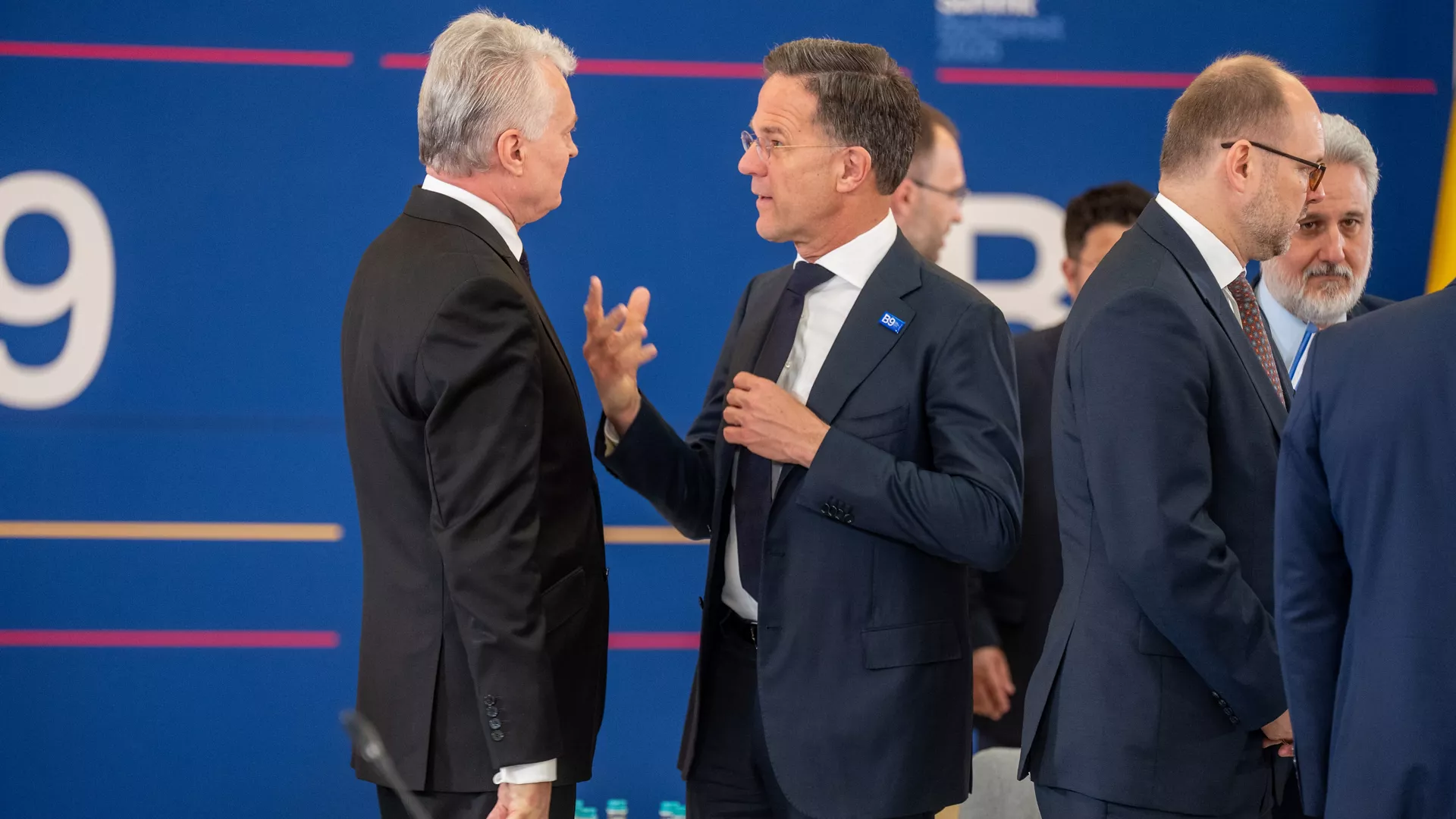
NATO Secretary General Mark Rutte with Gitanas Nausėda, President of Lithuania
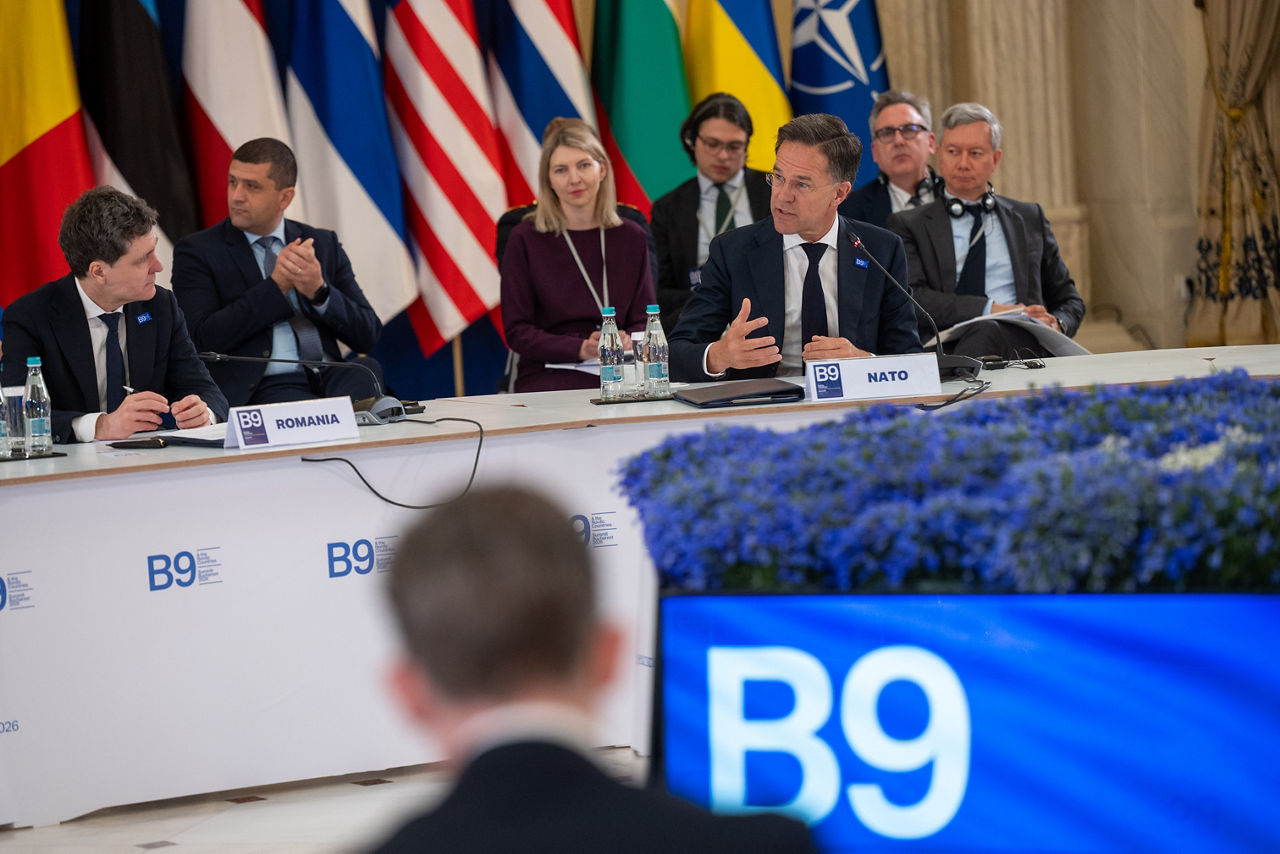
NATO Secretary General Mark Rutte at the B9 Summit
NATO Secretary General Mark Rutte at the B9 Summit
NATO Secretary General Mark Rutte at the B9 Summit
NATO Secretary General Mark Rutte at the B9 Summit
NATO Secretary General Mark Rutte at the B9 Summit
NATO Secretary General Mark Rutte with U.S. Under Secretary of State for Arms Control and International Security Thomas DiNanno
NATO Secretary General Mark Rutte attends the B9 Summit in Bucharest, Romania
NATO Secretary General Mark Rutte with Mette Frederiksen, Prime Minister of Denmark
Family photo from the B9 Summit in Bucharest, Romania
Joint press statements by the NATO Secretary General Mark Rutte with Nicușor Dan, President of Romania and Karol Nawrocki, President of Poland
Joint press statements by the NATO Secretary General Mark Rutte with Nicușor Dan, President of Romania and Karol Nawrocki, President of Poland
Joint press statements by the NATO Secretary General Mark Rutte with Nicușor Dan, President of Romania and Karol Nawrocki, President of Poland
Joint press statements by the NATO Secretary General Mark Rutte with Nicușor Dan, President of Romania and Karol Nawrocki, President of Poland
NATO Secretary General attends the B9 Summit in Bucharest