Apple reaches $5 trillion market cap as investors retreat from AI stocks
The iPhone maker became the second company ever to cross the threshold, benefiting from strong product demand and its decision to avoid the heavy AI infrastructure spending that has weighed on rivals.
Apple on Tuesday briefly touched a market capitalization of $5 trillion, becoming only the second company ever to cross the threshold after Nvidia first breached the mark last October. The milestone reflects a striking reversal of fortune for the iPhone maker, which lagged its trillion-dollar peers late last year as investors questioned whether its restrained approach to artificial intelligence would leave it behind. That restraint now looks like a strategy.
Shares reached a session high of $342.89, giving Apple a market capitalization of $5.04 trillion, before easing back to about $339.68, around the $4.99 trillion mark. The stock has gained roughly 25% this year, outpacing every other member of the so-called Magnificent Seven. Nvidia, the first company to reach $5 trillion, has risen just 6% this year. Apple overtook the chipmaker as the world’s most valuable publicly traded company this month, ending Nvidia’s reign at the top since June 2025.
Why Apple’s restraint is paying off
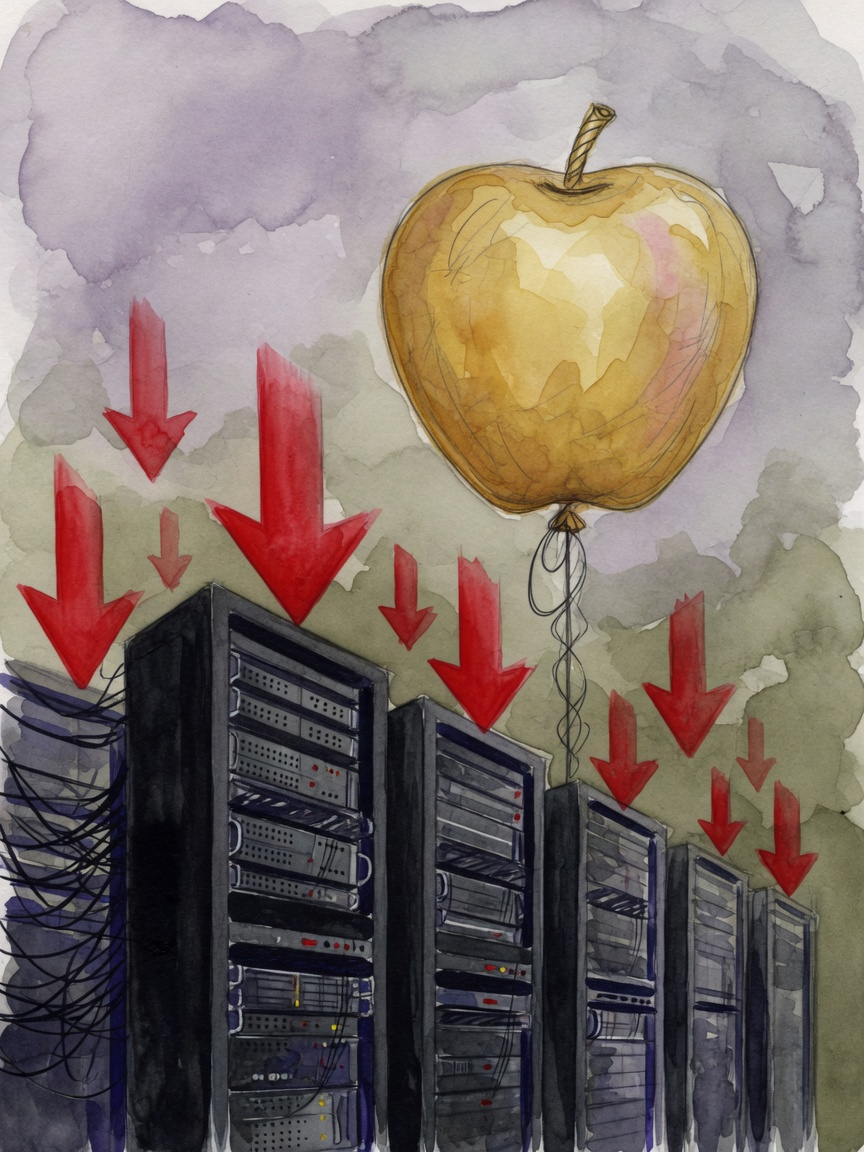
While Alphabet, Amazon, Meta, and Microsoft collectively pour hundreds of billions of dollars into capital expenditures for their artificial intelligence buildouts this year, Apple has kept its spending low. The company has relied on cloud infrastructure and AI technology from Google to power new services such as a revamped Siri, rather than building its own. That decision spared Apple the hefty infrastructure costs now unsettling investors across the technology sector.
Apple trailed its trillion-dollar peers on the market last year as investors worried the company was missing out on the AI boom by keeping investments in check and delaying the long-awaited rollout of an upgraded Siri. The revamped voice assistant will be released this fall alongside new iPhone hardware. But the narrative has flipped of late due to concerns that the aggressive tech spenders are raising mounds of debt and going cash flow negative without a clear path to hefty returns.
Concerns are mounting. Google said last week it was further increasing capital spending this year to as much as $205 billion to fund its AI plans, while reporting negative free cash flow for the first time in its history. The company burned through $5.9 billion in the three months to the end of June. Investors have also grown jittery about the circular funding at the heart of the AI industry, through which artificial intelligence companies finance one another.
The sell-off has been broad. US chip stocks including Intel, Advanced Micro Devices, Sandisk, Western Digital, and Seagate Technology each fell more than 4% on Tuesday. The Nasdaq 100 dropped as much as 1.8%, pushing the index down more than 10% from its early June record high and into a technical market correction. In South Korea, SK Hynix and Samsung Electronics each lost more than 10%. Analysts attributed the sell-off to renewed worries over AI investment spending and competition from cheaper Chinese companies, after a report that China had begun mass production of homegrown deep ultraviolet chip-making tools.
Product demand and a new leasing program
Apple’s rally also reflects strong product demand. The stock has climbed despite price hikes on devices resulting from the global memory shortage. The company held iPhone prices steady last month while raising prices on MacBooks and iPads, its first formal move to pass higher memory and storage costs to consumers after CEO Tim Cook said increases had become unavoidable. Buyers scooped up iPhones ahead of expected price hikes later this year, analysts said.
On Tuesday, Apple announced a new leasing program called Upgrade, allowing US customers to lease iPhones and other products instead of buying them outright. The Guardian reported the program runs through the payments firm Klarna, with monthly payments starting at $17.99 for an iPhone, $11.99 for an Apple Watch or iPad, and $24.99 for a Mac. Dipanjan Chatterjee, a vice president and principal analyst at Forrester, said Apple has resisted the AI spending race, betting that customer experience, not infrastructure investment, will ultimately determine the winners. He called the leasing program a clever response that changes how consumers perceive the cost by replacing sticker shock with a predictable monthly payment.
Apple reports third-quarter earnings on Thursday. Analysts expect revenue to jump more than 15% from a year earlier. The earnings call will be Tim Cook’s last as CEO. John Ternus is set to take over on Sept. 1.
Sources & methods
- CNBC article on Apple touching $5 trillion market cap, its capex strategy, the Upgrade leasing program, and Tim Cook's final earnings call as CEO Archived Jul 28, 2026
- The Guardian article on Apple becoming the second $5tn company, the AI stock sell-off, Klarna leasing details, Google's negative free cash flow, and analyst Dipanjan Chatterjee's commentary Archived Jul 28, 2026
This piece was reported using two published articles from CNBC and The Guardian covering Apple’s market capitalization milestone, the broader AI stock sell-off, and Apple’s product and leasing announcements.