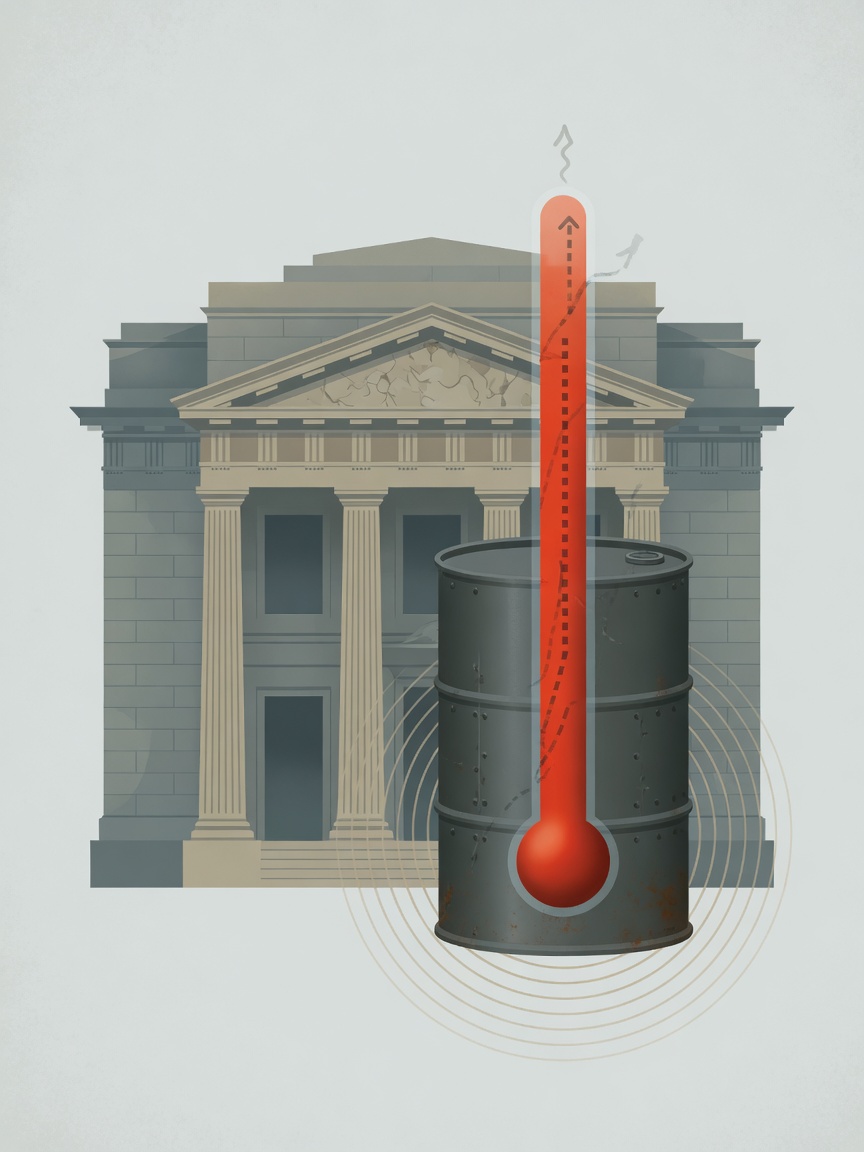
LONDON — The Bank of England held interest rates at 3.75% for a fifth consecutive meeting, citing inflation risks from the Iran war even as it upgraded its growth forecast for the UK economy.
The vote shifted. Three of nine rate-setters wanted a hike to 4%, one more than at the previous meeting. The majority held firm. The central bank said any change in borrowing costs would depend on how long the energy shock lasts and how severe it proves.
The UK economy is now expected to grow 1.1% this year, ahead of forecasts the Bank made in April. Inflation eased to 2.6% in the year to June, when diesel and petrol prices fell during a brief lull in hostilities between the US and Iran. But the Bank expects price rises to pick up again, driven by volatile oil and gas prices caused by the conflict in the Middle East.
Bailey warns of renewed inflation
Governor Andrew Bailey said inflation has fallen faster than expected but warned that the Middle East conflict continues to mean high and volatile energy prices. “That will cause inflation to rise again this year,” he said. “However, as the conflict unfolds, our job is to make sure any increase in inflation is temporary and that it comes back to our 2% target.” At his press conference, Bailey said there is little evidence that inflationary pressures are becoming embedded in the UK economy, pointing to underlying disinflation. He said it is hazardous to make assumptions about the Iran conflict, noting that the world feels as uncertain and volatile today as it did three months ago in April.
The Bank examined a range of scenarios. Inflation was previously expected to reach 3.5% this year. In a worst-case scenario where oil prices reach $100 a barrel, the Bank now projects inflation could reach 3.2% in 2026. In a scenario where oil prices are around $76 before falling back to $71, inflation could reach 3%. Both remain above target.
Oil prices swing on Trump’s mixed signals
Oil prices have swung sharply. On Monday, crude fell after US President Donald Trump said there were “very friendly negotiations” between Washington and Tehran. On Wednesday, oil shot up to more than $91 per barrel after Trump said of Iran: “We’ll be hitting them hard. They’re going to get a beating.”
Megan Greene, one of the three members who voted for a rise, said other risks loom over inflation beyond the Iran war. She cited a second choke point for global energy supplies in the Red Sea, where Houthi rebels in Yemen recently attacked oil tankers. Droughts around the world and the prospect of a “super El Niño” weather pattern could hike food prices, while the market for microchips could also affect technology costs.
Deputy governor Clare Lombardelli said the Bank has learned that the conflict could go on for longer, but that the most extreme energy price scenarios have not come to pass. Another deputy governor, Dave Ramsden, said the balance of risks on inflation is tilted to the upside. Bailey raised the possibility of an “episodic” war in Iran. If the conflict persists, the Bank will likely have to tighten policy, he said, while peace could allow for looser monetary policy. The backdrop of relatively weak household demand reduces the ability of businesses to pass on price rises to customers, Bailey said. The lack of spare capacity in the labour market means people may struggle to secure higher pay. He cautioned that the lack of evidence so far does not rule out that second-round effects could kick in later, calling the Bank’s assessment “tentative.” Ofgem’s price cap will rise to about £1,600 for an average household energy bill, Bailey said, stressing the need to watch carefully that the direct and indirect effects of inflation do not get embedded into the expectations of businesses and households.
Rob Wood, chief UK economist at Pantheon Macroeconomics, said the committee’s guidance looked slightly less hawkish. He noted that the MPC had inserted a sentence in its monetary policy summary acknowledging little evidence so far of second-round effects and pointing to clear signs of underlying disinflation in recent data. Wood added that the rest of the minutes signal that limited evidence of second-round effects is far from surprising given the usual lags, and the committee concluded that the arguments warranted caution in placing too much weight on initial evidence.
Investors are inching up their probabilities of a “no change” decision at the September meeting. If the Iran war continues and oil prices hover around $100 a barrel, a rate rise seems likely. Many in the markets expect tensions to subside in the coming weeks, ahead of crucial elections across the US in the autumn. The Bank is ready to raise rates if the war re-escalates, leading to higher oil costs and elevated gas prices as Europe refills its storage capacity ahead of winter. But that judgement changes day to day, depending on the responses of the US and Iran. If a ceasefire returns and holds, energy prices could fall rapidly and raise the prospect of a rate cut.