Factory prices index hit a four-year high in April even as hiring kept slipping
The ISM Manufacturing PMI held at 52.7 percent for a second month. Underneath that flat headline, the prices subindex jumped to 84.6 percent, and the employment subindex fell deeper into contraction.
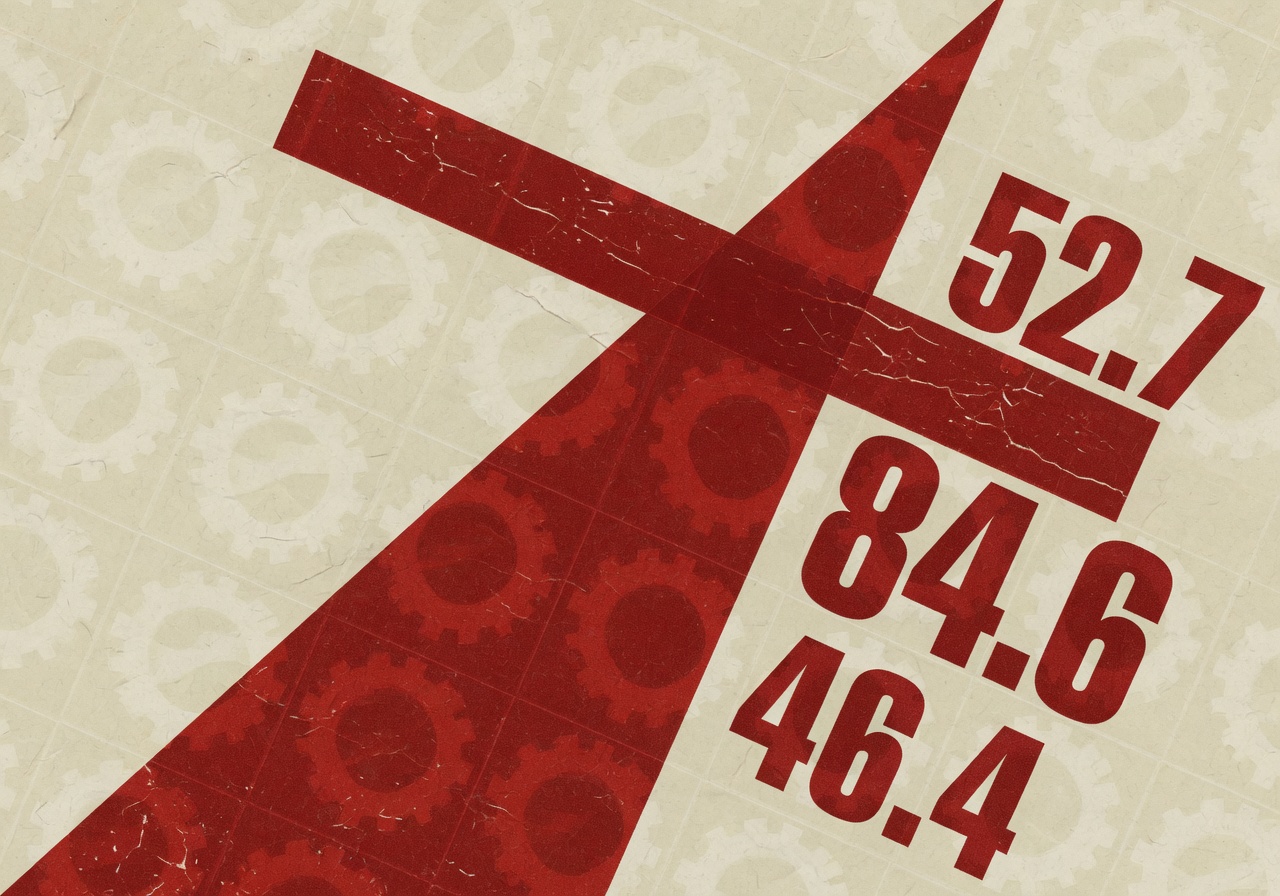
The Institute for Supply Management reported on Thursday that its Manufacturing Purchasing Managers’ Index registered 52.7 percent in April, the same reading as March, and the fourth consecutive month of expansion in the factory sector. Below the headline number, two of the subindexes that make up the PMI moved hard in opposite directions. The Prices Index, which tracks what manufacturers pay for inputs, jumped 6.3 percentage points to 84.6 percent, its highest reading since April 2022. The Employment Index fell 2.3 percentage points to 46.4 percent, its fifth straight month in contraction.
The PMI is a diffusion index. A reading above 50 means more surveyed purchasing managers reported expansion than contraction in a given month; a reading below 50 means the opposite. The headline composite is built from five equally weighted subindexes: New Orders, Production, Employment, Supplier Deliveries, and Inventories. ISM has run the survey monthly since 1948, with roughly 400 panelists across 18 manufacturing industries returning responses on the first business day of each month.
What changed in April
New Orders rose 0.6 points to 54.1 percent and Supplier Deliveries rose 1.7 points to 60.6 percent. A rising Supplier Deliveries reading sounds positive but means the opposite of what an outsider might assume: it signals that suppliers are taking longer to fulfill orders, which the index treats as a sign of demand outrunning capacity. Production fell 1.7 points to 53.4 percent, still in expansion. New Export Orders fell 2.0 points to 47.9 percent, and Imports fell 2.3 points to 50.3 percent, just barely on the expansion side of the line.
The two readings that moved most are the ones that matter most for the next quarter. Prices at 84.6 percent is the highest level since the post-pandemic surge of April 2022, and the index has now climbed 25.6 percentage points over three months. Employment at 46.4 percent is the deepest contraction in the labor subindex in this cycle. Susan Spence, chair of the ISM Manufacturing Business Survey Committee, wrote in the release that 60 percent of panelists reported their companies are managing head counts rather than hiring, and that of those managing head counts, 34 percent are using layoffs and 43 percent are using attrition or declining to backfill open roles.
All imports from China are up 15 percent to 25 percent, which is impossible for us to absorb or to fully pass along. — Chemical Products panelist, ISM April 2026 report
Why prices are climbing while output holds
The unsigned panelist comments published with the ISM release describe the mechanism in plain terms. A Transportation Equipment respondent wrote that tariffs on inputs were being closely monitored and that rerouting measures had been implemented. A Chemical Products respondent said imports from China had risen 15 to 25 percent in landed cost. Tariff-related comments appeared in 18 percent of all panelist remarks in April. Comments referencing the ongoing Iran conflict, now in its second month, appeared in 47 percent of remarks; positive-to-negative sentiment in that subset ran roughly one to two.
For a reader trying to translate the Prices Index into a household consequence, the chain is short. An 84.6 reading does not mean prices rose 84.6 percent. It means more than 84 percent of surveyed purchasing managers reported paying more for inputs in April than in March. Manufacturers do not absorb that. They pass it along, usually with a lag of one to three quarters, into the wholesale prices their customers pay, which eventually show up in the goods component of the Consumer Price Index. Headline CPI for March, the most recent BLS release as of Thursday, showed core goods prices already running above the central bank’s implicit target.
What it means for workers
The April Employment subindex is the more legible number for anyone not employed in a forecasting role. It says that, across 18 manufacturing industries, the dominant hiring posture is now defensive. Attrition plus selective layoffs. Three industries reported outright contraction in employment in April: Wood Products, Petroleum and Coal Products, and Food, Beverage and Tobacco Products. Thirteen industries reported expansion in output, led by Textile Mills, Nonmetallic Mineral Products, and Primary Metals. The split between an output index in expansion and an employment index in contraction is the central feature of this report, and it is the feature that does not appear in the one-line summary that crossed wire services at 10 a.m.
There is a coherent story that fits the data. Factories are running. Input costs are climbing, in part because tariffs are altering the landed-cost math on imported components and in part because a Middle East conflict is raising freight and insurance costs on routes that cross the region. Manufacturers are absorbing some of that on margin, passing some of it through to customers, and protecting the rest by holding payrolls flat or shrinking them. The PMI headline at 52.7 percent reports the first half of that sentence. It does not report the second half.
What to watch next
Three data releases will sharpen the picture before the next ISM print on June 1. The Bureau of Labor Statistics is scheduled to release the April Employment Situation report on Friday, May 2, which will show whether the contraction in the ISM employment subindex shows up in nonfarm payrolls. The BLS Producer Price Index for April is scheduled for May 15; that release will indicate how much of the input-price surge in the PMI has reached the wholesale stage. The Bureau of Economic Analysis releases personal income and outlays, including the PCE price index the Federal Reserve uses for its inflation target, on May 30.
The Federal Open Market Committee next meets on June 17. Officials at the May 14 meeting held rates at a range of 4.25 to 4.50 percent and described the inflation path as broadly intact. A Prices subindex above 80 percent, sustained, is not consistent with that description. Whether it shows up in PCE before the June meeting will determine whether the central bank gets to keep the description it has.
Sources & methods
- Institute for Supply Management · April 2026 Manufacturing PMI release (issued 1 May 2026), with full subindex tables, sector breakdowns, and unsigned panelist comments Archived May 16, 2026
- ISM · Manufacturing PMI report archive page for the April reading, including the survey methodology overview Archived May 16, 2026
- ISM · Report On Business release calendar (next manufacturing release scheduled 1 June 2026, 10:00 a.m. ET) Archived May 16, 2026
- Bureau of Labor Statistics · Consumer Price Index program page, source for the March 2026 core goods component referenced in the price pass-through discussion
- Bureau of Labor Statistics · Producer Price Index program page, with the May 15 release schedule for April PPI
- Bureau of Labor Statistics · Employment Situation release schedule, May 2, 2026 release for April nonfarm payrolls
- Bureau of Economic Analysis · release schedule, including the May 30 Personal Income and Outlays release (PCE price index) Archived May 16, 2026
- Federal Reserve · FOMC meeting calendar and statements, including the May 14 statement language and the June 17 meeting date Archived May 16, 2026
Reporting is built from the ISM Manufacturing Report On Business release issued at 10 a.m. ET on 1 May 2026, including the full table of subindex values, the chair’s commentary, and the unsigned panelist quotations published by ISM. The survey methodology and panelist count are taken from ISM’s public methodology page; ISM has conducted the manufacturing survey monthly since 1948. Forward-looking schedule references are taken from the BLS, BEA, and Federal Reserve public release calendars as of the morning of publication. No anonymous sources were used. The article makes no forecasts beyond the data and forward release dates placed on the record by the named institutions.