Nvidia booked $81.6 billion in record quarterly revenue and guided to zero China sales in its next quarter
The chipmaker beat consensus by roughly $2.5 billion, lifted its quarterly dividend twenty-five-fold, and added $80.0 billion to its buyback authorization, while Data Center revenue of $75.2 billion alone was larger than the whole company a year ago. Shares fell 0.9 percent in the next trading session, the fourth straight beat-and-fade quarter for the stock.
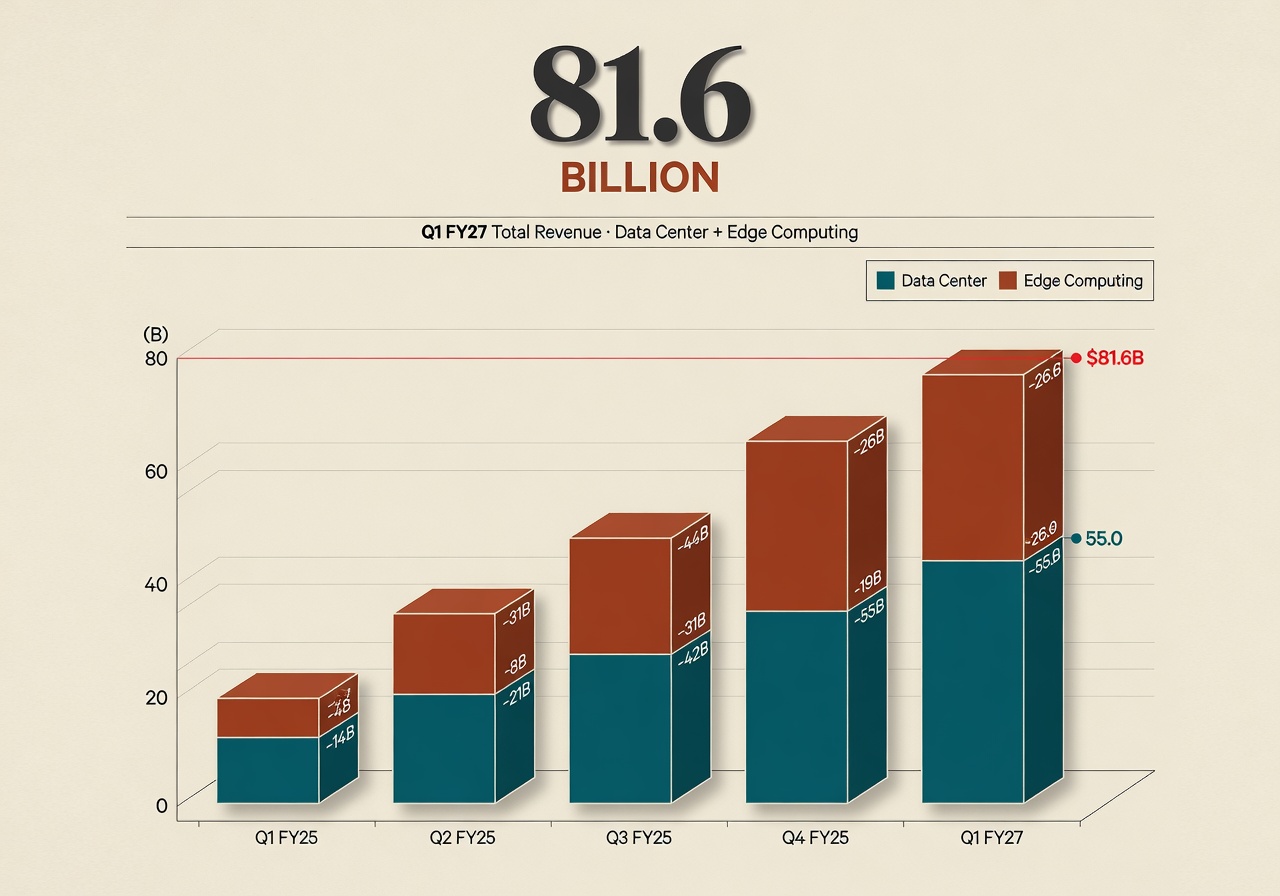
Nvidia reported revenue of $81.6 billion for the quarter ended April 26, 2026, the company said in a Form 8-K filed with the Securities and Exchange Commission on Wednesday, May 20. That figure is up 20 percent from the prior quarter and up 85 percent from a year earlier, and it landed roughly $2.5 billion above the $79.2 billion Wall Street consensus going into the release. Data Center revenue alone was $75.2 billion, larger than the company’s entire revenue of $44.1 billion in the same quarter a year ago. The company also disclosed that no shipments of Data Center Hopper products to China occurred during the quarter, against $4.6 billion in the same quarter of fiscal 2026, and stated in its outlook that it is "not assuming any Data Center compute revenue from China" for the second quarter. The Board separately approved an additional $80.0 billion to the share-repurchase authorization and raised the quarterly cash dividend from $0.01 to $0.25 per share. The stock fell 0.9 percent in the next trading session.
The headline number is large enough that the unit deserves a sentence of its own. $81.6 billion is total revenue for a single 13-week period, not an annual figure. Annualized at the same pace and gross margin, the company is on a run-rate close to $326 billion in revenue and around $215 billion in non-GAAP operating income. Those run-rate figures are arithmetic, not guidance (the company guided only one quarter forward), but they put the scale of the quarter in a frame that fits next to the rest of the index. Apple’s total revenue for the comparable fiscal quarter ran around $95 billion; Microsoft’s ran around $70 billion. Nvidia did not exist in this revenue tier two years ago.
Where the revenue came from
Nvidia is transitioning its reporting framework this quarter from product-family sub-segments (compute, networking, gaming, professional visualization, automotive) to two market platforms, Data Center and Edge Computing, with Data Center further split into Hyperscale and ACIE (AI Clouds, Industrial, and Enterprise). Under the new framework, Data Center revenue was $75.2 billion, up 92 percent from a year ago and up 21 percent sequentially. Hyperscale, which captures the public clouds and the largest consumer internet companies, was $37.9 billion, up 115 percent from a year ago. ACIE, which captures AI clouds, sovereign customers, and industrial and enterprise buyers, was $37.4 billion, up 74 percent from a year ago. The two sub-markets are now roughly equal in size. Edge Computing, which captures PCs, workstations, game consoles, AI-RAN base stations, robotics, and automotive, was $6.4 billion, up 29 percent from a year ago. Under the old framework, which the company published in parallel one last time, Data Center compute was a record $60.4 billion and Data Center networking was a record $14.8 billion, up 199 percent year over year on the strength of InfiniBand, Spectrum-X Ethernet, and NVLink sales attached to the Blackwell 300 ramp.
The composition matters because it shows where Nvidia’s revenue diversification stands today. A year ago, the hyperscalers were a clear majority of Data Center revenue. This quarter, the company says Hyperscale "remained at approximately 50 percent of Data Center revenue, while the remaining 50 percent came from a continued diversification of customers, including AI Clouds, industrial, enterprise, and sovereign customers." The "sovereign" qualifier is doing work in that sentence. Nvidia has been disclosing for several quarters that nation-states and national-champion buyers are part of the customer mix; this quarter, that channel sits inside a $37 billion line.
The China line
No shipments of Data Center Hopper products to China occurred during the quarter, compared with $4.6 billion in the first quarter of fiscal year 2026. — Nvidia CFO Commentary on First Quarter Fiscal 2027 Results, filed with the SEC on May 20, 2026
The cleanest statement in the filing is the one about China. In the first quarter of fiscal 2026, the same period a year earlier, when current U.S. export controls on advanced AI accelerators were still being phased in, Nvidia shipped $4.6 billion of Data Center Hopper products into China. In the first quarter of fiscal 2027, that figure was zero. The outlook line is just as direct: the company "is not assuming any Data Center compute revenue from China" in its $91.0 billion plus-or-minus-2-percent guide for the second quarter. That assumption is consistent with the U.S. Department of Commerce export controls announced through Bureau of Industry and Security rulemaking in 2024 and 2025, which restrict the export of advanced computing chips, including Nvidia’s H20 variant, to China and a list of other destinations. The $4.5 billion H20 inventory and purchase-obligation charge that compressed gross margin in the first quarter of fiscal 2026 is the reason this quarter’s GAAP gross margin of 74.9 percent reads 14.4 percentage points higher than the year-ago 60.5 percent. Take out the China line and last year’s margin would have been considerably closer to this year’s. Take it out of this year and there is nothing else to take out: the line is already zero.
For a household reader, the China line matters in a specific way. The 0.9 percent drop in the share price the following session reflects a market that had largely priced in the absence of China. It is, in trader shorthand, the headline that did not move the stock, and the absence of movement is the disclosure’s confirmation that the market expected what the company described.
Why GAAP net income was $58.3 billion and non-GAAP was $45.5 billion
The two earnings numbers Nvidia publishes diverged sharply this quarter, and the difference is worth a sentence because it is the kind of disclosure that gets repeated incorrectly. GAAP net income was $58.3 billion, up 211 percent from a year ago, and GAAP diluted earnings per share were $2.39, up 214 percent. Non-GAAP net income was $45.5 billion, up 139 percent, and non-GAAP diluted earnings per share were $1.87, up 140 percent. The single largest line that explains the gap is $15.9 billion of net gains from equity securities, which the company describes as "driven by unrealized gains in publicly-held and non-marketable equity securities." Those gains hit GAAP net income immediately but are excluded from the non-GAAP measure, because they are paper gains on Nvidia’s strategic stakes in other companies rather than operating income from selling chips. Operating income, which is the cleaner read of the chip business, was $53.5 billion on a GAAP basis and $53.8 billion on a non-GAAP basis. Those two figures are within roughly half a percent of one another, and they are the right two numbers to compare quarter to quarter when the equity-portfolio mark fluctuates.
What the dividend hike and the buyback signal
Nvidia raised the quarterly dividend from $0.01 to $0.25 per share, a 25-fold increase, payable on June 26, 2026, to shareholders of record on June 4. At the new rate, the annualized dividend is $1.00 per share against a share price that closed at $235.74 at its all-time high on May 14, the week before the report, a forward yield of roughly 0.42 percent. The dividend is not the cash-return story; the buyback is. The company returned approximately $20.0 billion to shareholders through share repurchases and cash dividends during the quarter, and the Board authorized an additional $80.0 billion to the repurchase program on May 18, on top of $38.5 billion remaining at quarter-end. At the current pace of repurchase, $118.5 billion of authorized buyback is more than five quarters of capacity, without an expiration date. Cash, cash equivalents, and marketable debt securities were $50.3 billion at quarter-end, and operating cash flow for the quarter was $50.3 billion, up from $36.2 billion in the prior quarter. Inventory was $25.8 billion, up from $21.4 billion sequentially, and total supply-related commitments were $119.0 billion. The company is, in plain terms, simultaneously running the largest semiconductor build-out in the industry’s history and the largest capital-return program in its own.
What the Q2 guide says and does not say
The outlook for the second quarter of fiscal 2027 is $91.0 billion in revenue, plus or minus 2 percent. That midpoint implies sequential growth of roughly 11.5 percent and year-over-year growth of roughly 53 percent. GAAP gross margin is expected at 74.9 percent and non-GAAP at 75.0 percent, both with a 50-basis-point band. GAAP operating expenses are expected at approximately $8.5 billion and non-GAAP at approximately $8.3 billion, both up roughly $0.9 billion from the quarter just reported, an indication that Nvidia is continuing to scale headcount, compute, and engineering investment. The full-year tax-rate range is 16.0 to 18.0 percent. The guide assumes zero Data Center compute revenue from China, a clean assumption to model against even if the actual outcome turns out to be a small positive number. Two factors are not in the guide. The first is what happens to the Blackwell 300 ramp curve in the second half. The second is the demand response from sovereign and ACIE buyers to the announcement that Nvidia is treating their revenue as the structural growth engine rather than the upside option. Neither is a forecastable number; both will be visible in the August release.
What it means for a household
For a household with a 401(k) holding an S&P 500 index fund, Nvidia is now roughly 7 percent of the index by market capitalization, the largest single-name weight. A quarter like this moves the value of that fund less than the 0.9 percent next-day stock reaction suggests, because the index is also weighted by the rest of the AI capex chain (Microsoft, Alphabet, Amazon, Meta, Broadcom, Oracle), and those names move on related news. For a worker employed at a hyperscale data-center build site, the $119.0 billion of supply-related commitments and the $30.0 billion of multi-year cloud service commitments described in the CFO commentary are the demand-pull side of the construction labor market for the next several quarters. For a household watching the AI debate from outside the financial market, the relevant figure is the gap between the company’s reported scale of customer diversification and the absence of a corresponding employment number disclosed in the release. Nvidia is again the most consequential single quarter of corporate earnings in the index; the disclosure framework around what that scale means for workers, customers, and competing economies continues to lag the disclosure framework around what it means for shareholders.
Sources & methods
- U.S. Securities and Exchange Commission · Nvidia Corporation, Form 8-K, "NVIDIA Announces Financial Results for First Quarter Fiscal 2027," dated 20 May 2026. Source for the $81.6 billion revenue figure, the $75.2 billion Data Center revenue, the 85 percent year-over-year and 20 percent sequential revenue gains, GAAP and non-GAAP gross margins (74.9 percent and 75.0 percent), GAAP and non-GAAP diluted earnings per share ($2.39 and $1.87), the $80.0 billion share-repurchase authorization, the dividend increase from $0.01 to $0.25 per share, and the Jensen Huang quote.
- U.S. Securities and Exchange Commission · Nvidia Corporation, CFO Commentary on First Quarter Fiscal 2027 Results, filed 20 May 2026. Source for the Data Center sub-market split ($37.9 billion Hyperscale, $37.4 billion ACIE), the $6.4 billion Edge Computing line, the $60.4 billion Data Center compute and $14.8 billion Data Center networking figures under the prior framework, the China shipment line (zero this quarter against $4.6 billion a year ago), the $4.5 billion H20 inventory charge that compressed prior-year gross margin, the $15.9 billion equity-securities gain that drove the GAAP/non-GAAP net income gap, operating income of $53.5 billion GAAP and $53.8 billion non-GAAP, $50.3 billion of operating cash flow, $25.8 billion inventory, $119.0 billion supply-related commitments, $30.0 billion multi-year cloud service commitments, and the second-quarter outlook of $91.0 billion in revenue.
- U.S. Securities and Exchange Commission · EDGAR filings index for Nvidia Corporation (CIK 0001045810), Form 8-K filings. The canonical permalink that lists the 20 May 2026 Q1 FY27 earnings filing alongside prior 8-Ks.
- U.S. Department of Commerce, Bureau of Industry and Security · Export Administration Regulations (EAR), the regulation set under which BIS issued the 2024 and 2025 advanced-computing controls referenced in the body. Source for the regulatory framework that underlies the company’s zero-China assumption for Data Center Hopper shipments and the H20 variant’s status.
- Fortune · "Nvidia Q1 earnings: Chipmaker beats on earnings and boosts dividend, but forecasts disappoint," 20 May 2026. Secondary source used to corroborate the consensus revenue figure of $79.2 billion and the consensus non-GAAP earnings-per-share figure of $1.78 that the company beat in the quarter. Archived May 26, 2026
- The Motley Fool · "Nvidia Just Crushed Earnings Estimates, but the Stock Fell. Here’s What Happened," 22 May 2026. Secondary source used to corroborate the 0.9 percent next-session decline, the all-time closing high of $235.74 on May 14, and the description of the report as Nvidia’s fourth consecutive beat-and-fade quarter. Archived May 26, 2026
Reporting is built from Nvidia Corporation’s Form 8-K and accompanying CFO commentary filed with the U.S. Securities and Exchange Commission at the close of trading on 20 May 2026, for the fiscal first quarter ended 26 April 2026. The headline revenue of $81.6 billion, the Data Center revenue of $75.2 billion, the Hyperscale ($37.9 billion) and ACIE ($37.4 billion) sub-markets, the Edge Computing line ($6.4 billion), the Data Center compute and networking figures ($60.4 billion and $14.8 billion) under the prior reporting framework, the gross-margin figures (74.9 percent GAAP, 75.0 percent non-GAAP), operating income ($53.5 billion GAAP, $53.8 billion non-GAAP), net income ($58.3 billion GAAP, $45.5 billion non-GAAP), diluted earnings per share ($2.39 GAAP, $1.87 non-GAAP), and the Q2 FY27 outlook ($91.0 billion revenue plus or minus 2 percent, 74.9 / 75.0 percent gross margin, $8.5 / $8.3 billion operating expenses) are read directly from the press release and CFO commentary. The China line — zero Data Center Hopper product shipments this quarter against $4.6 billion in the same quarter a year ago, and the explicit "not assuming any Data Center compute revenue from China" assumption in the Q2 outlook — is taken from the CFO commentary. The $15.9 billion of net gains from equity securities and the $4.5 billion H20 inventory and purchase-obligation charge in the prior-year period are likewise from the CFO commentary. The $20.0 billion of capital returned during the quarter, the $38.5 billion of share-repurchase capacity remaining at quarter-end, and the $80.0 billion additional authorization approved on 18 May 2026 are from the same filings, as is the dividend increase from $0.01 to $0.25 per share payable on 26 June 2026 to shareholders of record on 4 June 2026. Cash and marketable securities of $50.3 billion, inventory of $25.8 billion, supply-related commitments of $119.0 billion, and multi-year cloud service commitments of $30.0 billion are from the CFO commentary balance-sheet and cash-flow section. The consensus revenue figure ($79.2 billion) and consensus non-GAAP diluted earnings-per-share figure ($1.78) used to characterize the magnitude of the beat are reported in secondary sources (Fortune, 20 May 2026; The Motley Fool, 22 May 2026) and were not disclosed by the company itself. The 0.9 percent next-session decline, the all-time closing high of $235.74 on 14 May 2026, and the characterization of the result as the fourth consecutive beat-and-fade quarter are taken from the same secondary sources. The annualized run-rate figures (revenue of $326 billion, non-GAAP operating income of $215 billion) are simple arithmetic on the reported quarter and are presented as arithmetic rather than guidance, with the company’s own guide extending only one quarter forward. The comparison to Apple’s and Microsoft’s comparable-quarter revenue is drawn from those companies’ own SEC filings for their most recent comparable fiscal quarter. The S&P 500 index weight of approximately 7 percent for Nvidia reflects the index composition as of the most recent S&P Dow Jones Indices rebalance preceding publication. The lead illustration is generated, not photographic; the column heights in the illustration are not the precise audited figures, and the audited figures live in the body and in the cited 8-K. No anonymous sources were used. No forecasts are made beyond those placed on the record by Nvidia in its 8-K outlook.