Tesla and Alphabet lose hundreds of billions in market value as AI spending plans alarm investors
Both companies reported negative free cash flow and raised capital expenditure forecasts, wiping out roughly $200 billion and $300 billion in market capitalization respectively.
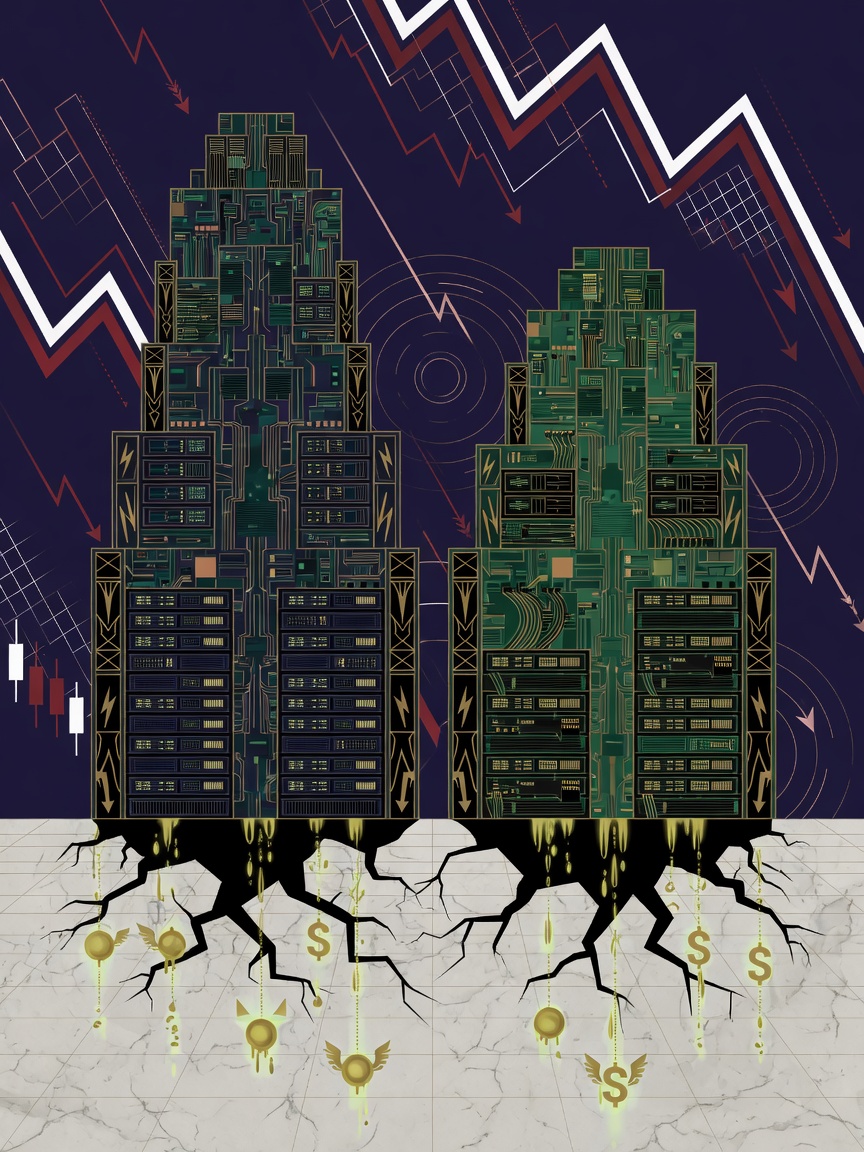
Tesla and Alphabet together shed hundreds of billions in market value on Thursday after both companies laid out aggressive artificial intelligence spending plans that pushed their free cash flow negative and rattled investors across the technology sector.
The sell-off was swift. Tesla shares closed 14.5% lower, marking the electric vehicle maker’s worst single session since March 2025, while Alphabet dropped 7.1%. Tesla lost about $200 billion in market capitalization and the Google parent saw approximately $300 billion wiped out. Amazon was caught in the downdraft too, falling 4.6% and losing roughly $120 billion in value.
The rout highlights a growing tension in the technology industry: companies are pouring unprecedented sums into AI infrastructure with no clear timeline for when those investments will translate into profits, and shareholders are beginning to push back. Both Tesla and Alphabet reported negative free cash flow for the second quarter on Wednesday, a signal that spending is outpacing the cash their businesses generate after covering operations and investments.
For Alphabet, the numbers were striking. The company’s free cash flow came in at negative $5.9 billion, the first time the metric has turned negative since Alphabet became a public company in 2004. Chief financial officer Anat Ashkanazi told financial analysts that the negative cash flow was driven by growing capital expenditures, essentially all of it tied to AI spending. Alphabet spent $45 billion in the second quarter alone, with 60% going toward servers and 40% toward data centres, up from $36 billion in capital spending during the first quarter.
Alphabet now expects to spend as much as $205 billion this year, mainly on AI projects and infrastructure. That figure represents a $15 billion increase from the spending estimate the company gave just three months ago, when it projected capital expenditures between $180 billion and $190 billion. The company also warned of even higher figures in 2027.
Executives defend the spending
Ashkanazi said the spending increase is primarily due to an acceleration in the delivery of capacity to meet growing demand, and the company has maintained that it does not have enough computing capacity to handle the AI demand it sees. “The demand still outpaces that investment,” she said. “As long as we see these attractive opportunities to invest, we will continue to invest.”
Sundar Pichai, Google’s chief executive, said the technological shift to AI tools and capabilities still feels like early innings in a shift across multiple areas, and he described the company’s plans for generating financial returns as disciplined. “What I see with what you can do with frontier capabilities, there is still a lot of work left to do to translate that into experiences for our users,” Pichai said. “So that looks like extraordinary opportunities with extraordinary returns.”
Not everyone was convinced. Russ Mould, an investment director at AJ Bell, said there is still a healthy degree of scepticism about the ability of these investments to generate a commensurate level of return. Rachel Winter, a partner at Killik & Co, said there was surprise among investors about how much Google was spending. “These are huge numbers,” Winter said. “The fact that the shares dropped when the results came out, that suggests there is a little bit of concern about those levels.”
Ben Barringer, head of technology research at Quilter Cheviot, told CNBC that investors appear to be focusing on the sharp rise in capital expenditure alongside a weaker margin outlook. Continued delays to Gemini 3.5 Pro and a lack of standout product releases have raised questions about whether Alphabet’s AI investments are yet translating into a clear competitive advantage, he said.
Tesla’s spending surge
Tesla’s situation was similarly stark. The company reported negative free cash flow of $1.1 billion for the second quarter, its first negative showing in two years. Capital expenditures surged 142% year on year to $5.79 billion. Tesla expects more than $25 billion in capital spending this year, a figure chief financial officer Vaibhav Taneja said would probably increase further over the next three years as the company remains in a big investment cycle.
Elon Musk sought to reassure investors on the earnings call, calling it a massive capex year and saying he was confident that everything the company is investing in will yield incredible returns, maybe the best capex returns Tesla has ever seen. Musk pointed to semiconductor production and Optimus, Tesla’s humanoid robot, as areas where the spending is going. Tesla said it is installing first-generation lines for Optimus and will start production soon.
There were bright spots in both companies’ results. Alphabet’s combined quarterly revenue hit $119.8 billion, up 23% from the same period last year. Google Cloud revenue jumped 82% to $24.8 billion, beating forecasts, and the division’s operating margin rose to 35.6% from 20.7% a year earlier. Alison Porter, a portfolio manager at Janus Henderson, told CNBC’s Squawk Box Europe that this was one of the strongest revenue growth quarters Alphabet has had in five years, calling the company a great barometer for the whole AI wave. Tesla’s core automotive business brought in $20.52 billion in revenue, up 23% year on year.
Sources & methods
- BBC News article reporting on Google and Tesla share plunges following AI spending announcements, with quotes from Alphabet and Tesla executives and market analysts. Archived Jul 24, 2026
- CNBC article detailing market cap losses for Tesla, Alphabet, and Amazon, with capital expenditure figures, analyst commentary, and revenue breakdowns for both companies. Archived Jul 24, 2026
This article was compiled from BBC News and CNBC reporting on Tesla and Alphabet’s second-quarter earnings results, market reactions, and analyst commentary. All financial figures, quotes, and attributions are drawn directly from those sources.