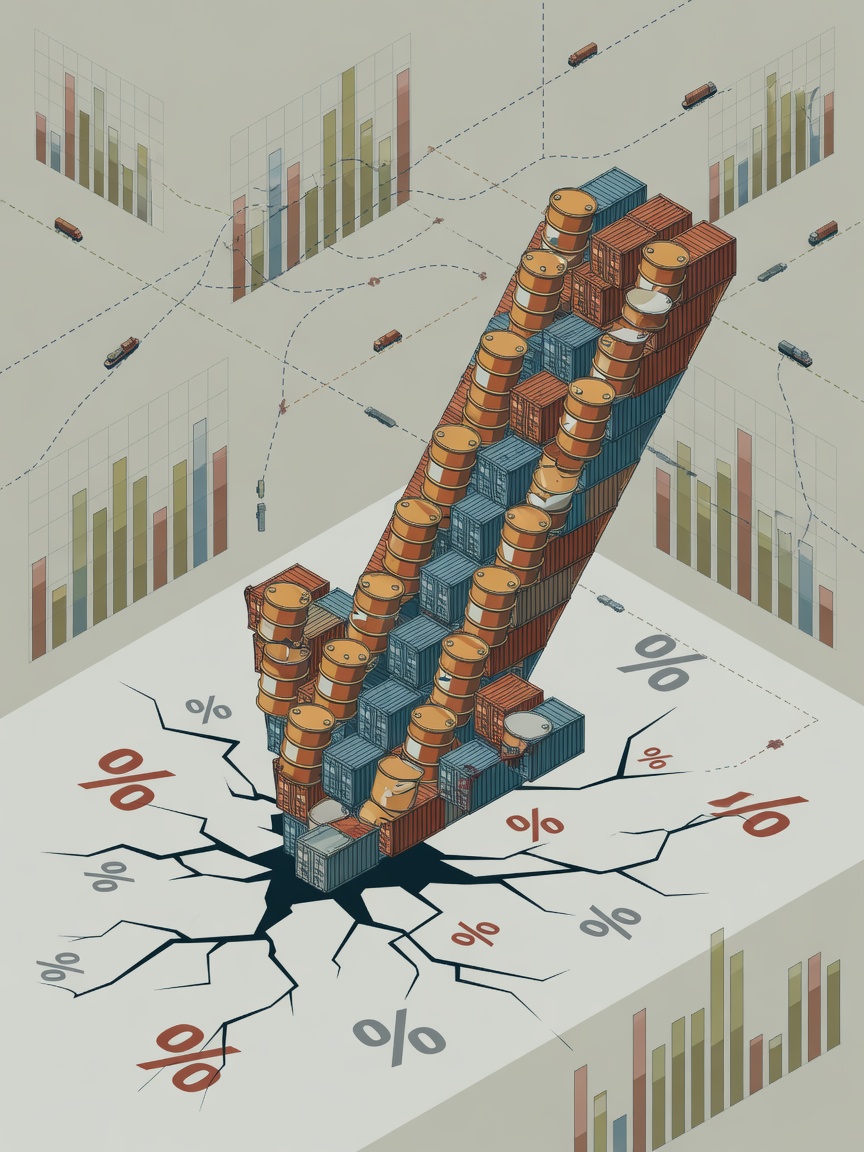
The US economy grew at an annual rate of 1.5% in the second quarter of 2026, a sharp decline from 2.1% in the first three months of the year, as tariffs and oil price spikes from the war with Iran combined to drag down growth.
Analysts had forecast growth to remain around 2%. The Bureau of Economic Analysis released the figures on Thursday. The Commerce Department attributed the downturn to lower government spending, investment, and exports, which offset a boost in consumer spending.
“It’s a classic supply shock.” That is how Michael Klein, professor of international economic affairs at The Fletcher School at Tufts University, described the situation to Al Jazeera. “The combination of tariffs and oil price spikes is exactly what a macroeconomist would expect to happen,” he said.
A widening trade deficit weighed heavily on the headline number. The trade deficit in May grew to $77.6bn, a 42% increase from the month before, according to BEA data. Exports tumbled by 3.2% to $317.7bn, while imports rose by 3.3% to $395.3bn. “Imports rose due to the investment and consumption driver, and so net exports were a drag on overall growth,” Rachel Ziemba, adjunct senior fellow at the Center for a New American Security, told Al Jazeera. She added that the US is investing and consuming more but not producing more.
Business investment in equipment rose by more than 15% in the second quarter, driven by purchases of semiconductors, telecommunications equipment, and industrial equipment, the essential elements for the ongoing artificial intelligence investment boom. Michael Pearce, chief US economist at Oxford Economics, said that “surging AI-related investment is still the biggest game in town,” but noted that imports of microchips used in its development meant its contribution to growth remained modest.
Energy prices and consumer spending
Energy prices fluctuated sharply. US petrol prices hit $4.48 per gallon in May, then retreated to $3.96 by the end of June. The reprieve was short-lived. Prices moved back above $4 in July after a fragile peace deal failed to take hold. Brent crude, the global benchmark, was about $90 a barrel on Thursday.
Petrol prices drove inflation for much of the quarter. Between March and April, prices jumped 5.4%. The next month, they jumped another 7%. They eased between May and June, falling 9.7% as global benchmark prices pulled back. The Personal Consumption Expenditures Price Index, a measure of inflation closely watched by the Federal Reserve, increased by 3.7%.
Consumer spending, which accounts for more than two-thirds of US economic activity, grew at a rate of 3.2% last quarter after slowing to 0.5% earlier in the year. Americans continued to spend on motor vehicles, particularly light-duty trucks, furniture, and prescription drugs. Spending also rose at restaurants and hotels. Bank of America analysis found that discretionary spending surged in June as fuel prices temporarily eased, with total card spending excluding gas rising 5.6% year over year, the strongest growth since April 2022.
The Federal Reserve and the outlook
The Federal Reserve held interest rates for a fifth consecutive time on Wednesday. New chairman Kevin Warsh warned there was no “magic wand” to tackle rising prices. The Fed said US economic activity was expanding at a solid pace despite uncertainty caused by the conflict in the Middle East. Prices have been rising above the Fed’s 2% target for more than five years.
Consumer confidence fell for the third straight month in July, according to a Conference Board report. Consumers attributed the decline to current business conditions, and the organization expects little improvement for the remainder of the year. Klein said spending is concentrated among high-income earners, indicating a K-shaped economy where the wealthy thrive while lower-income consumers and small businesses face tougher conditions. He said the continued consumption growth of those who are better off depends on the stock market and housing prices staying strong, but noted that by a number of measures, the stock market seems to be very highly valued.
Some economists saw reasons for optimism. Pearce said the growth slowdown underplayed the strength of the US economy and suggested the pace would return to above 2% later this year, with signs that investment in industries away from the AI boom was reviving. Bradley Saunders, North America economist for Capital Economics, said the figure “seriously undersells a healthy economy” and that households had shrugged off the hit to budgets from higher fuel prices.
Countries around the globe have sought to reduce their dependence on the US due to President Donald Trump’s tariff policies. Canada, historically one of the biggest US trading partners, has pursued new trade deals with China and Saudi Arabia in recent months. Trump has slapped steep tariffs on Canada, threatened to annex it, called it the 51st state, and refused to renew a trade deal with Canada and Mexico. Klein said consistent trade policies would help. “The pervasive uncertainty in the economy will affect businesses’ decisions on hiring and investing,” he said. “That can also contribute to the slowdown, because, in an uncertain environment, businesses don’t want to make decisions that have long-lasting consequences when they have little idea of what the future will look like.”