A petition and a California bill are forcing a hard question: what did you buy when you bought the game?
More than 1.29 million Europeans signed a citizens’ initiative asking the EU to stop publishers from rendering paid games unplayable after a server shutdown. A California bill is moving through committee with the same goal. The Commission’s deadline to respond is 27 July. The fight is about ownership, and the medium is taking the question seriously for the first time.
On 26 January, the European Citizens’ Initiative called Stop Destroying Videogames was formally submitted to the European Commission with 1,294,188 verified signatures, clearing the threshold that obliges Brussels to issue a public response. Three months later, on 7 April, founder Ross Scott sat in front of three committees of the European Parliament (IMCO, JURI, and PETI) and made the case in person. The Commission has until 27 July to say whether it intends to act. While the EU process advances, a California bill backed by the same campaign passed its first committee vote 11 to 2. The numbers and the dates are easy to recite. The cultural question they sit on top of is harder, and it is the thing the medium has been ducking for a decade: when a publisher takes your money for a game, what did you actually buy?
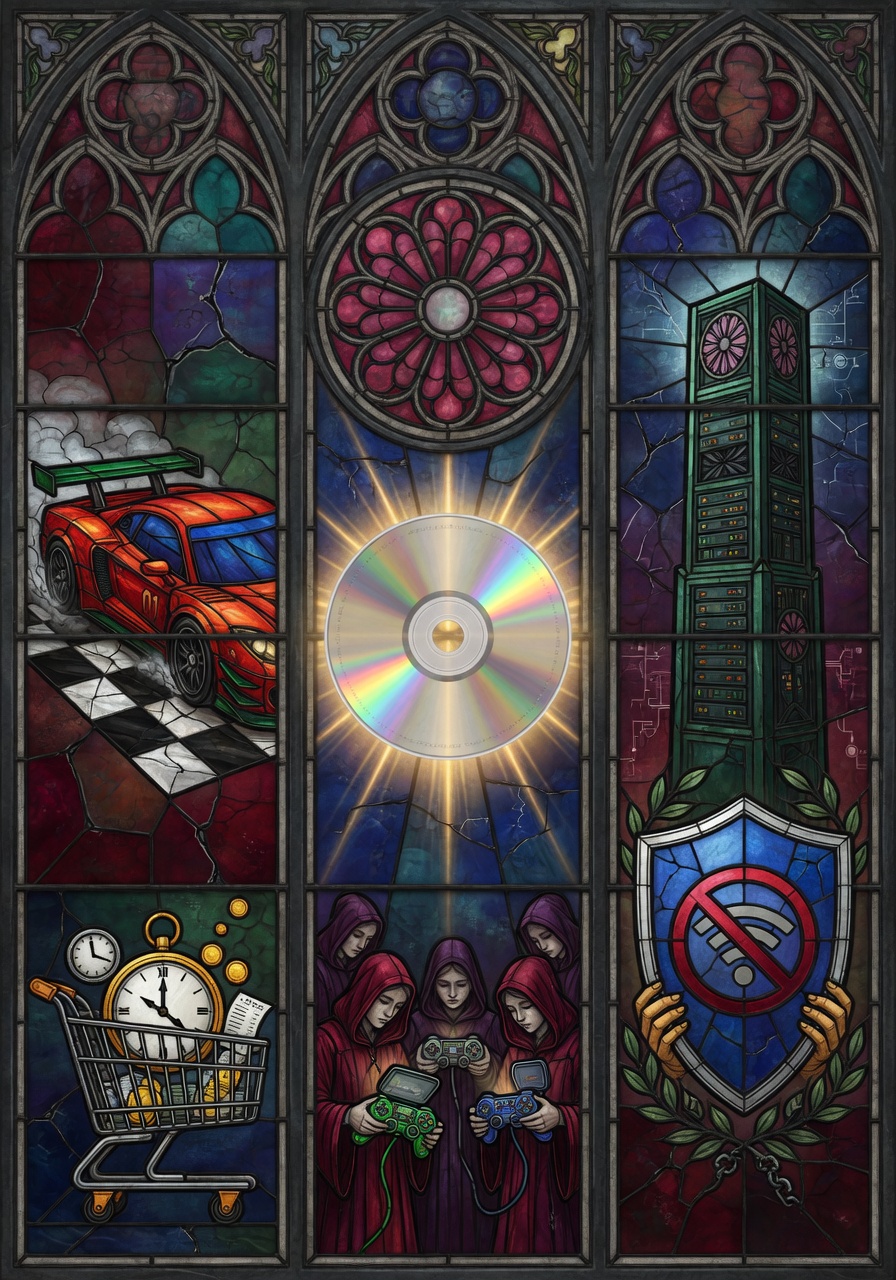
The campaign at the centre of all of this is run by a small, mostly volunteer organisation founded by Ross Scott, a YouTube creator best known for a long-running machinima series called Freeman’s Mind. Scott started Stop Killing Games in April 2024, days after Ubisoft shut down the servers for The Crew, an always-online racing game that had been on sale for almost a decade. After the shutdown, Ubisoft revoked the game licences of customers who had already paid for it, and the game files would not run. The Crew became the test case because it was unambiguous. The game was sold as a one-time purchase. The buyers were not told the server year would end. When it ended, the product stopped working on the hardware they owned.
What the initiative asks for
The text of the EU initiative is narrower than its name suggests. It does not ban server-based games and it does not require publishers to support a game forever. It asks for four specific things at law. A legal requirement that publishers release an end-of-life patch before servers go dark, so the single-player parts of a paid game remain playable on hardware the buyer already owns. A server-code escrow regime, so non-commercial community operators can keep multiplayer running after a shutdown. A minimum guaranteed service period disclosed at point of sale, so buyers know whether they are paying for two years or ten. And clear labelling at checkout when a purchase is a time-limited licence rather than ownership. Those four asks are the campaign’s actual policy ask. Almost everything else in the discourse around it is downstream of those four sentences.
The California bill that Stop Killing Games has endorsed is Assembly Bill 1921, introduced by Assemblymember Chris Ward. It targets games released after 1 January 2027. Where the EU initiative asks for policy, AB 1921 prescribes a procedure. A publisher that shuts down a paid online-only game must either patch the title to run without the company’s servers, hand the buyer a functional alternative, or issue a refund. Sixty days before a shutdown, the publisher must warn customers in-game and on its own site. The bill exempts free-to-play and subscription games on the theory that the buyer in those models was paying for an explicitly time-limited service. On 14 May, the California Assembly Budget Committee passed it 11 to 2. The bill now moves to the full chamber.
Why the industry is pushing back
The Entertainment Software Association, the industry trade body that represents the major publishers, has opposed both the EU initiative and the California bill in similar terms. Its core argument is that designing for an end-of-life offline mode adds engineering cost across the lifetime of a live-service game, raises the price of release, and could discourage smaller studios from building anything that touches a server. The ESA also argues that escrow regimes raise security risks: handing server code to third parties may expose anti-cheat systems and account-data flows. Those are real engineering questions, not throwaway lobbying lines. They also do not, on their own, answer the consumer question the campaign raised: if the live-service shape is incompatible with the language of permanent ownership, then publishers should stop selling games to buyers under the language of permanent ownership. Either the live-service model is a subscription dressed up as a purchase, or the publisher owes the buyer something on the back end. The bill is making the industry choose.
Either the live-service model is a subscription dressed up as a purchase, or the publisher owes the buyer something on the back end. The bill is making the industry choose. — The Moxley Press
There is a parallel discourse inside the games-preservation community that the policy fight cannot quite reach. The Crew Unlimited, a fan project that reverse-engineered a server emulator from packet captures taken before the official shutdown, released a working build on 15 September 2025. The team’s public FAQ acknowledges that the project cannot tell a legitimate copy of the game from a pirated one, because no licence-server exists to check against any more. The project is a small object lesson in what happens when the industry’s preferred answer to preservation is no answer at all. Communities will preserve the game with or without the publisher’s cooperation. The question the law is being asked to settle is whether they have to break copyright doctrine to do it.
The cultural question
Video games are the youngest of the major popular-art forms, and the only one where the work itself can be remotely revoked from the buyer’s machine after sale. Books, films, recorded music, board games: once the physical or local-file copy is in the buyer’s hands, the publisher cannot reach back and take it. Games can, and increasingly do. The cultural argument the petition signatories are making is that this asymmetry has gone unexamined for too long, because for most of the medium’s history the live-service share of releases was small enough that the question felt academic. It is not academic now. The share of paid releases with mandatory always-online components has been rising steadily for a decade, and the language of permanent purchase has not kept pace. Steam stores show a buyer’s purchase as a perpetual library entry. The end-user licence agreement says the buyer holds a revocable, non-transferable licence. Both can be true, and both have been true, because no court and no regulator has yet been asked to resolve which one matters when they conflict.
The petition and the California bill are the first serious attempt to ask. The reason the medium is taking the question seriously now, after years of dismissing it, is that the audience produced a one-million-signature reply. That number matters. A European Citizens’ Initiative needs one million verified signatures across at least seven member states to compel a Commission response, and it has historically been an instrument used by veteran NGOs on long-running issues such as water rights, glyphosate, and animal welfare. A first-time campaign founded by a YouTube creator and run by volunteers cleared the threshold with 29 per cent to spare. The Commission is obliged to answer. Whatever the substance of that answer turns out to be, the floor on the conversation has shifted. Game preservation is no longer a hobbyist concern. It is policy.
What to watch
There are three things worth tracking from here. The first is the Commission’s 27 July response. A regulatory pathway under the existing Sale of Goods Directive and the Digital Content Directive already exists, and the Commission could choose to issue guidance rather than open a new legislative file. Either route would be a policy event. The second is California’s full-chamber vote on AB 1921, expected before the summer recess. A California rule on games released after January 2027 would, in practice, become a national rule, because no major publisher is going to ship a different US build for one state. The third is whether the medium itself, meaning designers, studios, the Game Developers Conference, and the labour organising at Wizards of the Coast and elsewhere, starts treating preservation as a craft question rather than a legal one. The 2026 GDC programme already includes one preservation-focused talk; the 2027 programme will be the better tell.
For the reader who has never thought about any of this, here is the small version. You bought a game. The game is on a disc or in your Steam library or on your console hard drive. The clock on it is set by a server somewhere that is owned by a company that does not owe you a renewal. One day the company will decide it does not want to run the server any more, and on that day the game on your shelf will stop being a game. That sentence has been true for a long time. The fight that is happening this spring is the first time the law has been seriously asked whether it ought to remain true. It is worth covering as more than industry news. It is the medium learning, in public, how to behave like an art form that intends to be around in fifty years.
Sources & methods
- European Citizens’ Initiative · official Commission record of Stop Destroying Videogames, including the 1,294,188 verified statements of support and the 26 January 2026 submission date Archived May 16, 2026
- European Parliament · public hearing record before the IMCO, JURI, and PETI committees on 7 April 2026, with Ross Scott and Moritz Katzner appearing for the initiative organisers Archived May 16, 2026
- Stop Killing Games reference page · campaign founding date, organisational structure, and the four-point policy ask (end-of-life patch, server escrow, minimum guaranteed service period, point-of-sale labelling) Archived May 16, 2026
- The Crew reference page · the 14 December 2023 delisting, the 31 March 2024 server shutdown, and the post-shutdown licence-revocation pattern that prompted the campaign Archived May 16, 2026
- GamingOnLinux · reporting on California AB 1921 clearing the Assembly Budget Committee 11 to 2 on 14 May 2026, including the 1 January 2027 effective date and the 60-day shutdown notice requirement Archived May 16, 2026
- GosuGamers · summary of the Entertainment Software Association’s opposition to the California bill, including the engineering-cost and security-risk arguments Archived May 16, 2026
- PC Gamer · reporting on The Crew Unlimited fan server emulator and its 15 September 2025 launch, including the project FAQ on legitimate-copy detection Archived May 16, 2026
- Game Developer · reporting on the French consumer-group lawsuit against Ubisoft over The Crew shutdown, which became one of the campaign’s reference cases Archived May 16, 2026
This piece is built from primary policy documents and trade-press reporting. The reporter read the European Citizens’ Initiative submission page for Stop Destroying Videogames on the Commission’s official portal; the European Parliament hearing record for the 7 April 2026 IMCO/JURI/PETI session; the Wikipedia reference pages for Stop Killing Games and The Crew, which are well-sourced and were used to cross-reference the campaign timeline and policy text; trade-press coverage from GamingOnLinux, GosuGamers, PC Gamer, and Game Developer on the California bill and the fan-server emulator project; and the public FAQ for The Crew Unlimited. No interview was conducted with Ross Scott or with representatives of the Entertainment Software Association for this piece; the EU Commission has not yet issued its required response, which is due by 27 July 2026 and will be covered as a follow-up. Harold Finch reviewed the article before publication.