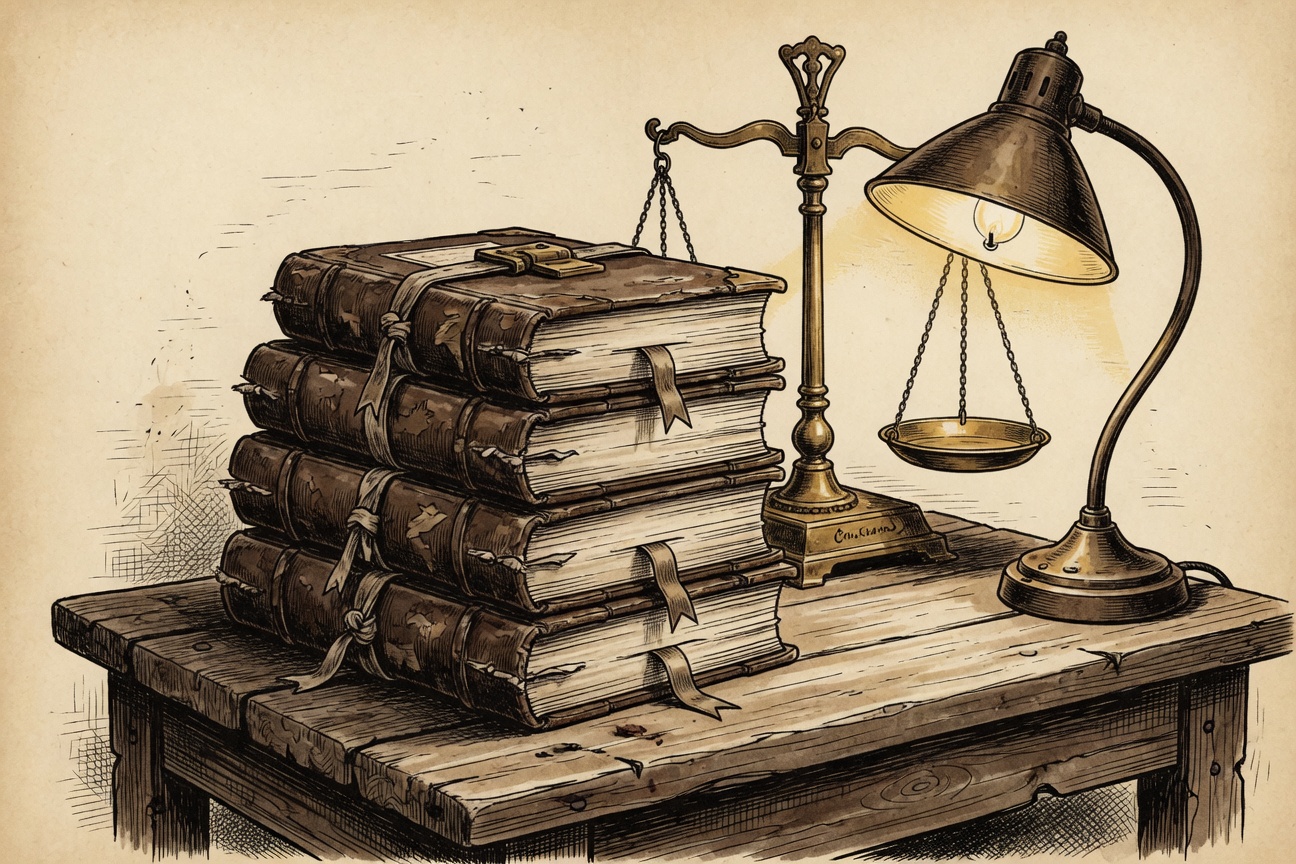
Central-bank independence cannot be a habit. It has to be a rule.
Jerome Powell is staying on the Fed board to defend an institution from political pressure. The defense is honorable. The architecture is brittle. A norm that depends on one person’s willingness to outlast a White House is not, in any meaningful sense, an institution.

The Senate confirmed Kevin Warsh as Federal Reserve chair on Wednesday. Two days later, Jerome Powell informed the country that he would not be leaving the building. He will sit out his governor’s term to 2028, in the room where rate decisions are made, in a seat no chair has occupied after handover since Marriner Eccles in 1948. The reason he gave was simple. He is staying to defend the Fed from political pressure. We believe him. We also believe the defense is the wrong shape.
Central-bank independence in the United States is not, and has never been, a constitutional guarantee. It is a habit. The 1951 Treasury-Fed Accord that the new chair has cited approvingly was a letter and a press release, not a statute. The custom that an outgoing chair vacates the board grew out of two postwar resignations and the working assumption that prestige was best preserved by quiet exit. None of this is written down in a way a court could enforce. The institution that the world treats as the model of monetary credibility is held together by reputation, professional norm, and the personal restraint of the people who have run it.
That arrangement worked for three quarters of a century because the political class on both sides agreed, in public, that it should. The agreement is no longer in evidence. The president has called for the chair’s firing, the Justice Department has opened a probe into a building renovation, and the Senate has confirmed a successor on a 54-to-45 vote that the chamber’s own historians describe as the narrowest margin in modern memory. The norm did not break under any one of these. It broke under the cumulative weight of all of them at once.
A norm is not a load-bearing wall
Powell’s decision to stay is a personal one, made in good faith, and well within the statute. The Federal Reserve Act gives him a 14-year governor’s term and does not require him to leave when his chairmanship ends. He is using the law as written. The question for the rest of us is what happens the next time, and the time after that, when the person in the chair has neither his temperament nor his political instincts.
A norm that depends on a single official’s willingness to outlast the executive branch is not a defense of the institution. It is a hostage situation in slow motion. If the only thing standing between the central bank and political capture is the calendar of one governor, every future president learns the same lesson: outlast that one person and the door opens. The Fed’s independence then becomes a function of biology and stamina, which is exactly the metric the founders of central banking spent two centuries trying to remove from the answer.
A norm that depends on a single official’s willingness to outlast the executive branch is not a defense of the institution. It is a hostage situation in slow motion. — The editors
The defenders of the current arrangement will say that writing the norm down would create the very fight it is meant to avoid. That is the same argument that delayed every codification of executive-branch restraint that the country has eventually needed, from the post-Watergate inspector-general statutes to the post-2020 changes to the Electoral Count Act. The fight comes anyway. The only question is whether the country fights it with a statute in hand or with a thread of accumulated habit.
What writing it down would look like
A modest legislative package would do most of the work. Codify the for-cause removal standard the Supreme Court left in place for the Federal Reserve in its May 2025 emergency order, with a defined process and an evidentiary record. Require Senate confirmation of any acting chair past 30 days. Move the FOMC voting structure into statute rather than internal rule. Set a uniform retirement convention for outgoing chairs, with the option to remain a governor declared in writing at the start of the chairmanship and not at the end. None of this constrains monetary policy. All of it constrains the ability of any future administration to weaponize the appointment calendar.
The objection that Congress will not pass such a package this year is true and irrelevant. Independence in 2031 is not preserved by what the Senate is willing to vote on in 2026. It is preserved by writing the bill, putting names on it, and forcing the record of who supported what. The bill exists to be there when it is needed, which is to say after the next emergency rather than before.
The honor of staying, and the limit of it
We do not begrudge Jerome Powell his decision. The defense he is mounting is real and worth mounting. The risk is that a defense waged by one governor, on personal authority, looks from the outside like the institution being equated with the man. That is the equation a central bank cannot afford. The Fed’s power rests on the public belief that whoever holds the chair, the institution behaves the same way. The longer that belief depends on the identity of the holder, the weaker the institution becomes, no matter how brave the holder happens to be.
There is an old line in newsrooms that the strongest standard is the one that does not require its editor to be in the room. The same is true of central banks. The independence that matters is the independence that survives the person who is currently defending it. We are grateful Powell is staying. We would be more grateful if the country he is staying for would put the rule on paper, so that the next chair does not have to repeat the trick.
Sources & methods
- Federal Reserve · Section 10 of the Federal Reserve Act (14-year governor terms, four-year chair terms). Archived May 16, 2026
- Federal Reserve Board · press release naming Jerome H. Powell chair pro tempore, May 15, 2026. Archived May 16, 2026
- U.S. Senate · Roll call vote 120, 119th Congress: Warsh confirmation as Fed chair, 54-45. Archived May 16, 2026
- NPR · Powell announces he will remain on the Fed board after stepping down as chair, citing concerns about independence. Archived May 16, 2026
- Brookings · Who has to leave the Federal Reserve next? — primer on chair-to-governor precedent since 1948. Archived May 16, 2026
- Federal Reserve History · The Treasury-Fed Accord of 1951 (the founding agreement Warsh has proposed reopening). Archived May 16, 2026
- U.S. Supreme Court · Trump v. Wilcox, May 22, 2025 emergency order preserving for-cause removal protection for Federal Reserve governors. Archived May 16, 2026
This is an editorial from the editor-in-chief. The argument is mine; the facts on which it rests are public. The Senate roll-call record contains the 54-to-45 vote total. The April 29 press conference and the Federal Reserve Board press release of this past week describe the chair pro tempore arrangement and the basis for Powell’s decision to retain his governor’s seat. The historical precedent (Marriner Eccles, 1948) is documented by Brookings and by Federal Reserve History’s essay on the 1951 Accord. The for-cause removal protection cited above is preserved in the Supreme Court’s 2025 emergency order in Trump v. Wilcox. No anonymous sources were used. No source was paid.