Cuban dissident artist Luis Manuel Otero Alcántara arrives in US after five years in prison
The San Isidro Movement leader was released on the condition that he leave Cuba, landing in Miami to cheering supporters as diplomatic tensions between Washington and Havana continue to escalate.
Luis Manuel Otero Alcántara, one of Cuba’s most prominent dissident artists, arrived in Miami on Saturday after serving five years in a maximum-security prison, released on the condition that he leave his country.
The 38-year-old co-founder of the San Isidro Movement was greeted at the airport by a crowd of supporters who cheered, sang the Cuban national anthem, and held their phones high to photograph him. They draped him in a Cuban flag printed with the words “Patria y Vida,” or “Homeland and Life,” the title of a song he shared a Grammy for that became an anthem for Cuba’s political opposition. He held up his forefinger and thumb in the shape of the letter L, a recognized anti-government symbol representing “Libertad,” meaning freedom.
His arrival ended days of uncertainty during which Cuban authorities held him in an unknown location while the United States approved a parole request, leaving his advocates unable to contact him or confirm whether he was truly free until he boarded a plane Saturday. The organization Cubalex, which legally advises dissidents and reports human rights violations from outside Cuba, filed a habeas corpus petition on his behalf on Monday. A social media page maintained by his friends and supporters wrote that he accepted exile as the only way to escape persecution and continue his art and activism.
From protest to prison
Otero Alcántara was arrested on July 11, 2021, during Cuba’s largest anti-government protests in decades. In 2022, a court sentenced him to five years in prison for public disorder, contempt, and disrespect toward national symbols. He spent those years in the maximum-security Guanajay prison near Havana. Human rights organizations, including Amnesty International, had long denounced his arrest and incarceration and called him a political prisoner, an allegation the Cuban government rejected.
The San Isidro Movement, named for the Havana neighborhood where Otero Alcántara lived, is a group of artists, journalists, and intellectuals who have campaigned for freedom of speech and democracy in communist Cuba. Cuban authorities allege the movement is funded by Washington and has been used to subvert the state, claims the movement denies. Many members say they have been constantly targeted by security forces. Some were arbitrarily detained.
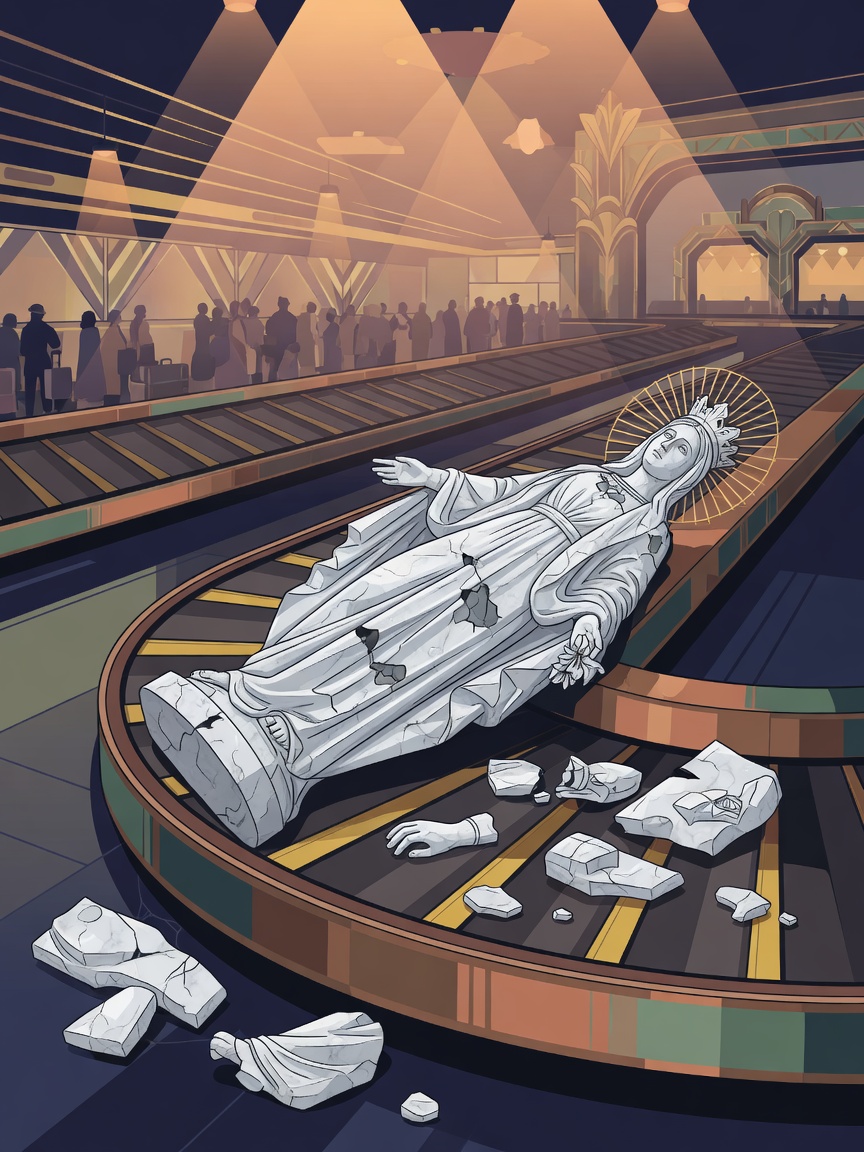
After emerging from the airport, Otero Alcántara told journalists that the dictatorship has to end and the Castro dynasty has to end as well, because as long as there is a Castro in power, there will be corruption. He said his first stop on American soil would be the Shrine of Our Lady of Charity, where he planned to make an offering. He brought from Cuba a broken statue of the Virgin Mary, which he described as a symbol of hope and healing, a chance to put back together something from fragments.
Diplomatic tensions escalate
His case and that of fellow San Isidro Movement member Maykel “Osorbo” Castillo Pérez, who is serving an eight-year prison sentence, have been a recurring source of diplomatic tension between Washington and Havana. Advocates said they hoped Otero Alcántara’s release would prompt insistence that Pérez also be set free. Other political prisoners remained imprisoned.
US Secretary of State Marco Rubio said in a statement that the Cuban government’s “brutal crackdown against its own people five years ago is yet another reminder of the unique misery and evil that is innate to the communist system.” He said Otero Alcántara’s only “crime” was refusing to stay silent and using his art to demand the basic freedoms everyday Cubans have been denied for almost seven decades.
Tensions have swelled in recent months. The Trump administration has hit Cuba with an oil blockade, sanctions, and open threats of military intervention. Last week, the BBC’s US news partner CBS reported that the Pentagon was looking at military options in Cuba, though officials said the briefings did not mean any decision to carry out an operation had been made.
The US oil blockade has worsened an ongoing fuel crisis on the island, with Cubans facing extended blackouts and food shortages in recent months. In May, the United States announced an unprecedented murder indictment against former Cuban leader Raúl Castro over the 1996 downing of two planes, an incident that killed four people. Russia and China condemned the move. Washington also warned in May that a peaceful agreement with the Caribbean nation was unlikely.
Tourism has suffered. Fewer than 360,000 people visited the island in the first five months of 2026, a decrease of nearly 60 percent compared with the same period last year, according to Onei. The sanctions have deepened the island’s economic strain.
Sources & methods
- BBC News article reporting on Otero Alcántara's arrival in the US, his prison sentence, the San Isidro Movement, US-Cuba diplomatic tensions, and the broader economic impact of US sanctions on Cuba. Archived Jul 19, 2026
- NPR article reporting on Otero Alcántara's arrival in Miami, the conditions of his release, the San Isidro Movement, his court sentence, the habeas corpus petition filed by Cubalex, and his fellow imprisoned artist Maykel Castillo Pérez. Archived Jul 19, 2026
This article was assembled from the provided source texts, which include one BBC News report and two identical NPR reports covering Otero Alcántara’s release, arrival in Miami, and the broader US-Cuba diplomatic context. All quotes, figures, and claims are drawn directly from those texts.