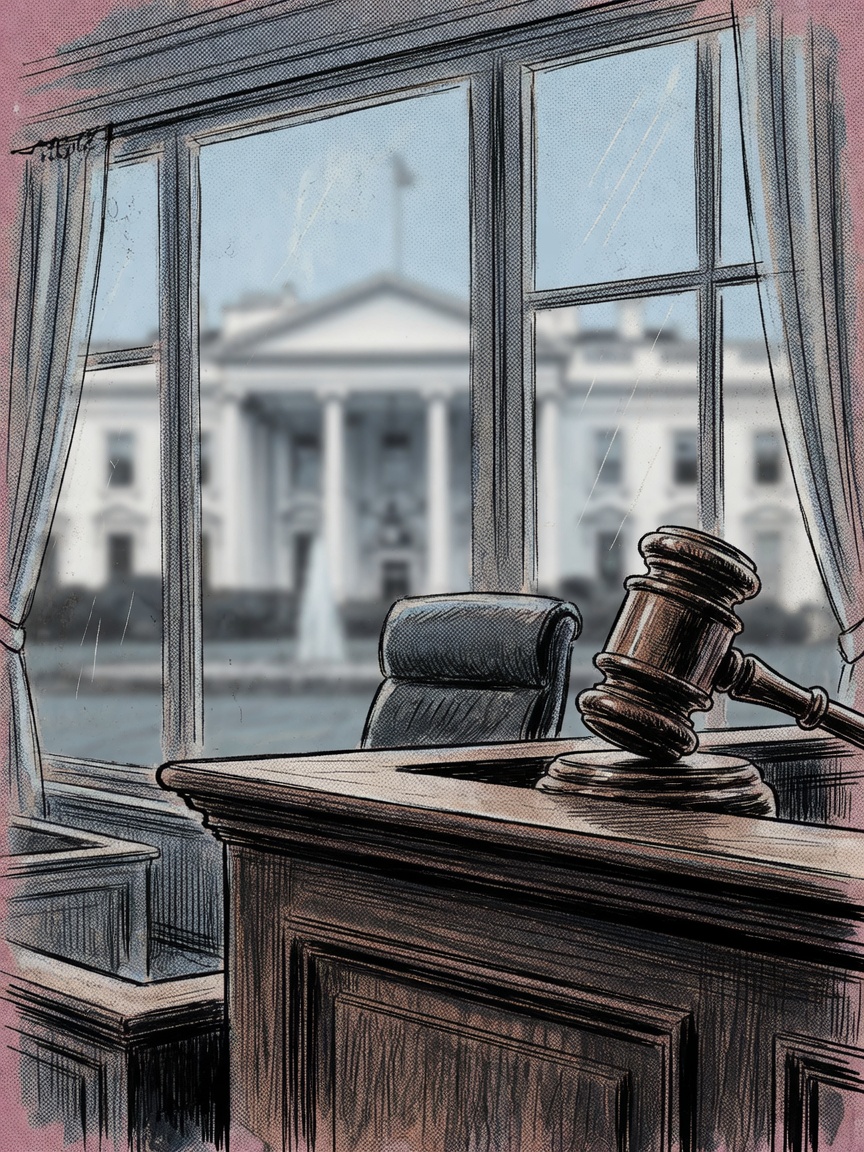
The Justice Department has formally defended President Donald Trump’s ban on CNN, Politico, and MS Now from the White House, accusing the three outlets in court filings of “trafficking in verifiable falsehoods” and publishing sensitive or classified information. The filings, submitted late Tuesday in a District of Columbia federal court, set the stage for a hearing Wednesday afternoon before U.S. District Court Judge Timothy Kelly, who will decide whether to temporarily lift the ban.
The case tests constitutional limits. At its core, the dispute asks whether a president can strip White House credentials from outlets whose coverage he dislikes, and whether national security claims can override First Amendment protections that courts have upheld for decades.
Trump barred the three outlets last week after their reporters had their passes confiscated and were denied entry to the building, prompting the organizations to sue on Monday and call the ban unconstitutional.
The government’s case
In its Tuesday filing, the Justice Department asked the court to deny the outlets’ request to restore their access, arguing that Trump concluded the organizations had failed to maintain basic minimum standards of professionalism and decorum. The filing included White House letters dated Sept. 22 that outlined specific reporting incidents the administration says violated expected standards.
The letters cited CNN’s reporting on construction of an East Wing security bunker beneath a new White House ballroom. They also referenced MS Now’s reporting on an alleged internal leak investigation. Politico’s cited incidents included its reporting on the lifting of sanctions against Russia and on the Republican midterm convention in Dallas, which the White House called a disaster. The DOJ filing referenced reporting on the depletion of U.S. ammunition stockpiles during the Iran war and on Secret Service investments in security improvements for the ballroom.
“Access to the White House is a privilege, not a right,” the DOJ argued. Lawyers for the department claimed the outlets relied on anonymous sources and failed to give the White House sufficient time to comment. The White House set a Friday deadline for the banned media to submit written complaints to contest Trump’s decision.
The outlets’ response
The three organizations argue the ban violates the First Amendment, which forbids the government from abridging press freedom, and the Fifth Amendment’s guarantee of due process. They say the White House revoked credentials without notice or any process to contest the decision.
“This ban could not be a more direct assault on the First Amendment nor a more blatant violation of our most fundamental constitutional principles,” the lawsuit stated. The outlets said in a joint statement that the White House revoked their journalists’ credentials without notice or process because it objected to their reporting, and that left unchallenged, the ban threatens press freedom and the public’s right to independent journalism free from government interference.
The lead attorney for the news outlets, Theodore J. Boutrous of Gibson Dunn, said the president has been explicit that the ban is intended to punish reporting he does not like and to intimidate journalists. Boutrous previously represented NPR in a case where a federal judge found a Trump executive order targeting public media funding to be unconstitutional.
Trump told reporters on Friday that his decision was not sparked by any specific reporting but by what he called two years of unfair and negative coverage. “There’s something wrong with a country that can allow people to write purposefully negative things,” Trump said. “Now, if they want to write them, that’s fine, but I don’t have to let them into my — into the people’s house.” Trump also called the three outlets “treasonous” on social media.
Judge Kelly himself ruled in favor of Jim Acosta, then a CNN correspondent, in 2018 when Trump aides stripped him of his credentials on similar grounds. Trump signaled on Truth Social that he expects to lose and plans to appeal, writing that publications that write negatively and violate national security should not be allowed access to the most important office in the world.
The ban has disrupted White House press operations. Major television networks withdrew from the media-sharing arrangement known as the pool in protest, leaving no network to fill CNN’s scheduled role as pool TV. NPR declined to broadcast audio of Trump. The White House responded by launching Trump TV, a YouTube streaming channel featuring a 24-hour feed of presidential clips. On Tuesday at the United Nations, Trump told CNN reporter Kaitlin Collins she should not be covering him. Collins noted later on air that the network had made no such pledge to stop covering him.