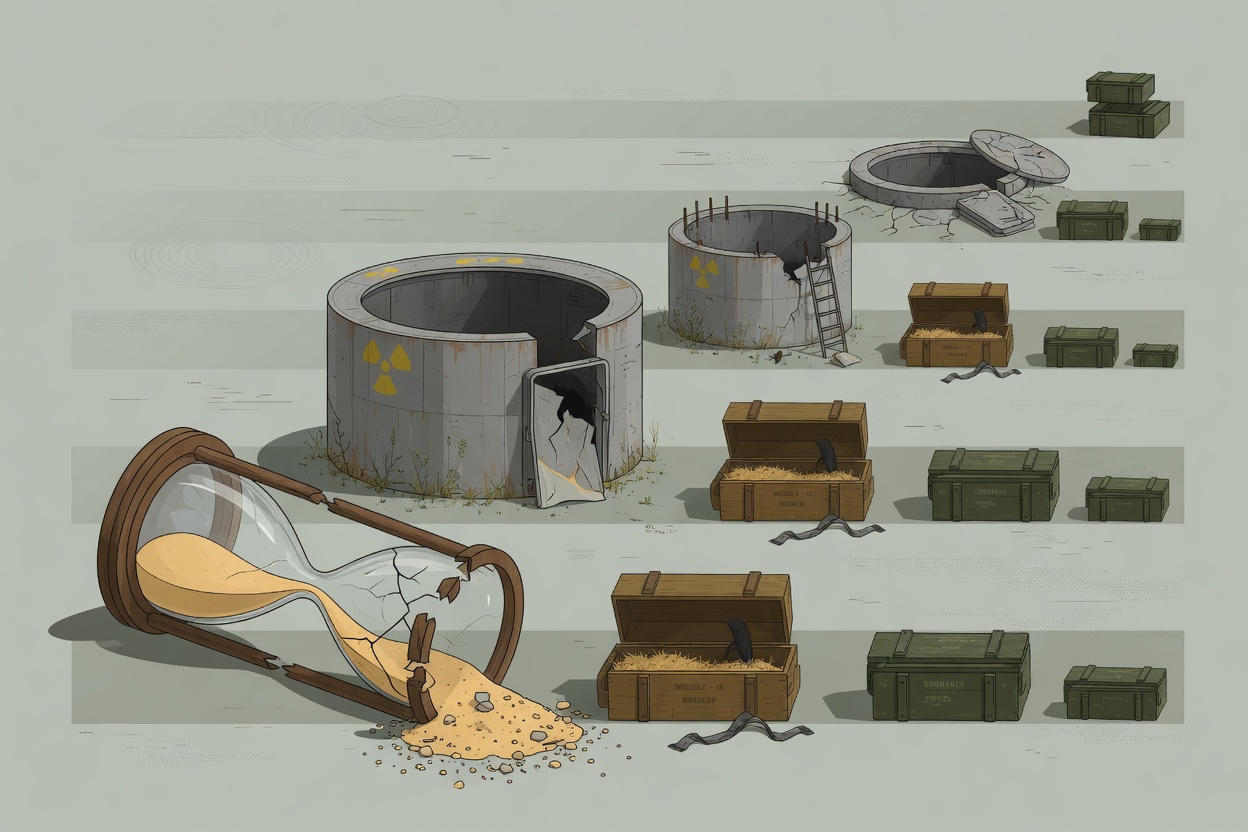
The Pentagon’s inspector general has confirmed that the war with Iran created “strategic inventory shortfalls” in US munitions stockpiles and exposed “industrial base bottlenecks” for resupply, contradicting President Donald Trump, who has repeatedly denied the US is facing shortages. The finding arrived alongside a Congressional Budget Office estimate that the war has cost $38.1 billion through Aug. 1, an average of $246 million per day.
The reports offer a first accounting. They paint a detailed public picture of a conflict that Trump initially said would last only weeks. The war has consumed as much as two-thirds of the nation’s missile-defense interceptors since June 2025, largely because of US efforts to help defend Israel against Iranian attacks. Rebuilding that inventory would probably take at least five years, even if production increased, CBO warned.
The inspector general’s report said the Defense Department spent more than $22.3 billion on munitions from February through June. Shortages of solid rocket motors, explosives, propellants, and skilled workers have complicated replenishment. The Pentagon is now working to “streamline procurement processes and production lead times” to address the shortages and “respond rapidly to a contingency,” the report added.
A political clash over the numbers
Trump has dismissed reporting on the shortages as “fake news.” In a Truth Social post on 3 September, he claimed that the US had “virtually unlimited” amounts of ammunition and was “stockpiling and preparing for any contingency that could happen.” Defense Secretary Pete Hegseth described news reporting on the shortages as “not true” in a 4 August post on X. White House spokeswoman Anna Kelly said the United States military has “more than enough munitions, ammo, and stockpiles to serve all of the Commander-in-Chief’s strategic goals and beyond.” Trump and other administration officials have also sought to cast reports of shortages as false and “treasonous.” The CBO said it was forced to build its estimates largely from public reporting because the Pentagon did not respond to its requests for information.
Costs mount across multiple fronts
The CBO report, requested by Democratic Representative Brendan Boyle of Pennsylvania, the ranking member of the House Budget Committee, found that munitions were the single largest driver of Pentagon costs. Replacing expended weapons accounted for $21.7 billion, of which $13.1 billion went toward missile defense interceptors alone. Increased flying hours cost another $10.4 billion. Higher fuel prices added $2.7 billion.
The inspector general put total Pentagon spending at $33.4 billion from 28 February to 30 June, comprising $7.4 billion in incremental operating costs, $22.3 billion to replace expended munitions, and $3.7 billion in equipment losses. The CBO’s higher $38.1 billion figure, calculated through Aug. 1, includes replaced munitions and equipment lost in battle, increased flying hours, and greater fuel costs. In June the White House requested $87.6 billion in supplemental funding, of which $67.1 billion was earmarked for the Pentagon. Once funding CBO judged unrelated to combat operations is stripped out, $42.3 billion of the Pentagon’s request appears tied to the Iran conflict, about 10 percent above CBO’s estimate. The request included $12.1 billion for classified programs CBO could not examine.
Equipment losses have been substantial. The Pentagon report documented four F-15E fighter jets, a single F-35A Joint Strike Fighter, seven KC-135 refueling aircraft, seven helicopters, and more than 30 MQ-9 drones destroyed in “various circumstances.” The F-35A costs as much as $92 million per plane, while the F-15E, no longer produced, cost $31.1 million in 1998, according to the US Air Force. The Pentagon report also noted State Department costs of $79.2 million for evacuations and $184 million in diplomatic site damage across Iraq, Kuwait, Saudi Arabia, and the United Arab Emirates.
Iranian strikes damaged or destroyed hundreds of buildings and structures at US bases across eight Middle Eastern countries: Kuwait, Bahrain, Qatar, the UAE, Saudi Arabia, Iraq, Oman, and Jordan. The Defense Department did not provide estimates for rebuilding plans or funding sources for damaged bases. The inspector general’s report also did not address an internal Pentagon investigation into the Minab school strike on the first day of the war, which killed 156 people, including 120 children. Critics have accused the Pentagon of burying the results of that investigation, which they say would show negligence in how the military compiled targeting data for the initial strikes.
The economic fallout extends beyond the Pentagon. CBO estimated that the war will have raised year-over-year inflation, as measured by the personal consumption expenditures price index, by 0.5 percentage points by the first quarter of 2027. Core PCE inflation is expected to run 0.3 points higher as energy costs ripple through supply chains. Short-term interest rates are already about 0.2 points higher than they otherwise would be, CBO found. “The price of almost every product reflects shipping costs,” CBO said. Oil prices have surged since Trump launched the war on 28 February. Brent crude jumped from $64 a barrel before the fighting to $103 at its peak, according to the Guardian. CNBC reported US crude topped $106 and Brent rose above $109 after Saudi Arabia reportedly canceled shipments following the closure of a major pipeline that bypasses the Strait of Hormuz. Regular gasoline averaged about $4.33 per gallon nationally, up almost 18 cents from a week earlier and $1.15 from a year ago, according to AAA. CBO projected that by early 2027, gasoline and other fuels will account for about 40 percent of the war’s effect on consumer prices.
The missile shortage carries strategic implications beyond Iran. CBO said the depleted inventory would be “especially problematic” in a hypothetical clash over Taiwan, where the need for interceptors to engage large numbers of ballistic and cruise missiles would far exceed what the Iran campaign has demanded. China maintains such an arsenal and is expanding it, the report noted.
The war’s political toll is growing. A Reuters/Ipsos poll released in early September found that only 23 percent of Americans, and only half of Republicans, believe the US is in a stronger position with Iran compared with before hostilities broke out. Trump recently said the conflict might not end until right after the November midterm elections. The CBO estimated the war will cost another $2 billion to $3 billion for each additional month of fighting.