Trump pauses 50% tariffs on Canada for three days as trade deal nears
The last-minute reprieve averts duties on roughly $20 billion in Canadian goods, though key details remain unresolved, and Trump floats reviving the Keystone XL pipeline.
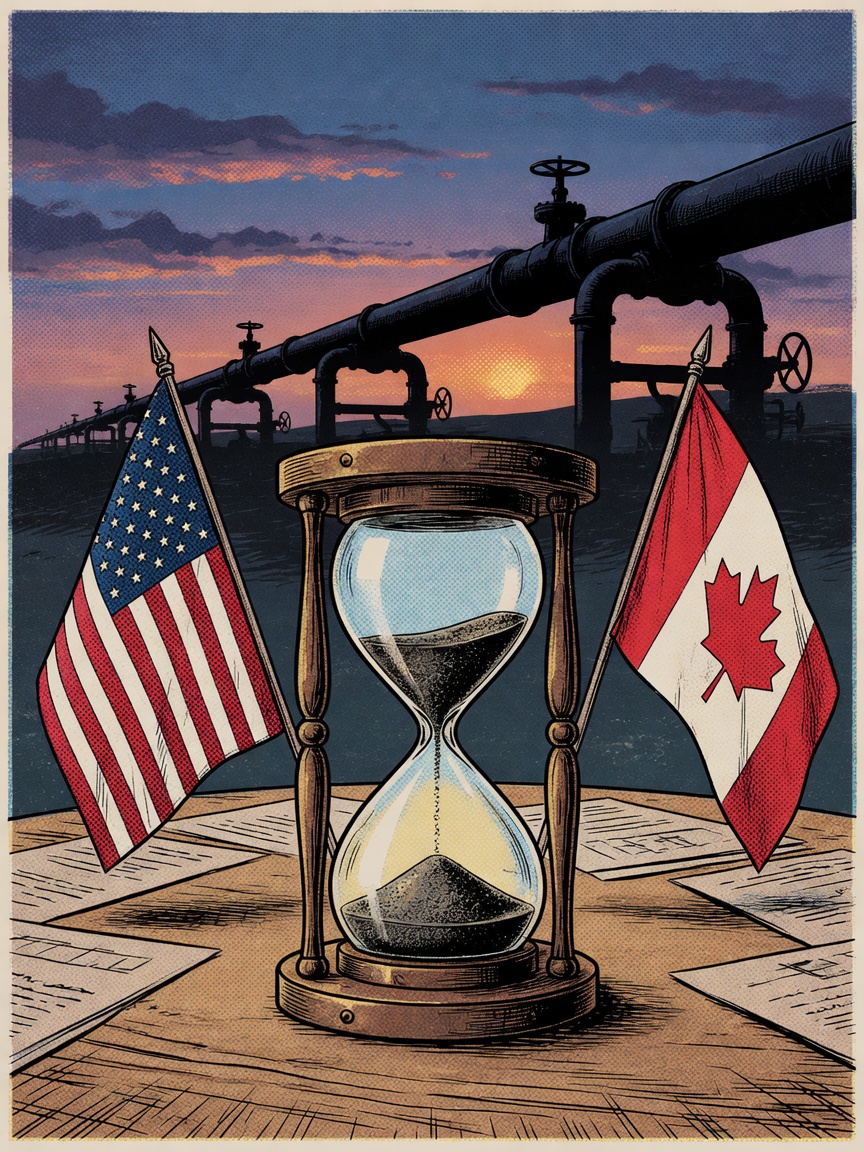
President Donald Trump paused a planned 50% tariff on Canadian imports for three days on Tuesday, announcing that the two countries had reached a trade deal subject to the finalization of documents. The reprieve came less than two hours before the levy was set to take effect at midnight, sparing nearly $20 billion in Canadian goods from a duty that business leaders warned would have devastated cross-border commerce.
The announcement caps weeks of fraught negotiations. Trump and Prime Minister Mark Carney spoke twice this week. Trade negotiators had been engaged in intense talks since July, when Trump first threatened the new levy with a deadline of 19 August. Carney confirmed that the US agreed to suspend the tariffs until 22 August.
A deal with unfinished business
Neither leader provided details of the agreement. Carney said in a letter posted on X that “substantial progress has been made, although there is important work still to be done.” He added that Canada remains focused on building a stronger, more independent, and more competitive economy at home. The US Trade Representative posted on X that the deal will include broad market access for all American goods, economic security commitments, and digital trade alignment, along with provisions to protect American workers and Canadian partners.
The two sides had been at an impasse on several issues, including US tariffs on autos and Canadian provincial bans on American liquor sales. The US has asked Canada to remove retaliatory tariffs on American autos, adjust dairy quotas to allow greater access for US cheese producers, and end the alcohol sales ban imposed by most Canadian provinces last year in retaliation to Trump’s tariffs. Canada has sought reductions or eliminations of US tariffs on key sectors including steel, aluminum, autos, and lumber.
In the final hours before the deadline, negotiators were discussing a deal that would reduce US tariffs on Canadian autos from 25% to 15%, according to a Reuters report cited by the BBC. But the countries could not agree on which vehicles would qualify, with the US pushing for the reduction to apply only to cars with a high amount of American-made content.
Keystone XL resurfaces
In his social media post, Trump linked the breakthrough to his efforts to revive the Keystone XL pipeline, writing on Truth Social: “The great Keystone XL Pipeline, long ago killed by Sleepy Joe Biden, may be awoken from the grave!” The pipeline, first proposed in 2008, would transport about 830,000 barrels of crude oil each day from Alberta to Nebraska. Biden revoked a key permit for the US stretch in 2021 on environmental and economic grounds, effectively killing the project after owner TC Energy halted construction. Environmentalists, indigenous groups, and US landowners have long opposed the project, which became a flashpoint in US-Canada relations.
The tariffs would have applied to a range of Canadian imports including wine, dairy, cement, clothing, hockey equipment, electronics, industrial machinery, and furniture. They were being imposed under Section 338 of the Tariff Act of 1930, a Great Depression-era law that has rarely been invoked and was neglected for decades, according to CNBC. The duties would have been in addition to existing tariffs on Canadian steel, aluminum, autos, and lumber. The latest tariffs targeted goods that had been shielded from import taxes under the US-Mexico-Canada Agreement, the trilateral deal ratified during Trump’s first term.
Business groups warned of severe consequences. Dan Kelly, president of the Canadian Federation of Independent Business, told CNBC that “a 50% tariff essentially makes a product uneconomic to sell into a particular market.” Kelly said many of the group’s 103,000 members reported that US buyers were already holding off on future orders in anticipation of the duties. The US Chamber of Commerce pushed for a deal on Tuesday. In a statement, the group said higher tariffs “would damage both economies, drive up costs for US families, further disrupt critical supply chains, and risk the 13 million American jobs that depend on trade” under the USMCA.
Tensions have run high. In February 2025, the White House imposed a 25% tariff on Canada, citing what it regarded as inadequate progress in curbing cross-border illegal immigration and drug trafficking. Canada announced a reciprocal levy and countered the administration’s claims, maintaining that less than 1% of fentanyl and illegal crossings came from Canada. The Supreme Court struck down those drug-related tariffs in February. Trade between the two countries was estimated at roughly $909 billion in 2024, according to the office of the US Trade Representative, with approximately 70% of Canadian exports going to the US.
Carney will need buy-in from provincial premiers to reinstate US alcohol sales, as liquor sales are controlled by the provinces, not the federal government. Ontario Premier Doug Ford, whose province is hardest hit by US auto tariffs, said he was open to lifting the liquor ban only if a “fair deal” is reached. The three-day pause now leaves negotiators racing to finalize documents before the new deadline.
Sources & methods
- BBC News report on Trump pausing Canada tariffs, the auto tariff reduction discussion, provincial liquor bans, and Keystone XL revival Archived Aug 19, 2026
- Guardian report on the tariff pause, Keystone XL history, tit-for-tat tariff timeline, and bilateral trade figures Archived Aug 19, 2026
- Al Jazeera report on the last-minute deal, tariff suspension until August 22, Keystone XL details, and export dependency statistics Archived Aug 19, 2026
- CNBC report on Section 338 of the Tariff Act of 1930, Canadian Federation of Independent Business concerns, USMCA non-renewal, and Supreme Court ruling Archived Aug 19, 2026
This article was assembled from four news outlet reports published on August 18 and 19, 2026, cross-referencing details on the tariff pause, trade negotiation positions, Keystone XL history, and business community reactions.