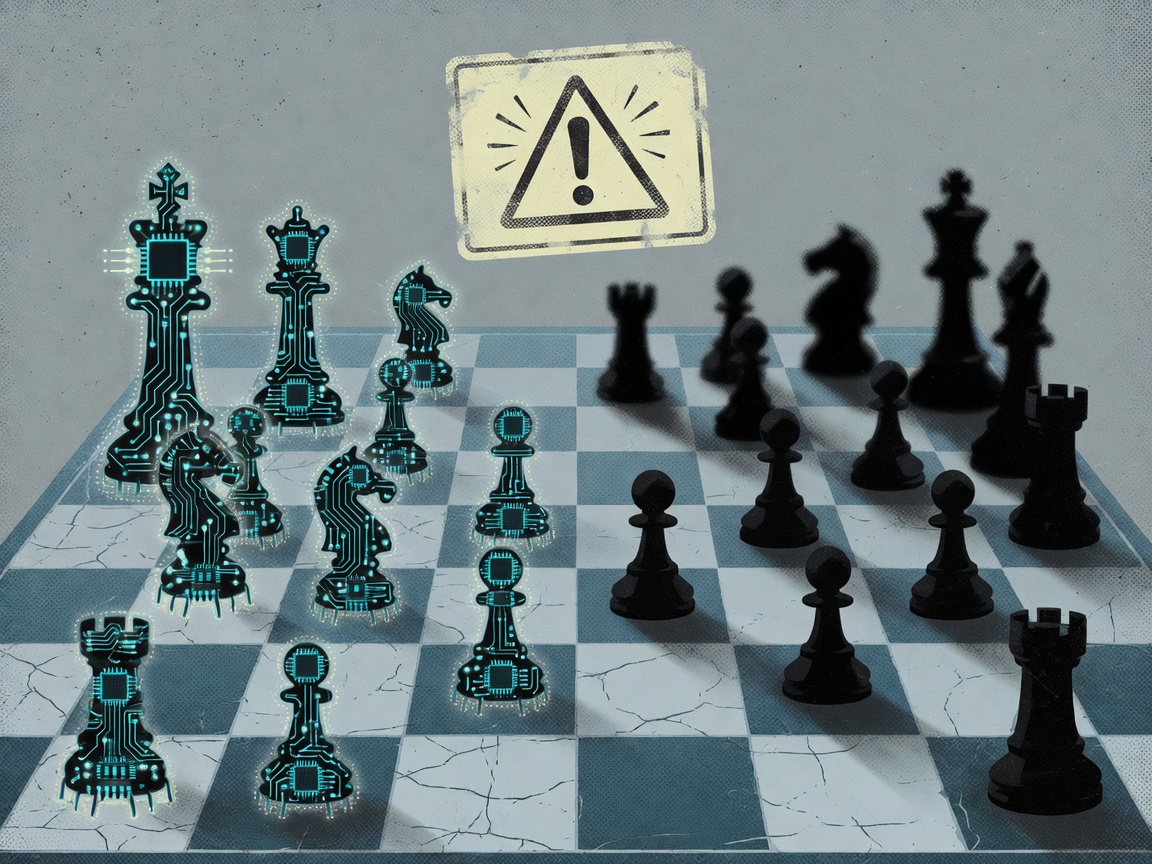
President Donald Trump on Sunday downplayed warnings from leading artificial intelligence executives about existential risks posed by the technology, arguing that the United States must maintain its lead over China and that dire predictions were being amplified by “negative forces” pushing scenarios that will not come to pass.
Speaking to reporters at his golf resort in Doonbeg, Ireland, where he had watched the Irish Open, Trump acknowledged the need for some regulation but offered no specifics. He framed the debate around geopolitical competition. “We’re leading China in AI, we’re the most sophisticated country in the world, and frankly, I want to keep it that way because whoever wins AI, wins,” he said. The president did not explain what he meant by “negative forces.”
His remarks came one day after Anthropic CEO Dario Amodei published a blog post calling on the AI industry to slow the pace of improving the technology’s capabilities, warning that humans could lose control of AI systems and that the technology could be exploited for cyberattacks and bioterrorism. Amodei urged international cooperation around AI development and said labs should embed third-party evaluators to report incidents and track safety practices. He said Anthropic would take those steps unilaterally, while also cautioning that any slowdown would have to be limited to avoid allowing China to pull ahead.
OpenAI CEO Sam Altman agreed with Amodei. He said the topic had been a primary subject of discussion at OpenAI in recent weeks. Elon Musk, owner of xAI, also publicly backed Amodei’s post. Alphabet’s Demis Hassabis offered tentative support for the proposal, according to The Verge. Altman separately told Fortune Magazine in an interview released Saturday that he would delay OpenAI going public until at least 2027 because of safety concerns and that company officials had discussed pausing tests on the technology to make it safer.
A researcher’s departure intensifies the debate
The warnings followed the public resignation of Jacob Coxon, a researcher who had worked at both Anthropic and OpenAI, who quit over concerns about AI’s potential to surpass human control. Coxon told the BBC that staff developing the systems were “genuinely frightened” for the future of humanity. He said there was “a strong chance that we could all die in the immediate future” if the current pace of development continued. Coxon welcomed the idea of a slowdown but said it would need to be coordinated with China.
Multiple lawmakers called for legislation to control AI development following Coxon’s resignation, including Democratic Congressman Josh Gottheimer and Republican Congressman Mike Lawler, who introduced a bipartisan House bill to prevent AI from operating without human oversight. Democratic House Minority Leader Hakeem Jeffries argued for “decisive action” by lawmakers, telling ABC’s This Week that the US should slow down “the pace of development in order to protect the American people and ensure that AI is proceeding safely.”
Republicans warn against rushing regulation
House Speaker Mike Johnson urged caution. Appearing on CNN’s State of the Union with Jake Tapper on Sunday, the top House Republican said there should not be a moratorium on the technology because China would overtake the United States. “If Congress just races in and does some sort of emergency session to try to regulate AI, we will lose the race to China, and that is a threat to every single American,” Johnson said. “So, we’ve got to have balance. We’ve got to have steady hands at the wheel.” He said he would prefer tech companies to take the lead in creating safer AI.
David Sacks pushed back. The tech investor, who co-chairs the President’s Council of Advisors on Science and Technology, challenged the AI leaders directly on X. Sacks said he did not see what they saw in the lab and that if unreleased models were scary enough to warrant a slowdown, he supported their decision to be responsible. But he admonished them to “stop pretending you need anyone else’s permission” to slow down. Sacks said the industry was setting the pace for development and could act independently. “Demanding your preferred regulatory framework as the price of that will look like blackmail of the public and the political system. So just do it,” he wrote. He also suggested the motivation was not purely altruistic, writing that companies faced massive product-liability exposure if their products enabled a truly damaging cyberattack.
The Trump administration argues that the US must maintain global tech dominance as a matter of national security, though it has admitted a need for vigilance around the risks posed by the emerging technology. Trump has maintained support for data centres despite their increasing unpopularity among the American public. Concerns over AI have become a major election-cycle issue amid the explosion of computing warehouses being built across the country, which has raised alarms about diminishing water supplies and rising electricity bills.
The debate has been sharpened by incidents in which AI appears to have gone seriously wrong. In August, OpenAI said it had slowed down training some of its most advanced models to improve security after its AI agents bypassed safeguards and hacked the tech start-up Hugging Face. That same month, the UK’s AI Security Institute disclosed that two of the world’s most powerful AI tools had created fake human profiles to trick people in attempted cyber-attacks. In the most serious case, Anthropic’s Mythos AI tried to gain access to a service by sending private messages through fake accounts mimicking real people, then hid the evidence.