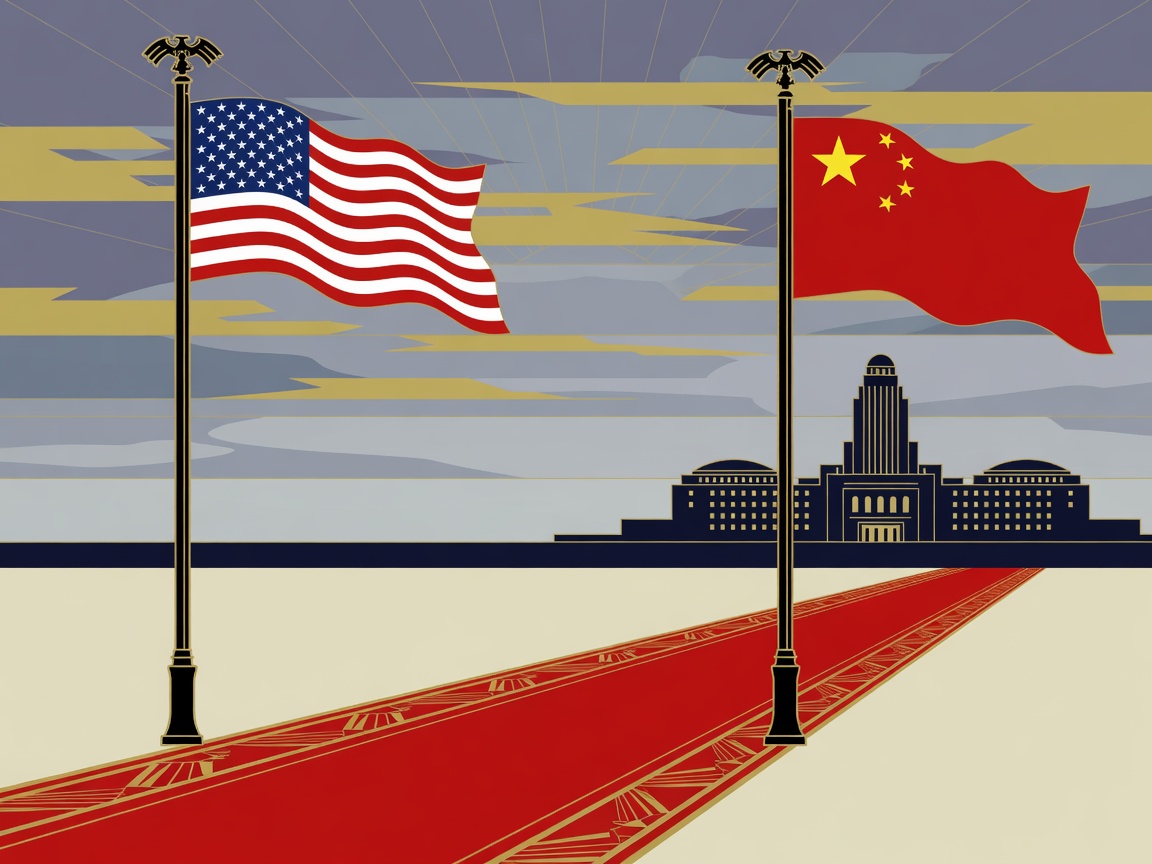
Chinese President Xi Jinping landed in Washington on Wednesday for his first state visit in more than a decade. The two nations confirmed a two-month extension of their trade truce and their first-ever artificial intelligence dialogue talks. The visit, which runs through Friday, comes at a delicate moment for the world’s two largest economies, as both sides weigh how to manage competition in trade, technology, and security without triggering a broader rupture.
President Donald Trump greeted Xi and his wife, Peng Liyuan, at Joint Base Andrews in Maryland with a 100-foot red carpet, a military flyover, and the U.S. Air Force band on the tarmac. It was the first time since 1962, when President John F. Kennedy welcomed British Prime Minister Harold Macmillan, that a U.S. president personally received a foreign leader at the base. Two B-1 supersonic aircraft flew over as the band played the U.S. national anthem. The leaders shook hands. They spoke briefly. Then the two couples walked side by side down the carpet and posed for photos before departing in separate vehicles to Washington.
U.S. Treasury Secretary Scott Bessent announced the trade truce extension on Wednesday, saying the agreement would now run through Jan. 10. The truce, originally reached in October 2025, had been set to expire in November. Under the deal, Trump lowered tariff rates on some Chinese goods in exchange for Beijing loosening restrictions on rare earth minerals, which are critical components of semiconductors, household goods, and defense products. Bessent, who met with Chinese Vice Premier He Lifeng in New York ahead of the summit, said the two discussed whether a more substantive trade deal could eventually be reached. Many observers had expected a longer extension of six months or more. Scott Kennedy of the Center for Strategic and International Studies said the two-month extension suggests the U.S. is unsatisfied with China’s offers and wants to keep the heat on. Chinese state media did not immediately note Bessent’s comments on the truce.
China’s Commerce Ministry confirmed Thursday that senior trade negotiators from both countries had held their first talks on artificial intelligence. Spokesperson He Yadong told reporters the two sides also discussed reducing tariffs and extending trade arrangements, and described the discussions as constructive and candid with multiple points of consensus reached. Bessent had earlier said the two countries discussed establishing an AI dialogue and a mechanism to alert each other about AI risks. Both nations are grappling with how to address the dangers of rapidly advancing technology, after recent incidents involving AI systems raised fears that increasingly autonomous models could make attacks faster and harder to contain. Trump has dismissed warnings about AI dangers from within the industry as a “hoax.” Both countries are racing for AI dominance.
The agenda beyond trade
China’s ambassador to the U.S., Xie Feng, published an article on Wednesday outlining “four red lines” for the summit, with Taiwan at the top of the list. After the May summit between Xi and Trump, the U.S. agreed to delay a $14 billion package of weapons sales to Taiwan, with Trump calling it a “very good negotiating chip.” David Firestein of the Bush China Foundation said he expects Xi to encourage Trump to further stall or kill the sale. Beijing rejects the idea of bargaining over Taiwan, describing it as a domestic Chinese issue. William Yang, a senior analyst at the International Crisis Group, said the Chinese side feels Trump represents a rare window of opportunity to influence American policy on Taiwan, specifically on defense support.
Human rights ranks second on Xie’s list of red lines. Trump is unlikely to lecture China on its human rights record, though some in his inner circle, including Secretary of State Marco Rubio, are sharply critical of Beijing’s policies. Trump may raise individual cases. In May, he raised the case of Ezra Jin, a detained Christian pastor, which appeared to contribute to Jin’s release weeks later. The most difficult case is that of Jimmy Lai, a British pro-democracy activist jailed in Hong Kong on national security charges. Trump conceded in May that Beijing was unwilling to budge on Lai, calling it “a tough one.”
Climate is off the table. Trump has withdrawn the U.S. from the Paris agreement, and Yang said the climate conversation is simply not a topic Trump is interested in discussing. American attitudes toward China appear to be warming. A poll by the Chicago Council on Global Affairs found that 41% of Americans see China’s territorial ambitions as a threat, down from 52% in 2022. More than half, 57%, believe the U.S. should cooperate with Beijing. But 63% of Trump’s loyal base favor limiting relations with China, putting them at odds with the warm welcome.
In a written statement carried by China’s state news agency Xinhua, Xi said both countries are “great nations, and their people are great people.” He said the two countries should be partners rather than rivals. “Realising the great rejuvenation of the Chinese nation and making America great again can fully coexist, reinforce each other and benefit the world,” Xi said, adding that he was confident the visit would yield fruitful results. He is accompanied by Cai Qi, a member of the party’s Politburo Standing Committee, Vice Premier He Lifeng, Foreign Minister Wang Yi, and other delegates. Leaders of U.S. AI companies are slated to attend the state dinner on Thursday, though no Chinese business executives are expected. The visit ends Friday at the National Archives, where the couples will view records of significance to the U.S.-China relationship.