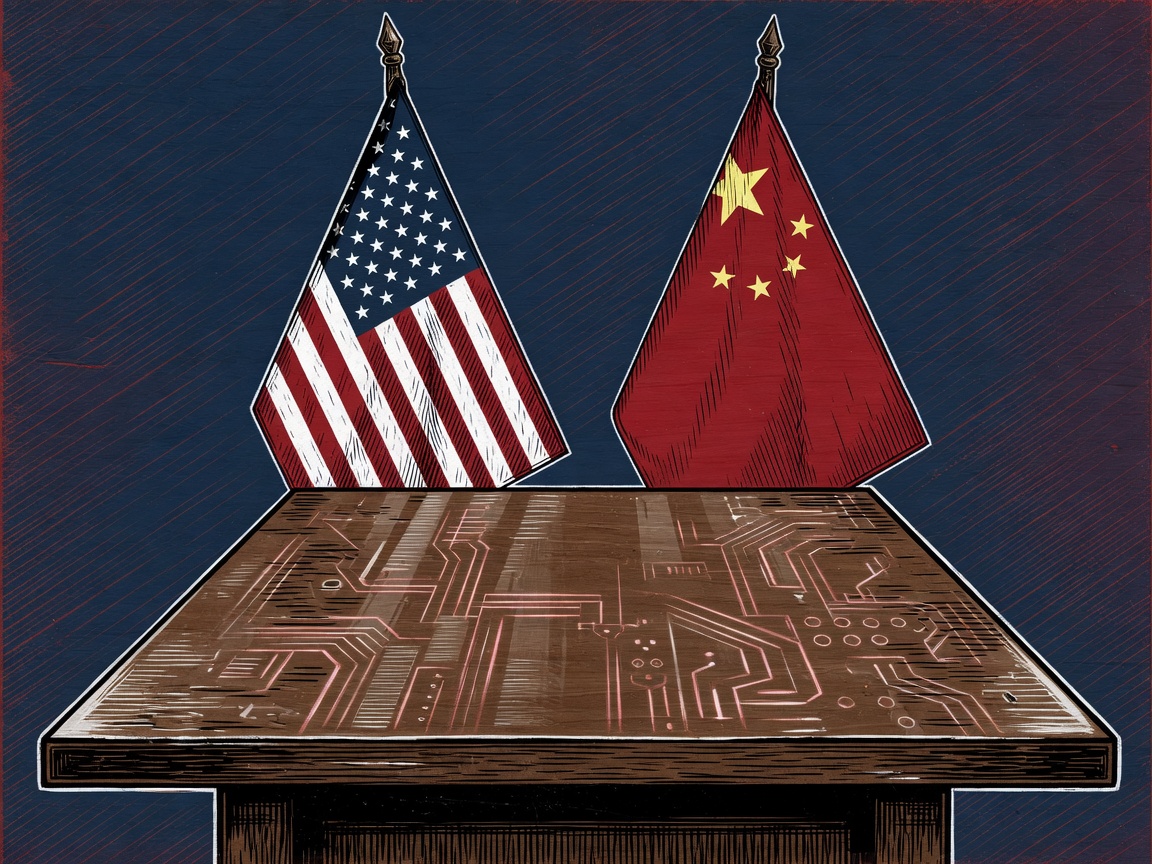
Chinese President Xi Jinping landed in Washington on Wednesday evening for his first state visit in 11 years, opening high-stakes talks with President Trump at a moment of global consequence for both men. Trump took the unusual step of greeting Xi on the tarmac at Joint Base Andrews in Maryland, where a 100ft red carpet, a military flyover by two B-1 bombers, and a presentation of both nations’ flags and anthems awaited the Chinese leader and his wife, Peng Liyuan.
The visit comes at a pressured moment for both leaders. Trump faces midterm elections in just over a month. Xi returns to Beijing to begin preparations for an all-important Party Congress. The two presidents last met in May at a Beijing summit where they agreed to build what China has dubbed a relationship of “constructive strategic stability,” but relations since then have grown more “fragile,” according to Wu Xinbo, who directs the American Studies center at Shanghai’s Fudan University and attended a state banquet at Beijing’s Great Hall of the People during Trump’s recent visit to China.
Hours before Xi’s arrival, Treasury Secretary Scott Bessent announced on Fox News that the two countries had agreed to extend their temporary trade truce, known as the “Busan agreement,” until Jan. 10, two months beyond its original November expiration. Bessent, who met with Chinese Vice Premier He Lifeng in New York earlier on Wednesday, said Beijing needs to fulfill more deliverables. Many observers had expected a longer extension of six months or more. Chinese state media did not immediately note Bessent’s comments.
AI race dominates the agenda
No topic looms larger than artificial intelligence. Trump has been blunt. “WHOEVER WINS AI, WINS!” he wrote on Truth Social last week, dismissing concerns about the technology’s dangers as “a hoax” and a “SICK conspiracy” against AI and data centers. Xi has been more measured in public. “China very much sees it as a race, they very much think China should be the leading force in AI,” said Rebecca Arcesati from the Mercator Institute for China Studies, adding that Beijing views AI as a “power maximiser.”
American companies lead on so-called frontier models, with the highest-performing systems coming from firms such as Anthropic, Google, and OpenAI. In February 2025, an AI model by China’s DeepSeek “briefly matched the top US model,” and as of March 2026, Anthropic’s top model led the pack “by just 2.7%,” according to researchers at Stanford University. Part of that advantage stems from vast sums invested in AI infrastructure and from sweeping government restrictions that prevent U.S. companies from selling advanced microchips to Chinese firms, which are crucial for developing advanced models.
Despite the chip restrictions, Chinese AI developers showed “remarkable resilience and innovation,” analyst Lian Jye Su from tech research firm Omdia said. China’s industry has focused on releasing open weight models, downloadable and tweakable in a similar way to open source software, at a rapid pace, with benchmarks showing the country’s top models trailing U.S. rivals by only a few months. Models such as Moonshot AI’s Kimi K3 have become popular in China and overseas because they perform close to the frontier models while remaining freely downloadable and adaptable.
China has become the world’s biggest manufacturer of robots, with more than two million working in the country’s factories, the International Federation of Robotics estimated. The nation is also the world’s biggest maker of humanoid robots, accounting for more than nine-tenths of global shipments in the first half of the year, according to independent policy institute Chatham House. Chinese AI companies are able to access the electricity they need for a much lower cost, Arcesati told the BBC World Service, which she called a real advantage given how energy hungry AI is.
On safety, the gap between the two governments is stark. Trump has said the U.S. already has sufficient rules in place and that the only guardrails AI needs are a “high IQ” president. Xi urged the country’s leaders to keep a close eye on AI’s risks and ensure the technology was always “under human control.” China has taken a “relatively cautious and centrally-coordinated approach,” introducing guides on data usage and algorithms before many other countries, said information security officer Jayant Dave from cybersecurity firm Check Point Software Technologies. Bessent said the two sides discussed setting up an alert system for AI incidents, though cooperation remains complicated by deep mistrust.
Taiwan, trade, and old tensions
Xi is expected to press Trump on Taiwan, which Beijing claims as its own and considers a red line. In previous meetings, Xi has repeatedly emphasized to Trump that Taiwan, if mishandled, could put U.S.-China relations in “jeopardy.” This spring, the Trump administration paused a $14 billion arms sale to Taiwan. Experts say Xi is expected to press Trump to maintain this momentum. On Wednesday, as Xi departed for the U.S., China’s state news agency published a statement from the country’s cabinet-like State Council excoriating Taiwan’s president, Lai Ching-te, whom Beijing suspects of trying to lead Taiwan to declare formal independence.
Trade discussions are also underway. Trump and Xi agreed to create trade and investment boards back in May. Among the discussions is a reciprocal tariff reduction framework on products worth $30 billion or more. China is expected to announce purchases of American agricultural products, and the U.S. is expected to announce tariff reductions on what are called 4A consumer goods, which include footwear and apparel, according to two people in the U.S.-China business community who requested anonymity. During Trump’s visit to China this spring, the U.S. said China agreed to purchase American beef, soybeans, and 200 Boeing jets. But data shows China is already behind schedule on its promises to buy American agricultural goods.
The pageantry continues with a formal state welcome on the South Lawn of the White House, private tea with the U.S. president and first lady, a tour of the National Archives, and a state dinner on Thursday. The White House has invited executives from OpenAI, Apple, xAI, Microsoft, Nvidia, and Meta to the dinner. Melania Trump told Fox & Friends on Wednesday morning that Xi was coming on American soil and needed to be welcomed with the most respect. The two leaders are also expected to discuss the wars in Iran and Ukraine and tensions along the Korean peninsula.
Whether this visit can arrest the slide is the question now hanging over both capitals. The U.S. imposed extra tariffs on Chinese exports over forced labor claims. The Pentagon added Chinese tech giants to a military blacklist. The Federal Communications Commission banned new imports of Chinese humanoid robots and robot dogs over national security concerns. Mutual distrust scuppered an offer from Beijing to extend the rare earths truce to the end of Trump’s term in January 2029. The key, said international studies professor Zhang Yun at Nanjing University, is to build high-level channels to deal with problems as they emerge and mitigate the negative impacts.