April 2026 came in fourth-warmest at NOAA, joint third at Copernicus, third at NASA, a small spread with a particular cause
The three monthly global temperature analyses for April 2026, released within four days of each other, agree the month was 1.12 to 1.43 degrees Celsius above their respective baselines and disagree on the ranking by a single position. The gap is methodological, not contested, and the agencies have explained it for years.
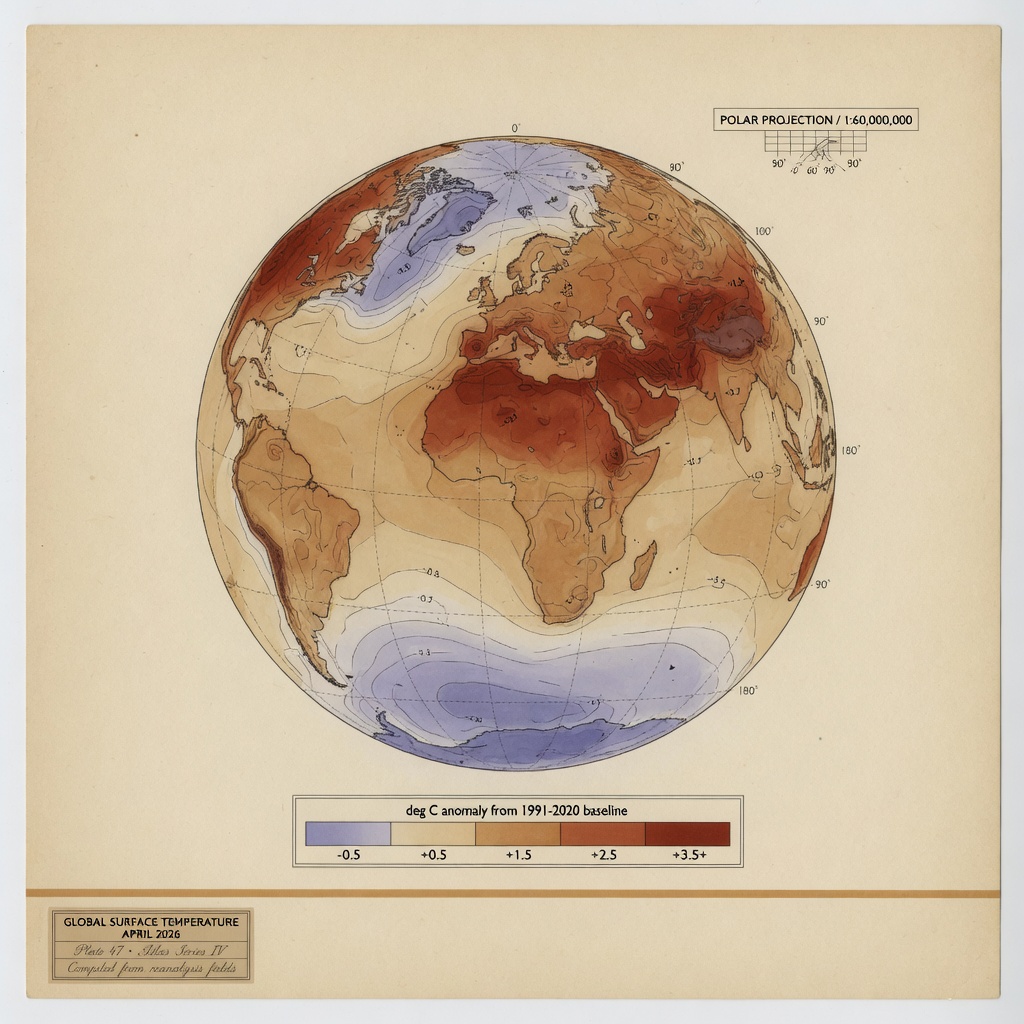
Three independent monthly summaries of April 2026 global surface temperature were released within four days of each other this month. NOAA’s National Centers for Environmental Information, on May 11, called it the fourth-warmest April in the 1850 to 2026 record, at 1.12 degrees Celsius above the twentieth-century average. NASA’s Goddard Institute for Space Studies, in its GISTEMP update of about the same date, called it the third-warmest April, at 0.55 degrees above its 1991 to 2020 baseline. The European Copernicus Climate Change Service, on May 8, called it the joint third-warmest, at 0.52 degrees above its 1991 to 2020 baseline and 1.43 degrees above a 1850 to 1900 pre-industrial reference. The three numbers are not in conflict. They are three different distances from three different starting lines.
The ranking gap, fourth at NOAA versus third at NASA versus joint third at Copernicus, is a single position. It exists because the three centres use different reference periods, different sea-surface-temperature products, and slightly different spatial-interpolation choices in the Arctic, where stations are sparse and a small change in method moves the global mean by a few hundredths of a degree. None of this is new. NASA’s standing GISTEMP documentation describes the inputs and the 1951 to 1980 baseline choice in detail, and NOAA NCEI publishes a standing explainer on why anomaly figures from different agencies do not match digit for digit.
What each centre reported
NOAA’s NCEI report places April 2026 at 1.12 degrees Celsius (2.02 degrees Fahrenheit) above the twentieth-century average of 13.7 degrees Celsius. The ranking is fourth-warmest, trailing 2024, 2025, and 2020. NCEI also recorded the fiftieth consecutive April with a global temperature above the twentieth-century average; the last below-average April was in 1976. Global sea-ice extent for the month was 7.63 million square miles, 590,000 square miles below the 1991 to 2020 average and the fifth smallest April extent in the 48-year satellite record. The Arctic recorded its second-smallest April extent.
Copernicus, working from the ERA5 reanalysis, recorded an April 2026 surface air temperature of 14.89 degrees Celsius, 0.52 degrees above the 1991 to 2020 April mean and 1.43 degrees above the 1850 to 1900 pre-industrial reference. The month tied 2016 and 2020 for third-warmest April in the ERA5 record. Sea-surface temperature across the 60 degrees south to 60 degrees north extra-polar ocean averaged 21.00 degrees Celsius, the second-highest April value behind only 2024 (21.04). Copernicus flagged record-high April SSTs across a broad region from the central equatorial Pacific to the western coast of the United States and Mexico, with marine heatwave classifications described as strong.
NASA GISTEMP, the third number, ranked April 2026 as third-warmest at 0.55 degrees Celsius above the 1991 to 2020 norm, ahead of NASA’s readings for April 2016 and April 2020 and behind 2024 (0.68) and 2025 (0.61). GISTEMP’s reference baseline and Arctic infilling differ from NOAA’s and from Copernicus’s, which is enough to flip the third-versus-fourth ordering without flipping the underlying picture.
Why three agencies report three numbers
The baselines are the first source of the spread. NOAA NCEI’s headline anomaly is taken against the twentieth-century average, 1901 to 2000. NASA GISTEMP currently reports against 1951 to 1980 as its historical baseline and against 1991 to 2020 in its monthly tables. Copernicus reports both against 1991 to 2020 and against 1850 to 1900 to make the pre-industrial framing direct. Three baselines, three reference periods, three sensible-but-different reference points, none of them in dispute.
The second source is the sea-surface-temperature product feeding each analysis. NASA GISTEMP uses NOAA’s ERSST v5 over ocean; NOAA NCEI uses a related but not identical ocean product, NOAAGlobalTemp; Copernicus uses ERA5, a reanalysis that assimilates observations into a physical model rather than averaging station and ship records directly. ERA5 and the ERSST/NOAAGlobalTemp family agree closely on long-term trend and disagree by hundredths of a degree on any given month. Those hundredths are enough to reorder months near the top of the leaderboard.
The third source is the Arctic. Surface stations above 80 degrees north are scarce, and the choice of how to extend the nearest observations across the data-sparse cap influences the global mean by a measurable amount. NASA GISTEMP infills the Arctic more aggressively than the operational NOAA product does, which tends to push GISTEMP’s monthly anomaly a touch warmer when the Arctic is anomalously warm and a touch cooler when it is not.
Three baselines, three reference periods, three sensible-but-different reference points, none of them in dispute. — Sofia Mendes, on the April 2026 NOAA, NASA, and Copernicus releases
The ocean signal, and the ENSO transition behind it
The April 2026 numbers land in the middle of an ENSO transition that the centres have been tracking since winter. NOAA’s Climate Prediction Center, in its May ENSO Diagnostic Discussion, described the equatorial Pacific as having transitioned out of La Niña to ENSO-neutral conditions during the spring, with model guidance favouring a continued move toward El Niño through northern-hemisphere summer and autumn. That trajectory is consistent with the April ocean signal Copernicus flagged: SSTs in the central equatorial Pacific are not yet at El Niño thresholds for the month-on-month indices, but the warmth is broad and sustained, and the marine heatwave footprint that Copernicus characterised as strong spans the same longitudes.
What this implies for the rest of 2026 is bounded and worth stating carefully. Year-to-date through April, NCEI reports the global surface temperature as the fifth highest on record for that period, and its Global Annual Temperature Outlook calls it very likely (above 90 percent probability under NCEI’s own scoring) that 2026 will finish among the five warmest years. The same outlook puts the probability of 2026 ranking warmest at a meaningfully lower figure than 2024, the El Niño-supported record year. A move into El Niño by late summer could lift the second-half anomalies; whether it does so enough to challenge the 2024 annual ranking is not yet a forecast the centres are willing to make.
What the disagreement is, and what it is not
A one-rank disagreement between three independent analyses is a measurement-pipeline story, not a contested-science story. The trend the three datasets share is the load-bearing fact: every April since 1977 has come in above the twentieth-century mean; every one of the ten warmest Aprils in the 1850 to 2026 record has occurred since 2016; and the global temperature outlook for the calendar year places 2026 firmly among the warmest on the instrumental record. The disagreement over whether April 2026 was third or fourth would not change any of those statements if it were resolved in either direction tomorrow.
It is also worth naming what this story does not establish. It does not establish the cause of any individual April’s anomaly in attribution terms — that requires a separate analysis the centres have not yet released for April 2026. It does not establish that El Niño will arrive by a particular month; the May ENSO discussion favours a transition but does not commit to a date. And it does not extrapolate from one month to long-term sensitivity. The April 2026 number is one observation. The trend behind it is what carries weight.
Sources & methods
- NOAA · National Centers for Environmental Information, “Assessing the Global Temperature and Precipitation Analysis in April 2026,” released May 11, 2026. Source for the 1.12 degrees Celsius anomaly, fourth-warmest ranking, sea-ice figures, and year-to-date outlook. Archived May 16, 2026
- NOAA · NCEI Monthly Global Climate Report for April 2026 (full data tables and figures). Released May 11, 2026. Archived May 16, 2026
- Copernicus Climate Change Service · “Surface air temperature for April 2026,” released early May 2026. Source for the 14.89 degrees Celsius monthly mean, 0.52 degrees above 1991 to 2020 and 1.43 degrees above pre-industrial figures, and the joint third-warmest ranking. Archived May 16, 2026
- Copernicus Climate Change Service · press release, “Second-highest sea surface temperatures recorded during third-warmest April globally,” released May 8, 2026. Source for the SST figure and the marine heatwave characterisation. Archived May 16, 2026
- NASA · Earth Indicators page for global temperature, the agency landing page for the GISTEMP v4 surface temperature analysis. Documents the underlying station, ship, buoy, and Antarctic inputs and the 1951 to 1980 reference baseline used in GISTEMP’s headline figures. (Replaces the data.giss.nasa.gov data portal, which was timing out for general readers at the time of publication.) Archived May 16, 2026
- NASA · Earth Observatory “World of Change: Global Temperatures,” the standing NASA explainer for the GISTEMP analysis and baseline choice. Source for the rationale behind the 1951 to 1980 baseline (alignment with the U.S. National Weather Service three-decade normal) and the general GISTEMP method. Archived May 16, 2026
- NOAA · NCEI “Did You Know?” explainer on anomalies versus absolute temperatures, the standing reference for why agency monthly anomaly figures differ. Archived May 16, 2026
- NOAA · Climate Prediction Center ENSO Diagnostic Discussion (current month). Source for the May 2026 ENSO-neutral assessment and outlook toward El Niño. Archived May 16, 2026
- Copernicus Climate Change Service · monthly climate bulletins archive, used to confirm baseline and ranking methodology consistency across recent months. Archived May 16, 2026
Reporting is based on three primary releases for April 2026: the NOAA NCEI Monthly Global Climate Report and accompanying news summary, both dated May 11, 2026; the Copernicus C3S surface air temperature bulletin and the Copernicus press release dated May 8, 2026; and the NASA GISTEMP v4 monthly update covering April 2026. Anomaly figures, rankings, sea-ice extents, and the year-to-date outlook are taken verbatim from the NCEI release. ERA5-based SST and pre-industrial anomaly figures are taken from the Copernicus materials. GISTEMP’s anomaly value and methodology notes are taken from NASA’s standing global-temperature documentation on science.nasa.gov (the GISS data portal at data.giss.nasa.gov was intermittently unreachable at the time of publication, and the cited NASA pages cover the same baseline and methodology material). The ENSO transition framing is taken from the NOAA Climate Prediction Center ENSO Diagnostic Discussion. Where the three datasets differ on ranking, the article reports each figure separately and explains the methodological sources of the spread (baseline period, SST product, Arctic infilling) without favouring one centre over another. The article does not extrapolate beyond the April 2026 observation, does not commit to a date for an El Niño onset, and does not perform single-event attribution. No anonymous sources were used.