WHO declares global health emergency as Bundibugyo Ebola outbreak crosses into Uganda with no approved vaccine
The WHO declared a Public Health Emergency of International Concern on May 17 after the DRC's seventeenth Ebola outbreak spread to Kampala. The Bundibugyo strain, which has no approved vaccine or targeted treatment, last caused a documented human outbreak in 2012.
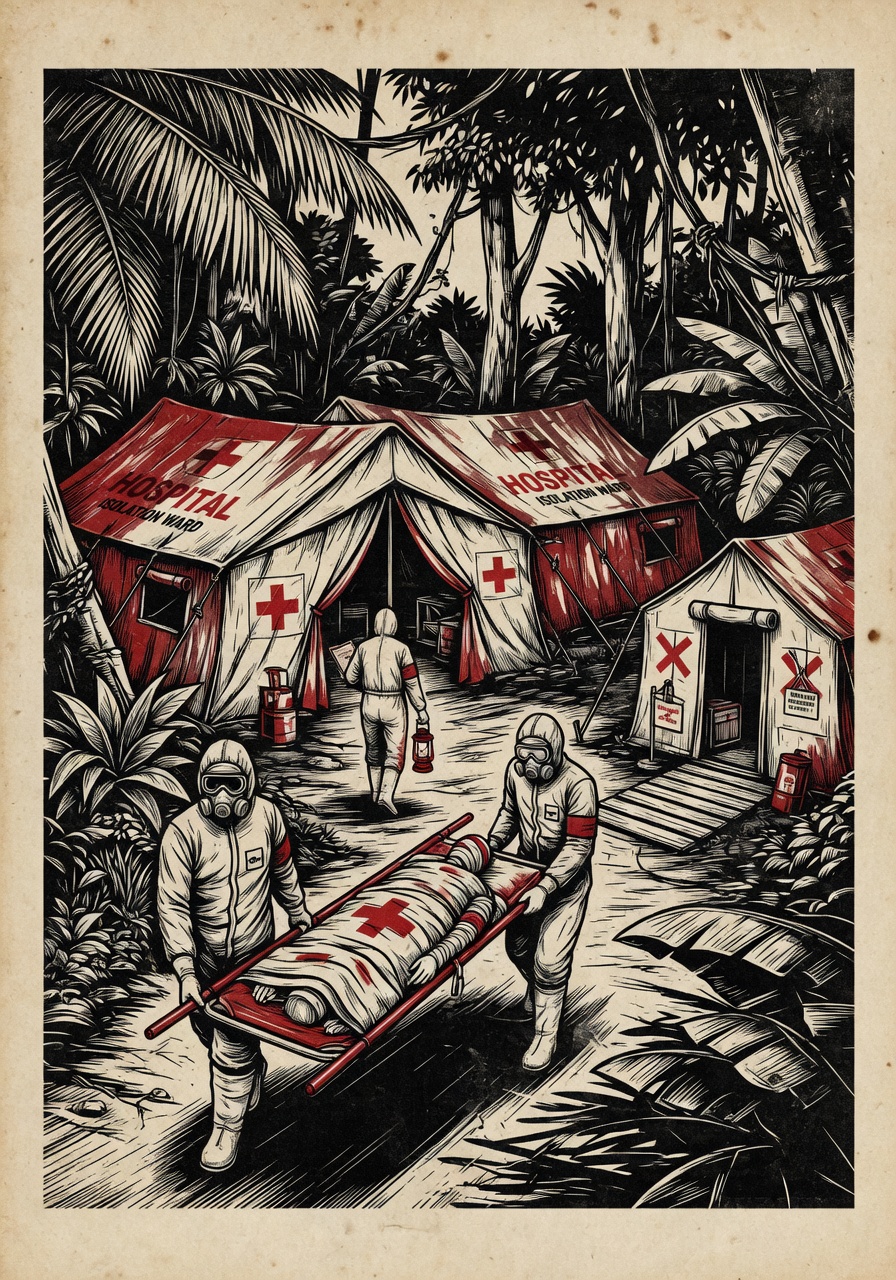
WHO Director-General Tedros Adhanom Ghebreyesus declared the Ebola disease outbreak in the Democratic Republic of the Congo and Uganda a Public Health Emergency of International Concern on May 17, invoking Article 12 of the International Health Regulations after two confirmed cases appeared in Kampala within 24 hours of each other, on May 15 and 16. As of May 17, the DRC had recorded 10 laboratory-confirmed cases, 336 suspected cases, and 88 deaths; Uganda had two confirmed cases, one of them fatal. The virus causing the outbreak is Bundibugyo ebolavirus, a distinct species for which no approved vaccine or specific treatment exists.
The index case, based on the WHO's Disease Outbreak News item for this event, was a health worker in Mongbwalu health zone whose symptoms began on April 24 and who died three days later. WHO was alerted to an unidentified high-mortality illness on May 5. Thirteen samples were analyzed by the Institut National de Recherche Biomédicale on May 14; genomic sequencing identified the virus as Bundibugyo. The DRC formally declared the outbreak on May 15. This is the country's 17th Ebola outbreak since 1976, and the first caused by the Bundibugyo strain since 2012.
What the Bundibugyo strain means for the response
Most public and clinical familiarity with Ebola is built around Zaire ebolavirus, the strain behind the catastrophic 2014 to 2016 West Africa epidemic and the 2018 to 2020 DRC outbreak that killed nearly 2,300 people. Two vaccines, rVSV-ZEBOV (Ervebo) and a two-dose Ad26.ZEBOV/MVA-BN-Filo regimen, offer substantial protection against Zaire. Neither covers Bundibugyo. The DRC health minister Samuel-Roger Kamba stated directly on May 16 that “the Bundibugyo strain has no vaccine, no specific treatment,” and cited a lethality rate that “can reach 50 percent.” The WHO’s outbreak notice gave a comparable range of 25 to 50 percent, based on the two prior Bundibugyo outbreaks: Uganda in 2007 to 2008, and the Democratic Republic of Congo in 2012.
The 2007 to 2008 Uganda outbreak, the first documented occurrence of Bundibugyo ebolavirus in humans, produced 56 laboratory-confirmed cases and a case fatality proportion of 40 percent among cases with acute diagnostic specimens, according to a 2010 paper in Emerging Infectious Diseases by Wamala et al. (CDC, volume 16, issue 12). That figure was notably lower than the 50 to 90 percent case fatality seen in most Zaire outbreaks, though the CDC description of the current outbreak uses the 25 to 50 percent range to account for the broader uncertainty across both prior events. The 2026 figures, with 88 suspected deaths against 336 suspected cases, work out to roughly 26 percent. Suspected-case counts are known to be imprecise during active outbreaks, and the ratio will shift as lab confirmation catches up.
Treatment is limited to supportive care: fluid management, electrolyte replacement, and treatment of secondary infections. The WHO noted that accelerating research into Bundibugyo-specific therapeutics and vaccine candidates is now an explicit priority, though no trials were listed as active at the time of the PHEIC declaration.
Why detection lagged by weeks
The gap between April 24 (symptom onset in the index case) and May 15 (formal outbreak declaration) drew immediate scrutiny from public health specialists. Jennifer Nuzzo, director of the Pandemic Center at Brown University School of Public Health, said publicly that these kinds of outbreaks are typically identified much earlier by health authorities or local reporting networks, and attributed part of the delay to cuts in global health surveillance programs. The WHO's own outbreak notice acknowledged the lag, noting that the first samples tested at the provincial laboratory came back negative for Ebola virus before being forwarded to the national reference laboratory, where PCR and sequencing confirmed Bundibugyo.
The Bundibugyo strain has no vaccine, no specific treatment. — Samuel-Roger Kamba, DRC Health Minister, May 16, 2026
At least four healthcare workers are among the confirmed dead, a pattern the WHO flagged as evidence of nosocomial (healthcare-setting) transmission and one that increases risk to response personnel. As of May 16, 65 contacts had been identified in Ituri Province, 15 of them classified as high-risk. Médecins Sans Frontières had mobilized teams to the affected health zones, and the European Centre for Disease Prevention and Control had deployed experts to support coordination.
Trish Newport of MSF described the pace of case accumulation as “extremely concerning.” The WHO’s PHEIC declaration cited three specific epidemiological features as justification: “rising cases, cross-border spread” into Uganda, and “significant epidemiological uncertainties” about the true geographic scope of the outbreak. The Director-General stated that high sample positivity rates and clusters of unexplained deaths suggest the outbreak is “likely larger than currently detected.”
The international situation and U.S. response
The two confirmed Uganda cases were detected in Kampala, the country's capital and main international transit hub, and had no apparent epidemiological link to each other, according to WHO. That two unconnected cases appeared in the capital on consecutive days drove the PHEIC determination. Uganda had successfully contained an Ebola Sudan outbreak in 2022 using ring vaccination, but that vaccine, too, does not cover Bundibugyo.
The CDC issued a Level 2 travel health notice for the DRC and a Level 1 notice for Uganda on May 17, and announced enhanced screening at U.S. airports for travelers arriving from both countries under a Title 42 health order issued May 18. The agency's statement as of May 17 confirmed no cases in the United States and characterized the risk to the American public as low, noting that Ebola spreads through direct contact with bodily fluids and not through casual contact or the airborne route. WHO explicitly recommended against blanket travel restrictions or trade disruptions, saying the available evidence does not support them.
The current situation is defined by a gap at its center: the two tools that contained recent Zaire ebolavirus outbreaks, Ervebo vaccination and the two-dose Ad26 regimen, are not applicable here. The next steps depend on how quickly candidate Bundibugyo vaccines can move from laboratory work into emergency-use frameworks, and on whether contact-tracing capacity in Ituri Province can keep pace with a case count that has more than doubled in the four days since the WHO outbreak notice was filed. Both are open questions as of May 18.
Sources & methods
- World Health Organization · "Epidemic of Ebola Disease caused by Bundibugyo virus in the Democratic Republic of the Congo and Uganda determined a public health emergency of international concern," May 17, 2026. Archived May 18, 2026
- World Health Organization · Disease Outbreak News, "Ebola disease caused by Bundibugyo virus, Democratic Republic of the Congo & Uganda," May 15, 2026. Contains case counts, timeline, index case, and geographic distribution as of May 15. Archived May 18, 2026
- Centers for Disease Control and Prevention · "Ebola Disease: Current Situation," accessed May 18, 2026. Includes confirmed and suspected case counts and CDC response measures. Archived May 18, 2026
- CDC Newsroom · "CDC Mobilizes International Response Following Ebola Disease Outbreak in DRC and Uganda," May 17, 2026. Archived May 18, 2026
- UN News · "Ebola outbreak in Central Africa declared a Public Health Emergency of International Concern," May 17, 2026. Includes Director-General Tedros Ghebreyesus statement and WHO PHEIC rationale. Archived May 18, 2026
- Al Jazeera · "WHO declares Ebola outbreak in DRC, Uganda a global emergency: What to know," May 17, 2026. Contains direct quotes from DRC Health Minister Samuel-Roger Kamba and MSF's Trish Newport. Archived May 18, 2026
- Wamala JF, et al. "Proportion of Deaths and Clinical Features in Bundibugyo Ebola Virus Infection, Uganda." Emerging Infectious Diseases, December 2010, vol. 16, no. 12. The primary peer-reviewed record for the 2007 to 2008 Bundibugyo outbreak case fatality data. Archived May 18, 2026
Reporting drew on the WHO PHEIC declaration of 2026-05-17; the WHO Disease Outbreak News item 2026-DON602 (filed 2026-05-15); the CDC current situation summary accessed 2026-05-18; the CDC newsroom press release of 2026-05-17; and the UN News report on the PHEIC declaration. The historical case fatality data for the 2007 to 2008 Bundibugyo Uganda outbreak comes from Wamala et al., Emerging Infectious Diseases, December 2010, read in full. Case counts as of 2026-05-17 reflect the CDC situation summary. Quotes from DRC Health Minister Samuel-Roger Kamba and MSF's Trish Newport are drawn from Al Jazeera reporting dated 2026-05-17. Jennifer Nuzzo is identified by her title, director of the Pandemic Center at Brown University School of Public Health; her characterization of surveillance lag is a paraphrase attributed to her public statements and is not a direct quotation in this piece. No anonymous sources were used.