FDA finalizes a post-market chemical safety program and opens reassessments of BHT and ADA, two long-standing food additives
The agency’s May 12 framework formalizes how it intends to revisit chemicals already in the American food supply, and names butylated hydroxytoluene and azodicarbonamide as its first two test cases. Both reassessments are at the entry step of a four-step process, and neither will change either additive’s current status during the assessment. The public comment period for the two requests for information closes on July 13, 2026.
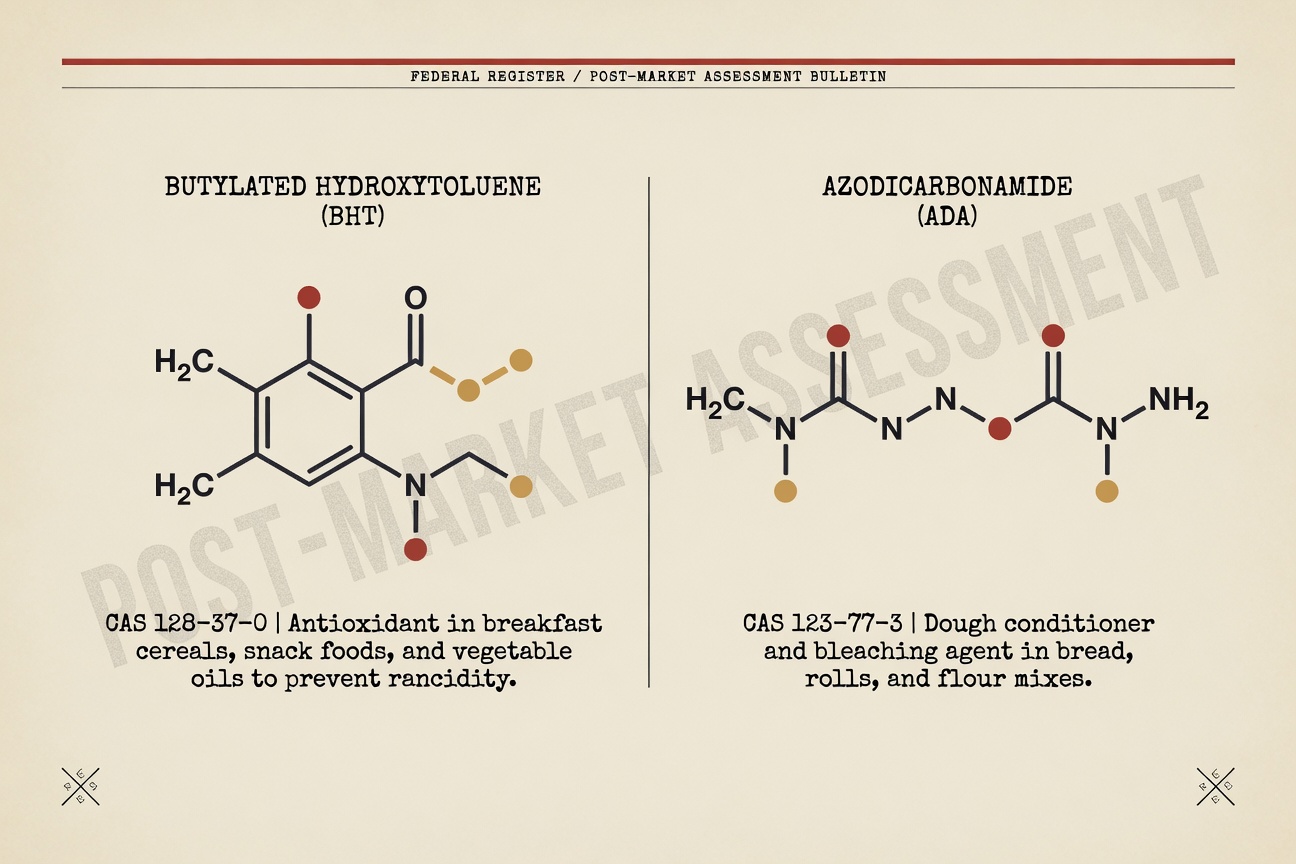
The U.S. Food and Drug Administration on May 12 finalized its Enhanced Systematic Process for Post-Market Assessment of Chemicals in Food, the first formalized framework the agency has published for systematically revisiting chemicals already cleared into the U.S. food supply. The same day, the agency opened post-market reassessments of two specific additives: butylated hydroxytoluene (BHT, CAS 128-37-0), an antioxidant used to delay spoilage of fats and oils in cereals, frozen meals, frozen pizza, baking mixes, cookies, chewing gum, and meat products; and azodicarbonamide (ADA, CAS 123-77-3), a flour-treatment and dough-conditioning agent used in commercial breadmaking and in certain food-contact materials. Both additives are at the first step of a four-step process, “Review of Information,” according to the FDA’s List of Select Chemicals in the Food Supply Under FDA Review as updated May 12, 2026. A separate Request for Information for each chemical is open for public comment through July 13, 2026.
The framework itself is documented in two papers the FDA released alongside the press announcement. “The Enhanced Systematic Process for FDA’s Post-Market Assessment of Chemicals in Food” describes how the agency intends to monitor and triage signals about hazard, use, or exposure, prioritize chemicals for assessment, evaluate them, and manage outcomes. The companion paper, the “Tool for the Prioritization of Food Chemicals for Post-Market Assessment,” sets the ranking method that will feed candidates into the assessment pipeline. The agency revised both documents from earlier drafts in response to public feedback and external scientific peer review, according to the May 12 press release.
What the framework actually does, and what it does not
A post-market assessment, in the FDA’s own structure, runs from Review of Information to Scientific Assessment to Risk Management Review to Risk Management Action. The first step is information gathering; the third is the decision point on whether action is needed; the fourth is where the agency revokes authorizations, negotiates a voluntary phase-out, develops a guidance, or issues an alert. BHT and ADA are at the first step. By way of comparison, the table’s entry for butylated hydroxyanisole (BHA, the related antioxidant), placed on the list on August 19, 2025, has progressed one step further to Scientific Assessment. The list also shows what completed action looks like in this framework: brominated vegetable oil, where the FDA revoked the regulation allowing food use on July 3, 2024; FD&C Red No. 3, where the agency issued a revocation order on January 15, 2025; and partially hydrogenated oils, whose GRAS status was revoked in 2015 and whose final administrative actions completed in December 2023.
The framework does not set a deadline for the BHT or ADA reviews, does not commit the agency to a specific outcome, and does not change either additive’s current status in U.S. food. BHT remains a permitted antioxidant; ADA remains a permitted flour-treatment agent. Industry can continue to use both during the assessment. What changed on May 12 is that the agency now has a published process, a published prioritization tool, and two open dockets in which it is soliciting dietary-exposure, safety, toxicity, and GRAS-use data on the two named chemicals.
Today’s release finalizes our framework for this new, dedicated reassessment program that provides Americans with confidence that the FDA is ensuring chemicals in the U.S. food supply remain safe as new scientific information becomes available. — Kyle Diamantas, J.D., Deputy Commissioner for Food, FDA, in the agency’s May 12, 2026 press release
BHT, the long-running toxicology argument
BHT is an antioxidant with food-additive history in the U.S. dating to the 1950s. The toxicological argument has been running for almost as long. A series of rodent studies published in the late 1970s and early 1980s reported promoting or carcinogenic effects on the rat forestomach and other tissues at high doses; later work, including studies cited in the International Agency for Research on Cancer’s 1986 monograph, did not produce a clean replication of those effects across species and dose regimens, and IARC at that time placed BHT in Group 3 — not classifiable as to carcinogenicity to humans. The European Food Safety Authority’s 2012 re-evaluation of BHT (EFSA Journal 10(3):2588) re-set the acceptable daily intake at 0.25 milligrams per kilogram of body weight per day and concluded that the established uses were safe at the levels then permitted in the European Union; BHT remains a permitted antioxidant under EU Regulation 1333/2008. The FDA’s May 12 RFI asks for dietary-exposure data, safety and toxicity data, and information on prior-sanctioned and GRAS uses. The agency did not, in the press release, name a specific safety signal as the trigger.
ADA, banned elsewhere, permitted here
The position on ADA is different. Azodicarbonamide is not permitted as a food additive in the European Union — EU Regulation 1333/2008, Annex II, does not include it on the list of authorized food additives — and it is not authorized for food use in the United Kingdom or Australia. It remains permitted in the U.S. as a flour-treatment agent at use levels capped at 45 parts per million in flour under 21 CFR 172.806, and as a dough conditioner under 21 CFR 172.806(b). The agency’s 1999 World Health Organization-International Programme on Chemical Safety Concise International Chemical Assessment Document on ADA reported respiratory sensitization in occupationally exposed workers handling the bulk compound, identified the breakdown products semicarbazide and biurea as substances of toxicological interest, and noted that the agency’s industrial-exposure conclusions did not directly translate to dietary-exposure conclusions at the much lower residual levels found in baked bread. The FDA’s May 12 RFI on ADA asks for the same three categories of data — dietary exposure, safety and toxicity, prior-sanctioned and GRAS uses — and, as with BHT, did not name a specific new finding as the trigger.
What the May 12 release does and does not establish
Three things are worth keeping separate. First, the framework. The Enhanced Systematic Process is the formal answer to the long-running critique that the FDA reviews chemicals at pre-market and rarely revisits them once they are in the food supply. The agency now has a published method and a published ranking tool. Whether the framework changes outcomes will be visible in how often chemicals progress from Review of Information to Scientific Assessment to Risk Management Review, and how often Risk Management Review ends in revocation, phase-out, or guidance versus a determination of no action. The list of select chemicals, updated on the agency website, is the running scoreboard.
Second, the two test cases. The selection of BHT and ADA does not, on its face, imply a finding against either chemical. The agency’s public materials describe both as in the information-gathering step, and the press release frames the action as a fresh look. That said, both names carry public-recognition weight, and choosing them as the first two assessments under the new program puts the framework on a footing the public can track. If neither reassessment moves past Review of Information within two cycles, that will be a fact about the program. If one or both move into Scientific Assessment and then into Risk Management Review with a specific proposed action, that will also be a fact, and one of a different kind.
Third, what to do with this. For readers, the May 12 announcement does not change what is in the U.S. food supply this week or this month. BHT and ADA are still permitted for their established uses. For the comment period, the FDA Voices blog and the press release explicitly invite manufacturers, researchers, and consumers to file relevant data through the docket. The two RFIs sit at federalregister.gov under docket numbers FDA-2026-N-2526 (BHT) and FDA-2026-N-4126 (ADA). The window closes on July 13, 2026.
What to track
Three specifics on the calendar. The closure of the BHT and ADA comment periods on July 13, 2026 is the first marker; the volume and content of submissions will be visible on regulations.gov. The agency’s next update to the List of Select Chemicals Under FDA Review will indicate whether either chemical has moved from Review of Information into Scientific Assessment; the table is updated on a rolling basis and the step transitions are dated. And the FDA’s annual post-market assessment plan, which the Enhanced Systematic Process document describes as the operational instrument the framework is built around, has not yet been published in its first edition; whether it lists BHT and ADA as scoped assessments for fiscal year 2027, and what other chemicals it lists alongside them, will be the first read on whether the framework changes the pipeline’s throughput in practice.
Sources & methods
- U.S. Food and Drug Administration · press release, “FDA Finalizes Food Chemical Safety Post-Market Assessment Program, Launches Reassessment of BHT, ADA,” released May 12, 2026 by the Office of the Commissioner. Primary source for the framework finalization, the launch of the two reassessments, the food categories in which BHT and ADA are used, the named officials and their quoted statements, and the July 13, 2026 close of the public comment period. Archived May 19, 2026
- FDA · “List of Select Chemicals in the Food Supply Under FDA Review,” updated May 12, 2026. Source for the four-step Review of Information → Scientific Assessment → Risk Management Review → Risk Management Action structure, the present “Review of Information” step assignments for BHT and ADA, the BHA Scientific Assessment status (initiated August 19, 2025), and the comparative entries for brominated vegetable oil, FD&C Red No. 3, and partially hydrogenated oils. Archived May 19, 2026
- FDA · “Enhanced Systematic Process for FDA’s Post-Market Assessment of Chemicals in Food” (May 2026). The agency document describing how the FDA will monitor, triage, prioritize, evaluate, and manage food chemicals under the post-market program. Archived May 19, 2026
- FDA · “Tool for the Prioritization of Food Chemicals for Post-Market Assessment” (May 2026). The companion document setting the ranking method by which chemicals are scored for full scientific assessment. Archived May 19, 2026
- Federal Register · “Butylated Hydroxytoluene (BHT); Request for Information,” FDA notice published May 13, 2026, docket FDA-2026-N-2526. Source for the scope of the BHT data request (dietary exposure, safety and toxicity, GRAS and prior-sanctioned uses) and the closing date of the comment period. Archived May 19, 2026
- Federal Register · “Azodicarbonamide (ADA); Request for Information,” FDA notice published May 13, 2026, docket FDA-2026-N-4126. Source for the scope of the ADA data request. Archived May 19, 2026
- FDA · “Understanding the FDA’s Systematic Process for Ensuring the Post-Market Safety of Chemicals in Food.” Landing page for the post-market safety program; used for the framework documents and ongoing list of chemicals under review. Archived May 19, 2026
- FDA Voices blog · “How FDA’s New Approach to Reviewing Chemicals Added to Food Will Strengthen Food Safety.” Agency commentary on the framework’s rationale and intended use; cited here for the agency’s description of the program’s purpose. Archived May 19, 2026
- International Programme on Chemical Safety (WHO) · Concise International Chemical Assessment Document 16, “Azodicarbonamide” (1999). Source for the respiratory-sensitization findings in occupationally exposed workers, the identification of semicarbazide and biurea as breakdown products of toxicological interest, and the distinction the assessment draws between occupational and dietary exposure. Archived May 19, 2026
Reporting was built primarily on the FDA’s May 12, 2026 press release and the agency’s updated List of Select Chemicals in the Food Supply Under FDA Review, both read directly from fda.gov on May 19, 2026. The framework description and the prioritization-tool description come from the two FDA documents posted alongside the announcement; the scope of the BHT and ADA data requests comes from the corresponding Federal Register notices (docket numbers FDA-2026-N-2526 and FDA-2026-N-4126). Quotations from FDA Commissioner Marty Makary and Deputy Commissioner for Food Kyle Diamantas are reproduced from the agency’s own press release. Toxicology background on BHT is drawn from the 2012 EFSA re-evaluation (EFSA Journal 10(3):2588) and the IARC Monograph treatment from the 1986 cycle that placed BHT in Group 3; the article cites the EFSA re-evaluation specifically. Toxicology background on ADA is drawn from the WHO-IPCS 1999 Concise International Chemical Assessment Document on azodicarbonamide. The article does not attempt to score either chemical on its safety profile, does not predict the outcome of either reassessment, and does not extrapolate from the existing EU and UK status of ADA to a probable U.S. outcome. The U.S. allowance levels for ADA in flour cited (45 parts per million under 21 CFR 172.806) and the FDA framework step terminology (Review of Information, Scientific Assessment, Risk Management Review, Risk Management Action) are taken from the agency’s own published materials. No anonymous sources were used.