Bavarian oaks delayed budburst by three days after a 2019 moth outbreak, satellite study finds
A Sentinel-1 radar analysis of 60 forest sites across Northern Bavaria, published this month in Nature Ecology & Evolution, links heavy 2019 caterpillar defoliation to a measurable lag in 2020 leaf emergence and a 55 percent reduction in subsequent leaf damage. The result is geographically narrow and methodologically novel; what it implies for warmer springs is still open.
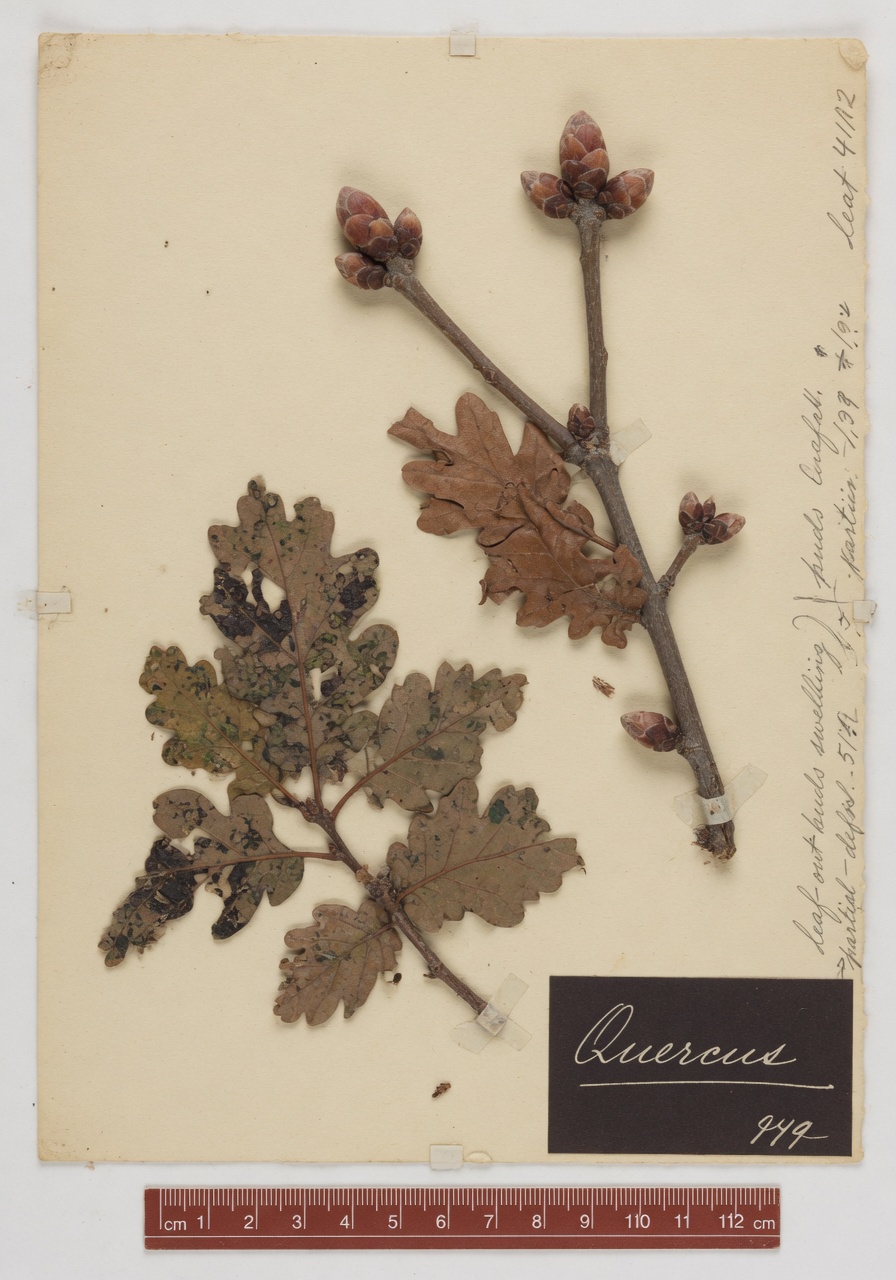
Oak trees in 60 forest sites across Northern Bavaria that were heavily defoliated by caterpillars in 2019 opened their buds, on average, three days later the following spring than oaks in the same region that had come through the outbreak largely unscathed, according to a study published this month in Nature Ecology & Evolution. The lag is small in absolute terms and confined to a single 2,400-square-kilometer landscape over five years of satellite observation. Within that window, the authors report, the delay was associated with a 55 percent reduction in leaf damage the next year.
The paper, “Satellite data show trees delay budburst across landscapes to escape herbivores” (DOI 10.1038/s41559-026-03071-9), is led by Soumen Mallick, a postdoctoral researcher at the University of Würzburg’s Biocentre, with Jörg Müller of Würzburg’s Chair of Conservation Biology and Forest Ecology and Andreas Prinzing of the University of Rennes as co-senior authors. It was published online in early May 2026.
What the satellites measured, and what they did not
The dataset is the unusual part. The team analyzed Sentinel-1 C-band radar imagery from the European Space Agency’s Copernicus programme over a 2,400-square-kilometer area in Northern Bavaria between 2017 and 2021. Sentinel-1 sees through cloud cover, which optical sensors do not, and resolves the landscape at roughly 10 by 10 meters per pixel, close to the crown of a single mature oak. The authors report 137,500 individual observations across 60 forest sites, with 27,500 pixels analyzed. The 2019 gypsy moth (Lymantria dispar) outbreak in the region produced the natural experiment: heavily defoliated stands one year, the same stands tracked through bud break the next.
What the radar measured was canopy condition through time, including the moment in spring when bare branches begin to register as leafed canopy. What it did not measure is the physiological mechanism inside the tree. The paper documents the pattern at landscape scale; it does not isolate which signal (hormonal, nutritional, mycorrhizal) carries information about last year’s defoliation forward to next year’s phenology. That is the next question, not this paper’s answer.
Two further scope notes belong with the result. First, the geography is one regional landscape in Central Europe, dominated by temperate oak forest under a continental climate; whether the same response shows up in Mediterranean Quercus, North American Quercus rubra and Quercus alba, or tropical congeners is not addressed by these data. Second, the herbivore in 2019 was specifically the gypsy moth, a spring-feeding lepidopteran whose larvae depend on tender young leaves. A late-summer defoliator, or a sap-sucking insect, would not necessarily produce the same pattern.
The chemistry-versus-timing argument
Plant defense against insect herbivores has, for decades, been read primarily through chemistry: tannins, terpenes, alkaloids, the bitter and sometimes toxic compounds that make leaves harder to eat. The Würzburg group’s argument is not that chemistry is unimportant but that phenological timing, in oaks at this site, is doing work the chemistry literature has tended to attribute elsewhere. “The delaying tactic is more effective for the oak than a chemical defence, such as bitter tannins in the leaves,” Mallick said in a statement issued by the University of Würzburg. The effect size the paper reports, a 55 percent reduction in leaf damage following a three-day delay, is the basis for that claim.
The delaying tactic is more effective for the oak than a chemical defence, such as bitter tannins in the leaves. — Soumen Mallick, postdoctoral researcher, University of Würzburg Biocentre
The mechanism the authors propose is straightforward in outline. Gypsy moth caterpillars hatch from overwintered eggs on a schedule cued to spring temperature. If the oak’s leaves are not yet open when the larvae emerge, the youngest, most vulnerable caterpillars have nothing edible at hand and starve before the tree leafs out. A three-day mismatch is plenty, the authors argue, to cause a population crash in the cohort that would otherwise have inflicted the next round of defoliation.
Why the climate framing matters, and why it is not yet a climate result
The temptation, with a phenology paper in 2026, is to extrapolate to warming springs. Rising mean April temperatures across temperate Europe have pushed oak budburst earlier over recent decades; that trend is documented in long-running phenological networks, and it is not in dispute. What this paper adds is a second axis. If oaks can delay budburst by a few days in response to last year’s herbivore pressure, then the timing of bud break in any given spring is set by at least two signals, temperature and the memory of last year’s defoliation, pulling in opposite directions. Co-senior author Andreas Prinzing, of the University of Rennes, described the result, in the Würzburg statement, as “an example of the forest’s high resilience and adaptability in a changing world.”
That framing should be read carefully. The paper does not project how the temperature signal and the herbivore-memory signal will trade off under future warming scenarios; it does not model whether a three-day delay will remain a meaningful defense if mean spring temperatures rise enough to advance caterpillar hatch by a week or more; and it does not extend its findings outside the Bavarian forests it observed. The five years of Sentinel-1 data establish that the response exists at landscape scale at this site over this interval. They do not establish how it will hold up by mid-century, and the authors do not claim they do.
What replication will need
Three pieces of follow-up work would change how confidently this result generalizes. The first is replication in a different oak system, a North American Quercus stand under a different climate, exposed to a different defoliating lepidopteran, using the same Sentinel-1 method. The second is a mechanistic study that opens the tree: tissue sampling across the dormant season to identify which biochemical signal carries the prior-year defoliation memory into next spring’s bud development. The third is a longer time series. Five years includes one major outbreak; understanding whether the delay scales with outbreak severity, or saturates, will take a decade or more of continuous observation.
Until those pieces arrive, the careful read is the one the data support: in a Bavarian oak landscape over five years, heavily defoliated stands leafed out three days later the next spring, and that small lag was associated with substantially less damage in the following season. The result is real, the dataset is large, and the scope is narrow. All three of those statements are true at once.
Sources & methods
- Mallick S, Müller J, Prinzing A, et al. “Satellite data show trees delay budburst across landscapes to escape herbivores.” Nature Ecology & Evolution, published online early May 2026. DOI 10.1038/s41559-026-03071-9. Archived May 16, 2026
- Nature Ecology & Evolution · News & Views companion piece, “Timing matters for plants and their herbivores,” published alongside the Mallick et al. paper in early May 2026. Archived May 16, 2026
- University of Würzburg · press release, “How oak trees outwit their predators,” May 2026. Source of the direct quotations from Soumen Mallick, Jörg Müller, and Andreas Prinzing. Archived May 16, 2026
- European Space Agency · Copernicus programme reference page for the Sentinel-1 C-band synthetic aperture radar mission, the satellite source for the canopy observations used in the study. Archived May 16, 2026
- Phys.org · summary coverage of the Würzburg release, used to corroborate quoted material and the gypsy moth (Lymantria dispar) outbreak context for 2019 in Northern Bavaria.
Reporting is based on the Mallick et al. paper in Nature Ecology & Evolution, read in full where the publisher allowed open access at the time of writing, and on the University of Würzburg press release issued in early May 2026, which contains the direct quotations attributed to Soumen Mallick, Jörg Müller, and Andreas Prinzing. The companion News & Views piece in the same issue of Nature Ecology & Evolution was consulted for the framing of timing-versus-chemistry plant defense. Sentinel-1 mission parameters were checked against the European Space Agency Copernicus reference page. The phys.org summary was used only to corroborate the gypsy moth outbreak context and the quoted material. The article does not extrapolate the result beyond the 2,400-square-kilometer Bavarian study area, the five-year 2017–2021 observation window, or the temperate-European oak system the authors observed; the limits of replication, mechanism, and longer time series are named explicitly in the body. No anonymous sources were used.