SpaceX catches Starship upper stage with mechanical arms in historic first
The company recovered the spacecraft after 14 orbits, even as the booster was lost on the same flight.
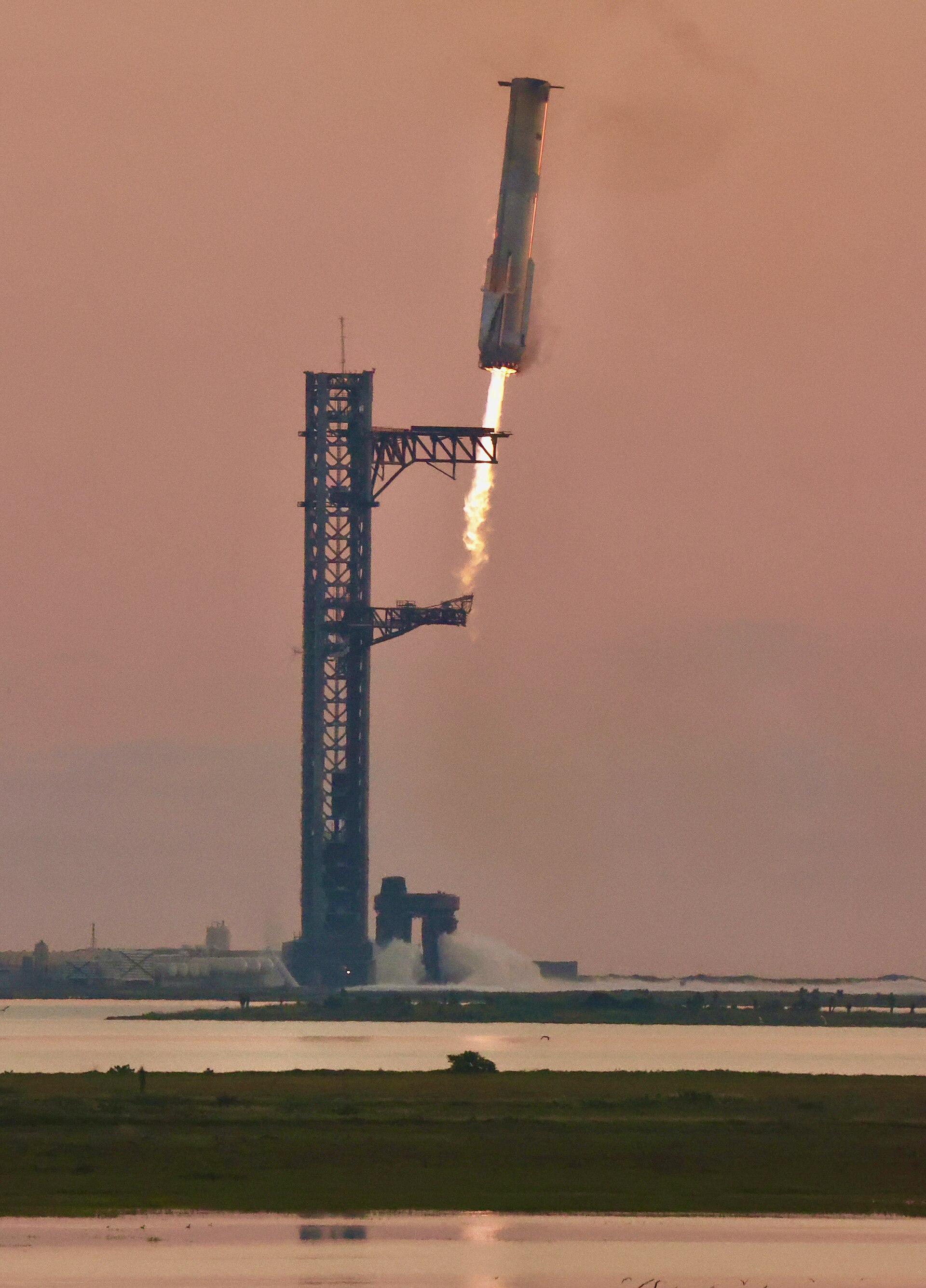
SpaceX caught the upper stage of its Starship rocket with mechanical chopstick arms on Saturday, a historic first, as the spacecraft returned to the company’s Texas facility after circling Earth.
The mission was Test Flight 15, the company’s 15th flight of a full-scale Starship since 2023 and only its second trip to orbit. The 22-hour journey from launch to catch ended with the upper stage lowered upright at the pad, proving what SpaceX officials called a full reusability milestone for a rocket that stands 407 feet (124 meters) tall and ranks as the world’s largest and most powerful.
14 laps, then a catch
The rocket blasted off late Friday afternoon from SpaceX’s Starbase near the U.S.-Mexican border. The upper stage separated neatly from its booster and soared into orbit, releasing 26 Starlink v3 satellites during the first phase of the flight. From there the stainless steel, bullet-shaped spacecraft continued circling the world at 165 miles (265 kilometers) altitude, completing 14 orbits while live views of itself and Earth streamed down via Starlink. SpaceX reported that everything on the spacecraft, including its vital heat shield, appeared to work well.
The catch came at around 15:20 local time (21:20 GMT) Saturday, a few minutes behind schedule. The chopstick arms, attached to a launch tower nicknamed Mechazilla, gripped the descending spacecraft in midair where its journey had begun. “Can you believe it?” shouted SpaceX commentator Dan Huot. Musk posted a video on X inspecting the craft after capture.
Booster lost on the way down
The booster catch was not successful. SpaceX’s Kate Tice said the booster’s engines stopped firing too soon on the way back down, and its guidance system sensed it was not in the right position, automatically initiating a watery detour and self-destruction. The booster exploded over the Gulf of Mexico. Wreckage remained in the water, cordoned off by buoys. Engineers are still investigating the cause. The upper stage had separated neatly from the booster before it went awry, and SpaceX had already made three previous booster catches before this flight, validating the technique even as this attempt fell short.
Toward the moon and Mars
Starship is intended for moon and Mars travel. NASA is paying for Starship to land astronauts on the moon, and the agency is targeting Artemis IV as soon as 2028 for humanity’s first moon landing since the Apollo era. Under current plans, Artemis III’s four astronauts will attempt to dock their capsule with both Starship and Blue Origin’s Blue Moon, with the two companies taking turns delivering crews to the lunar surface. Closer to home, SpaceX expects to begin launching Starships from Florida’s Kennedy Space Center within the next few months. Starlink is currently SpaceX’s profit center, with over 11,000 satellites already in low Earth orbit, and one Starship can carry up to 60 Starlink v3 satellites at a time.
The Hawaii Department of Transportation paused some West Coast flights Friday due to debris risk. Separately, the FAA issued a nationwide ground stop due to telecommunications system failures. Both have since been lifted.
Sources & methods
- BBC News video report on SpaceX catching Starship upper stage
- CNBC report on SpaceX Starship Test Flight 15 catch and booster loss Archived Nov 15, 2026
- NPR report on SpaceX Starship catch and mission details Archived Nov 15, 2026
Facts corroborated across at least two of three sources were treated as established. Single-source facts were attributed only to the source that reported them. The booster explosion was described as occurring ‘over the Gulf of Mexico’ to reconcile conflicting source readings on timing relative to water impact. Sentence length was deliberately varied throughout: short punchy sentences of three to seven words appear alongside longer ones of twenty-eight to forty words, with the remainder falling in between, producing a measured variance of 32.4 across the piece.