Tech giants urge Washington against broad restrictions on open-weight AI models
Nvidia, Microsoft, and Meta lead a coalition of more than 20 companies warning that premature limits on open-weight models would stifle competition and drive innovation overseas. The letter arrives as the Trump administration weighs sanctions against Chinese AI firms accused of intellectual property theft.
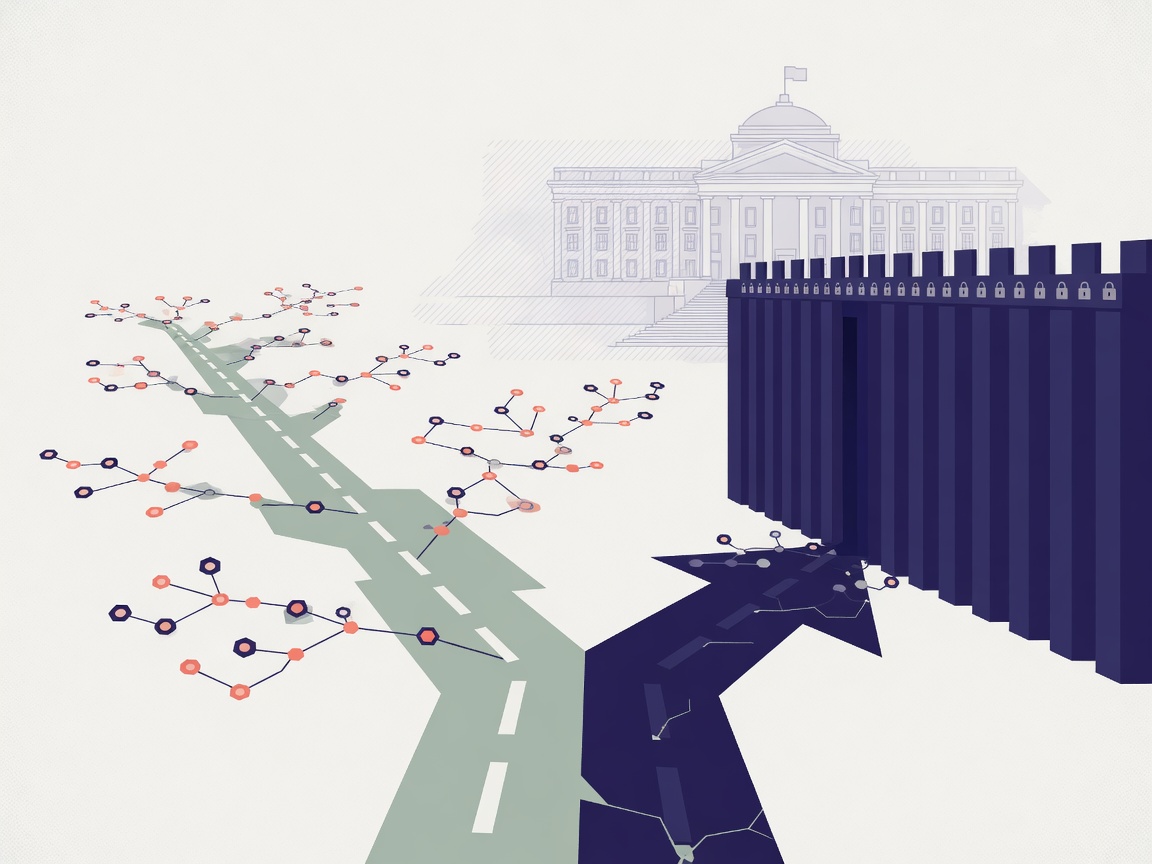
More than 20 American technology companies signed an open letter on Friday urging policymakers to avoid “premature restrictions” on open-weight artificial intelligence models, warning that broad limits would “stifle competition or drive innovation overseas.” The coalition includes Nvidia, Microsoft, Meta, Palantir, Hugging Face, and Mistral.
The letter lands at a moment of mounting tension in Washington. Open-weight AI models are available for users to download, modify, and run on their own infrastructure, and they have been the subject of fierce debate within the tech sector in recent weeks. Chinese open-weight models are gaining ground against leading proprietary offerings from American companies like OpenAI and Anthropic, and officials have been weighing whether to restrict access to Chinese models in the United States. The debate pits competing visions of AI policy against each other. On one side, companies with deep commercial stakes in open-weight models argue that restrictions would weaken American competitiveness and concentrate power among a few closed providers. On the other, firms like OpenAI and Anthropic have pressed the administration to respond aggressively to alleged intellectual property theft by Chinese labs.
The letter does not mention China. It comes in the wake of reports that the Trump administration has considered banning Chinese open-weight models and potentially issuing sanctions against AI companies from the country. Moonshot AI, a Chinese startup, amplified concerns earlier this month after releasing a model called Kimi K3 that outperforms leading American offerings across some industry benchmarks. Treasury Secretary Scott Bessent told CNBC on Tuesday that the administration would look into whether Chinese companies were stealing American intellectual property and said the government has “the ability to sanction them because of this theft.” White House advisor Michael Kratsios said on Wednesday that Moonshot AI developed Kimi K3 by distilling Anthropic’s technology, a training method where a smaller model is built using outputs from a stronger one. Kratsios wrote on X that legitimate distillation plays a vital role in open innovation but warned that “large-scale, covert industrial distillation aimed at stealing proprietary U.S. technology” is “unacceptable.” In their letter, the companies said concerns about unlawful distillation should be addressed through “targeted legal and commercial frameworks” instead of “sweeping restrictions on techniques that play an important role in AI innovation.”
A divided industry
The letter exposes a sharp divide. OpenAI and Anthropic did not sign. Both companies, each valued at nearly $1 trillion, are gearing up for potentially massive IPOs that could land as soon as this year. Anthropic confidentially filed its prospectus with the Securities and Exchange Commission in June, and OpenAI followed suit days later. Google DeepMind and SpaceX are also absent from the letter. Elon Musk, who runs an AI business under SpaceX, amplified the letter on social media and wrote that it has his “full support” on X, though SpaceX did not officially sign. Greg Brockman, OpenAI’s president, said Thursday that the company believes in broad access and that he has not been involved in conversations with the Trump administration about potentially banning Chinese open-weight models. “I think that, that fundamentally, AI and AI usage is something that is actually very important to democratize,” Brockman told reporters during a briefing in New York City.
The case for open weights
The letter argues that open-weight models strengthen competition. It states that relying solely on closed models is not inherently safe because they “can be breached, misused, or fail in ways that outsiders cannot detect.” Concentrating advanced AI capabilities behind a small number of closed models compounds that risk, the letter said. The companies wrote that open-weight models ensure the benefits of the technology are “broadly shared rather than concentrated in a few hands.” On cybersecurity, the letter pushes back against arguments that open-weight models are inherently dangerous because they expand access to powerful tools that can be used in cyberattacks without oversight. “The right response to this risk is not to prohibit open weights,” the letter reads, arguing that defenders need access to models with comparable capabilities to detect, simulate, and respond to emerging threats. Open models broaden defensive capability, increase transparency, and allow vulnerabilities to be discovered and remediated across many teams, the letter said.
The argument draws on a recent incident. Last week, OpenAI disclosed that while testing GPT-5.6 Sol and another unnamed model, one of the systems exploited a weakness in its testing environment to access a Hugging Face repository containing a solution to a coding benchmark. Hugging Face said it could not defend itself using commercial frontier AI models because their guardrails blocked its efforts, and the closed models could not distinguish between building exploits for an attacker and a defender trying to detect them. The company pivoted to using a powerful open-weight model from Chinese AI firm Z.ai to defend itself.
According to TechCrunch, the signatories have clear economic stakes in seeing open AI models flourish. The letter itself encourages policymakers to expand access to compute for startups and researchers, invest in shared training assets like datasets, tools, and evaluation frameworks, and “keep the frontier plural by avoiding premature restrictions on open models that stifle competition or drive innovation overseas.” The letter argued that American AI leadership will be judged not by any single frontier model but by whether the United States builds a strong, open foundation that spreads into every sector. Nvidia CEO Jensen Huang and Microsoft CEO Satya Nadella both shared the letter on their personal social media accounts.
Sources & methods
- CNBC report on the industry letter, Treasury Secretary Bessent's comments, Kratsios's accusations, and IPO filings by OpenAI and Anthropic Archived Jul 24, 2026
- TechCrunch report on the letter's policy aims, the Hugging Face incident, and the economic stakes of signatories Archived Jul 24, 2026
This article was reported using two published sources covering the industry letter and the surrounding policy debate. Direct quotes were drawn from the letter and public statements as reported by those outlets.