Uber launches London’s first commercial robotaxi service, beating Waymo to a milestone market
The ride-hailing company paired with UK startup Wayve to deploy 15 autonomous Ford Mustangs with safety drivers. Londoners can now hail a self-driving taxi through the Uber app, though the initial fleet is tiny.
Uber has launched London’s first commercial robotaxi service. The company paired with UK startup Wayve to deploy 15 autonomous Ford Mustangs across the capital, each carrying a licensed human safety driver ready to take the wheel if anything goes wrong. Londoners can indicate a preference for self-driving rides in the Uber app, though the chances of actually landing one remain slim given the tiny initial fleet operating across a city with more than 100,000 private hire cars.
The launch is a milestone for Uber, which has been plotting a UK deployment with Wayve for several years and now beats Waymo to a market seen as crucial for wider European expansion. Waymo, owned by Google’s Alphabet, has been mapping London’s streets for months with safety drivers and staff aboard, but has not yet opened its service to the public. The firm says it does not intend to introduce a service that includes a human at the wheel.
Each ride costs the same as a standard UberX, Uber Electric, or Uber Comfort journey, with upfront fares shown in the app. The self-driving option only appears after a customer books a trip, and only if one of the autonomous vehicles is available nearby. More than 100,000 London-based customers told Uber in a survey they would choose a self-driving taxi if one were available.
How the technology works
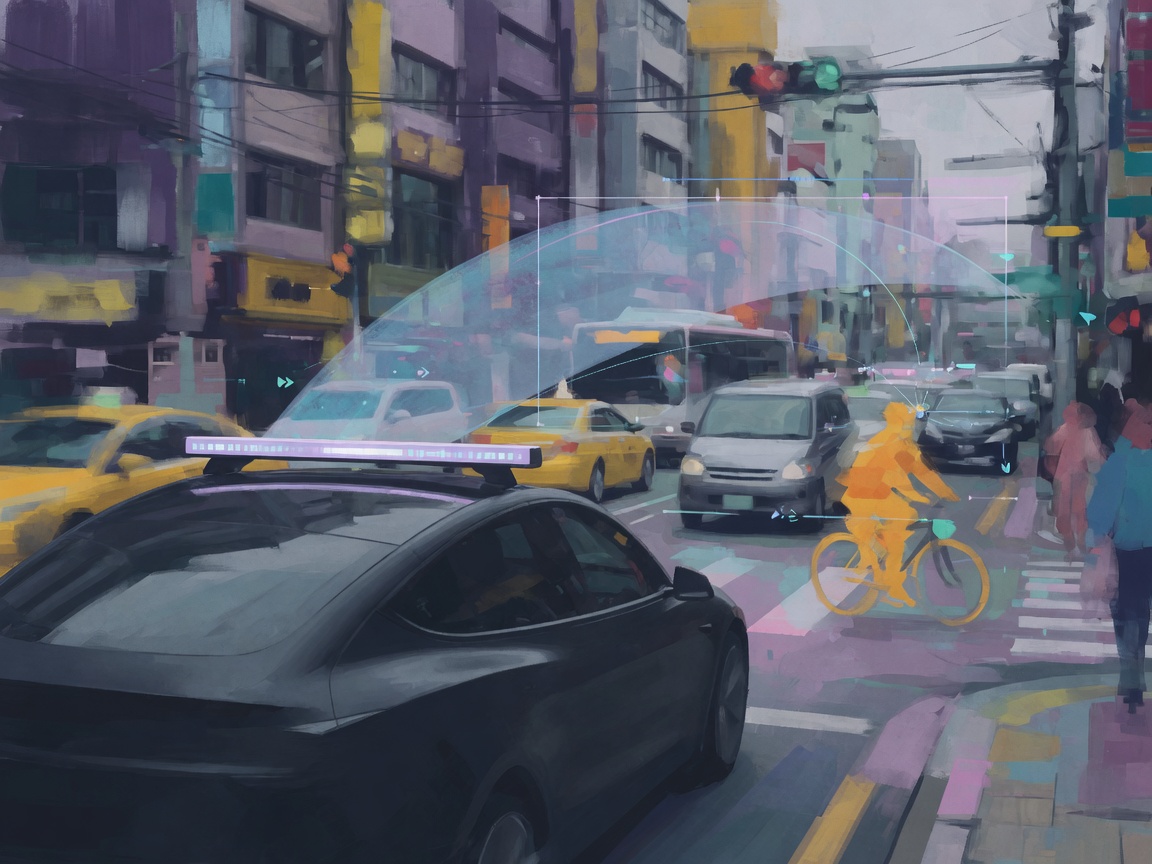
Wayve’s system differs sharply from its rivals. The vehicles carry cameras and radar but no lidar, the laser sensor that Waymo and many other robotaxi operators rely on, putting Wayve in a similar camp to Tesla. There is no geofence confining the cars to a virtual boundary, and no HD maps pre-programming routes. Instead, Wayve’s AV2.0 system uses a single learned AI driver trained to understand the world, anticipate risk, and adapt to new environments in real time, with sensors mounted in a bar on the roof and elsewhere on the vehicle. The cars are not pre-programmed; their actions are determined on the spot depending on what is happening around them.
Wayve, founded in 2017 by a pair of machine learning PhD students from the University of Cambridge, says its system can learn on the go, adapting to new roads, weather, and driving scenarios much like a human driver. Earlier this year, the startup raised $1.2 billion from Uber, Nvidia, Stellantis, Nissan, and Mercedes-Benz.
A measured rollout
A BBC journalist became the first British reporter to hail a self-driving Uber through the app. The safety driver gave a 30-second briefing. For several minutes, the car negotiated central London traffic without incident, passing a demonstration outside Parliament and handling traffic lights and roadworks. When a cyclist waved the car forward at a mini roundabout, it complied. But at one point the safety driver took control: as the car pulled off on a narrow side road, the back doors of a parked van appeared to swing open, triggering a sharp brake and an internal alarm. Wayve later said the driver chose to intervene and that the AI system would have handled the situation.
A Guardian test drive in Westminster passed without intervention. Alex Kendall, Wayve’s chief executive and co-founder, said he was proud to introduce the company’s AI Driver technology to the public for the first time in London, calling it “our home city and one of the most complex driving environments in the world.” He described the technology as “still maturing” but said fully driverless services would come, declining to predict exactly when. “I don’t want to put a timeline on it, but we’re pushing as fast as we can,” he said.
Regulators are in no rush. The Department for Transport said it is working toward a framework for self-driving cars on UK roads by 2027, without giving a specific date. Transport for London, which licensed Uber and Wayve’s modified Ford Mustangs as private hire vehicles last month, requires a safety driver to supervise. Approval for fully autonomous operations without a safety driver must come through a separate government process under the Driver and Vehicle Standards Agency, and is seen as unlikely this year.
Christina Calderator, director of transport strategy and policy at TfL, said the authority was “not holding up any decision” but was “taking time to get it right.” “This is something that’s new, it’s coming to London, we need to make sure it’s safe,” she said. Transport Secretary Heidi Alexander called the launch “a major milestone for the future of transport in London” and said British innovation was helping drive investment and growth.
David McMullen, a senior organiser at the GMB union, said caution was needed. “With hundreds of thousands of people employed to drive every day, we need to be really careful with the rollout of driverless cars unless we are prepared to see unprecedented levels of social and economic disruption,” he said. He called on TfL and the government to develop a plan that protects drivers, calling it “premature” to move to driverless services without one.
Uber maintains that human drivers and autonomous vehicles will coexist. Sarfraz Maredia, Uber’s global head of autonomous mobility and delivery, said Uber always wants consumers to be able to request either a human ride or an autonomous vehicle. Because the market is growing, he expects human drivers to remain on Uber London for a long time. Uber has been lobbying for a hybrid network, a vision that clashes with Waymo’s goal of a driver-free, rider-only system. The company has partnered with multiple AV companies including Zoox, Avride, Nuro, Motional, Waabi, and Wayve.
Wayve plans to move to scalable manufacturer-produced vehicles, specifically new Nissan Leaf robotaxis with its technology, and needs to validate safety metrics on that platform before securing regulatory approval for fully driverless operations. Uber partnered earlier this summer on Europe’s first commercial robotaxi service in Zagreb, Croatia, also with a human driver onboard. Lyft is working with Baidu on its own robotaxi service in London, starting in the neighborhood of Brent. Waymo has said it will launch its robotaxis in London before the end of the year.
Sources & methods
- BBC News report on Uber's UK robotaxi launch, including a first-person ride account, regulatory context, and union concerns Archived Sep 3, 2026
- The Guardian report on London's first self-driving taxis for hire, with quotes from Wayve CEO Alex Kendall, Uber's Sarfraz Maredia, Transport Secretary Heidi Alexander, and GMB union Archived Sep 3, 2026
- The Verge report on Uber beating Waymo to launch robotaxis in London, with technical details on Wayve's AV2.0 system, funding history, and competitive landscape Archived Sep 3, 2026
This article was assembled from three published reports covering the September 2026 launch: BBC News, The Guardian, and The Verge. Quotes were drawn directly from source texts, and technical and regulatory details were cross-referenced across all three outlets.