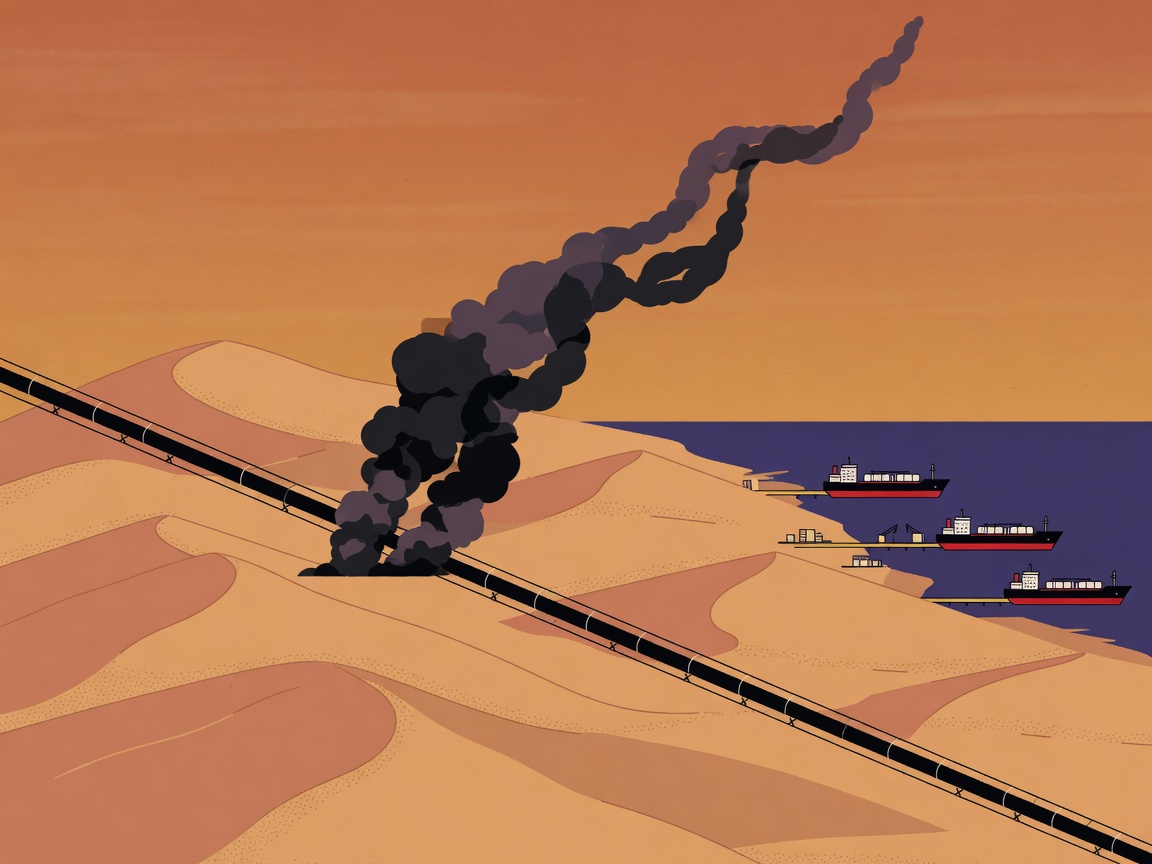
Drone strikes on Saudi Arabia’s East-West oil pipeline have forced a precautionary shutdown of a 1,200-kilometer conduit carrying up to five percent of global crude supply. Brent crude surged above $108 a barrel. The attacks deepen a crisis that has gripped energy markets since the US-Israel war on Iran began in February.
Saudi Arabia’s Ministry of Energy called the closure a precautionary measure after drones hit the pipeline in two areas around Riyadh and Medina, causing injuries and damage to infrastructure. Saudi authorities traced the launches to Maysan province in southeastern Iraq, near the Iranian border, an area where Iran-aligned armed groups have maintained a longstanding presence. Sources familiar with the incident told Reuters that repairs could take five to six weeks, though another source said operations could restart sooner. The extent of the damage remains unclear.
The closure sent oil prices surging. Brent crude futures for November expiry rose 3.3 percent to $108.02 per barrel on Monday morning, extending gains after jumping more than 20 percent over the past month. The international benchmark later climbed to more than $108.5 a barrel. U.S. West Texas Intermediate futures for October expiry traded nearly three percent higher at $102.98, surpassing $100 for the first time since May.
A critical bypass under pressure
The East-West pipeline, also known as the Petroline, was built in 1981 to carry crude from Saudi Arabia’s eastern oil fields near Abqaiq across the Arabian Peninsula to the Red Sea port of Yanbu, bypassing the Strait of Hormuz. It has a maximum capacity of seven million barrels per day. During the first five months of the conflict, Saudi Arabia increased crude sent west to roughly four to five million barrels per day. That represents about four to five percent of global supply and allowed the world’s second largest oil exporter to bypass the strait when shipping conditions deteriorated.
Actual flows had already been declining. Kpler data showed about two million barrels per day in August, the lowest monthly level since January, as Houthi attacks made the Red Sea route difficult to use. Riyadh told the OPEC oil cartel that its crude production in August was at its lowest level since 1990, according to Bloomberg.
Before the war, the Strait of Hormuz supplied more than a fifth of global oil at roughly 20 million barrels per day. Industry estimates cited by Reuters now put the flow at about six to nine million barrels per day, a dramatic reduction. The strait has largely been closed since February. Gulf states postponed a meeting with Tehran to discuss creating a temporary shipping lane through the waterway, further fueling Monday’s price spike.
Houthi advances widen the threat
Yemen’s Iran-backed Houthis have ramped up attacks on Saudi targets and launched a ground offensive toward the Bab al-Mandeb Strait. On Sunday, Houthi forces captured the strategic island of Perim in the strait, expanding their control of the waterway. CNBC reported concerns that the advance could have significant ramifications for energy markets and global trade, particularly if the group escalates threats against Red Sea shipping.
The pipeline strike follows an attack in March near the Saudi-Aramco-ExxonMobil refinery in Yanbu that temporarily disrupted crude loadings from the Red Sea port. That incident had little lasting impact. Shipments recovered within days. But it demonstrated that the kingdom’s western oil infrastructure was not immune to attacks. Gavekal Research, as cited by Al Jazeera, warned that if Yanbu, which processes more than one million barrels per day, goes offline because of Houthi drone threats, it would be a disaster for the world at a time when global refining capacity is already critically tight.
The fallout extended beyond oil. UK gas prices rose five percent to 208.73 pence a therm, the highest level since December 2022. Government borrowing costs climbed on both sides of the Atlantic, with 10-year U.S. government debt yields rising from four percent to almost five percent over the past year and 30-year UK government yields reaching their highest level since March 1998. Investors await interest rate decisions from the Federal Reserve on Wednesday and the Bank of England on Thursday, after the European Central Bank raised borrowing costs last week.
Saudi Arabia has limited buffer. Sources told Reuters that Yanbu holds enough stocks to sustain exports for about five to seven days, while Egyptian facilities in Ain Sukhna and Sidi Kerir, which store Saudi oil, could provide additional supplies for several days. Traders in the kingdom have warned it will run out of oil stocks for export if it does not reopen the pipeline within days.
Oil prices have been cushioned by stockpiles and strategic reserve releases. The benchmark soared from its prewar level of about $72 a barrel to peak at $126 in April before falling back over the summer amid ceasefire hopes. Prices resumed their climb after a memorandum of understanding between the U.S. and Iran fell apart. Chris Beauchamp of broker IG said a “move back to the spring highs” looked increasingly likely, noting that oil markets face their worst fears all at once.