Twenty thousand seafarers wait in the Gulf as Washington, Tehran, Manila and New Delhi argue past each other
Three weeks after a brokered ceasefire, the Strait of Hormuz is still closed to most commercial traffic, and the diplomacy is being conducted over the heads of the crews trapped inside it.
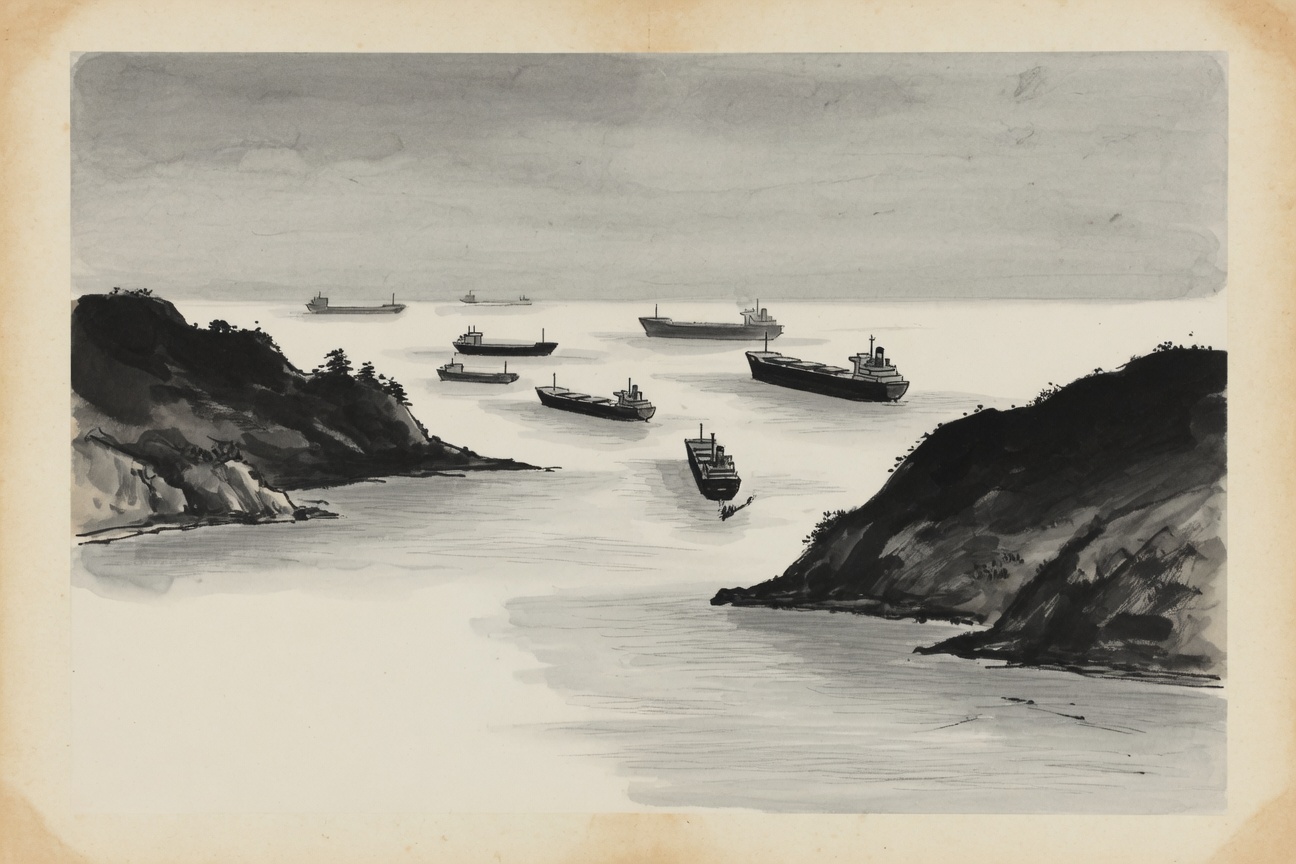
The Strait of Hormuz reopened on paper on April 8, when a Pakistan-brokered ceasefire between the United States, Israel and Iran included a clause guaranteeing safe passage through the waterway. It has not reopened in practice. As of this week, the International Transport Workers’ Federation puts the count at roughly 20,000 civilian seafarers stranded aboard about 2,000 vessels in and around the Persian Gulf, with food, potable water and replacement crews running short. The diplomacy over their fate is being conducted by Washington, Tehran, Manila and New Delhi, and so far, the four capitals are arguing past one another, not closing on a plan.
Why this is a U.S. story, even before any U.S. ship moves
Roughly twenty percent of the world’s seaborne oil and a comparable share of liquefied natural gas normally transit Hormuz. Brent crude closed above $118 a barrel on April 29 after President Donald Trump said he would maintain the naval blockade until Iran agreed to a new nuclear framework. Gasoline at the U.S. pump is the visible end of that line, but the upstream pressure is on every American input cost that touches petroleum: diesel for freight, jet fuel for airlines, naphtha for chemicals, urea for fertilizer. The supply-chain transmission is faster in 2026 than it was in earlier oil shocks because the inventories that cushioned the system in 2008 and 2022 were drawn down during last year’s pre-conflict tightening. The U.S. consequence is already in the price; the question is whether it stays there or moves into shortages.
Manila and New Delhi: the governments doing the actual extraction
The Philippines supplies roughly a quarter of the world’s commercial mariners. The Department of Migrant Workers in Manila, under Secretary Hans Cacdac, reported on April 29 that more than 1,000 Filipino seafarers had been moved out of Hormuz waters, with the Greek-managed Omicron Nikos and the Norwegian-flagged Nord cleared on April 25. The DMW issued Advisory No. 23, Series of 2026 on May 4, formally permitting limited crew changes inside the conflict zone, the agency’s acknowledgement that the war is now a labour-rights problem, not just a shipping problem. Filipino seafarers have, under existing DMW rules, the right to refuse sailing in declared war-risk zones; the agency has not banned passage, only allowed refusal.
India’s Ministry of External Affairs, in a briefing relayed by Doordarshan on May 7, said 11 Indian-flagged ships had exited the strait and 13 remained in the Gulf. The Ministry of Ports, Shipping and Waterways has shared a 41-vessel priority list with MEA and floated an evacuation corridor through Omani territorial waters. The MEA has, in parallel, summoned the Iranian envoy in New Delhi over the seizure of India-bound vessels. The two ministries are coordinating on what they have framed as a single operation in two registers: diplomatic engagement with Tehran on the freedom-of-navigation question, and consular work on the seafarers themselves.
The IMO and ITF: an evacuation framework with no legal hole, and no agreement
What is missing is not a legal basis, but the ability to reach agreement without further delay. — Arsenio Dominguez, IMO Secretary-General
The International Maritime Organization has had a contingency framework drafted for weeks. Secretary-General Arsenio Dominguez told the 111th session of the Maritime Safety Committee in London that around 800 ships and roughly 20,000 seafarers fall inside the potential evacuation envelope, and that the obstacle is political consent, not international law. The International Transport Workers’ Federation’s seafarers’ section coordinator, Jacqueline Smith, described the situation to NPR on May 1 as a “purgatory,” and noted that seafarers deliver about ninety percent of global goods, a figure she uses to argue that any defence of the global trading system that does not treat its crews as protected civilians is incoherent. The framework is on the table. Tehran has not signed; Washington has not pressed.
Tehran and Washington: dueling readings of the same ceasefire text
Iran’s position, conveyed via Islamabad and published in the response Tehran routed back to Washington in late April, is that the April 8 ceasefire is contingent on lifting sanctions, on a reconstruction protocol, and on a separately negotiated maritime-security regime for the Gulf. Iranian Revolutionary Guard Corps spokesman Ramezan Sharif, in remarks carried on April 24 by state outlets, accused U.S. naval forces of unilateral interception of Iranian commercial vessels in violation of the truce. Ebrahim Azizi, head of the Iranian parliament’s National Security and Foreign Policy Commission, has warned in television interviews that any U.S.-led escort operation through the strait would itself be read as a ceasefire breach. The State Department, in a press availability on May 1, said Secretary of State Marco Rubio considered Iran’s counter-proposal “unserious” and that the United States would not link sanctions relief to mariner evacuation. The two governments are arguing about whether the ceasefire is conditional on the politics or the other way around.
What the diplomacy is missing
The crews themselves are not parties to any of these conversations. The captain NPR interviewed for the May 1 dispatch described his ship as a “collateral” party to a war over which it had no influence; he is a Global South worker on a foreign-flagged vessel, paid through a manning agency in a third country, owned by a charter in a fourth. The legal regime that governs his employment, which includes Maritime Labour Convention 2006, the IMO conventions on safety at sea, and the bilateral seafarer agreements between flag states and labour-supply states, was built to handle disputes inside the commercial world, not to handle a blockade. As of May 2, ten civilian sailors have died in or around Hormuz since the war began on February 28; that figure, attributed to Rubio in subsequent remarks, is the running tally the IMO has not contested.
The diplomatic question, reduced to its operational core, is whether any of the four capitals is prepared to decouple the seafarer evacuation from the broader political settlement. Manila and New Delhi have effectively answered yes through their consular work; Washington and Tehran have effectively answered no. Until one of those two changes its mind, the IMO framework remains a draft, the ITF count of stranded mariners continues to climb, and the ceasefire that was supposed to reopen the strait reopens only the documents that describe it.
Sources & methods
- NPR · “‘It’s desperate’: A look at the conditions sailors stuck in the Strait of Hormuz face,” May 1, 2026 — including the Jacqueline Smith (ITF) interview and the captain’s statement Archived May 16, 2026
- NPR · “20,000 civilian sailors are stuck in the gulf that opens to the Strait of Hormuz,” April 30, 2026 Archived May 16, 2026
- International Maritime Organization · Secretary-General Arsenio Dominguez’s statement on seafarer deaths in the Strait of Hormuz Archived May 16, 2026
- UN News · “Uncertainty continues over safety in the Strait of Hormuz,” May 2026 — source for the 800-ship / 20,000-seafarer evacuation envelope Archived May 16, 2026
- SAFETY4SEA · “DMW reports 1,200 Filipino seafarers are now out of Hormuz,” April 29, 2026, citing Secretary Hans Cacdac and the Omicron Nikos / Nord transit Archived May 16, 2026
- The Manila Times · “DMW allows limited crew change for Filipino seafarers in Middle East conflict zones,” May 4, 2026 — source for DMW Advisory No. 23, Series of 2026 Archived May 16, 2026
- The Tribune (India) · “‘11 Indian ships exited Strait of Hormuz, 13 still in Gulf,’ says MEA,” May 7, 2026 — quoting MEA spokesperson Randhir Jaiswal Archived May 16, 2026
- Al Jazeera · “US-Iran ceasefire deal: What are the terms, and what’s next?,” April 8, 2026 — terms of the Pakistan-brokered ceasefire, including the Hormuz reopening clause Archived May 16, 2026
- CNBC · “Brent oil tops $118 after Trump says he will blockade Iran until it agrees to a nuclear deal,” April 29, 2026 Archived May 16, 2026
- UK House of Commons Library briefing CBP-10636 · “Israel/US-Iran conflict 2026: Reopening the Strait of Hormuz” — context on the February 28 outbreak, the IRGC interdiction pattern, and pre-conflict transit baselines
Reporting is based on the published statements and on-the-record briefings of named officials and institutional spokespeople. Those officials are IMO Secretary-General Arsenio Dominguez (in remarks to the 111th session of the Maritime Safety Committee, London); Jacqueline Smith of the International Transport Workers’ Federation (interview with NPR, 1.05.2026); Philippines Department of Migrant Workers Secretary Hans Cacdac (DMW press releases and Advisory No. 23, Series of 2026); the Indian Ministry of External Affairs spokesperson (MEA briefing relayed by Doordarshan, 7.05.2026); IRGC spokesman Brig. Gen. Ramezan Sharif (Iranian state media, 24.04.2026); Iranian parliamentary National Security Commission head Ebrahim Azizi (Iranian television interviews); and U.S. Secretary of State Marco Rubio (State Department press availability, 1.05.2026). Vessel counts and seafarer estimates are drawn from the IMO, the ITF and the UN News dispatch dated 04.05.2026. Oil-price figures are from CNBC. The April 8 ceasefire terms are taken from the Al Jazeera summary of the publicly released framework. Iran’s ten-point counter-proposal is described per Iranian state-media accounts as relayed through Pakistani officials; no anonymous sourcing is used in this article. No translations were performed by the reporter; the IMO and IRGC statements were originally released in English by their issuing offices, the DMW advisories were released in English, and the Doordarshan briefing was in English. Harold Finch reviewed the article before publication.