Saudi Arabia vows retaliation after Houthi strikes wound 73 and push Brent crude near $100
Attacks on Aramco-linked energy facilities in southern Saudi Arabia mark the most serious escalation since a 2022 truce, as oil markets reel from concurrent U.S.-Iran hostilities.
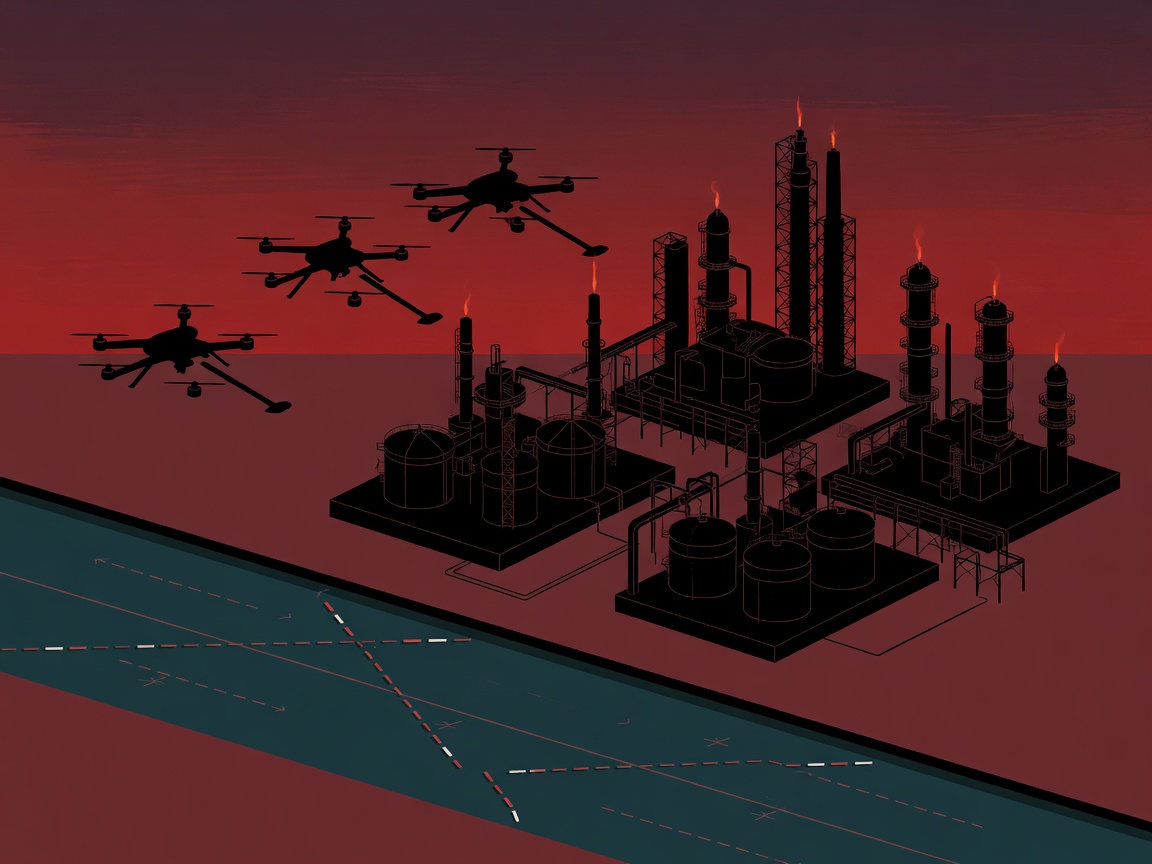
Houthi forces struck energy facilities across southern Saudi Arabia on Tuesday, wounding at least 73 people and triggering fires at oil installations, prompting Riyadh to promise firm retaliation as Brent crude climbed toward $100 a barrel.
The attacks targeted the Saudi cities of Abha, Khamis Mushait, Jazan, and Najran, according to Major-General Turki al-Malki, the Saudi spokesman for the Riyadh-led coalition in Yemen. Saudi Arabia’s Energy Ministry said the strikes halted operations at certain energy facilities and triggered fires at multiple oil installations and utility sites across the kingdom’s southern provinces. Emergency services are working to contain the blazes and assess the extent of the damage.
The Houthis claimed responsibility. The group’s military spokesman, Yahya Saree, described the operation as a broad attack on Saudi Aramco infrastructure in the south, carried out with drones and ballistic missiles. Saree said the strikes were retaliation for recent Saudi attacks on Houthi-controlled areas across Yemen.
Southern Saudi Arabia holds key oil infrastructure, including the Jazan refinery, one of the kingdom’s largest, capable of processing 400,000 barrels of crude per day. The targeting of Aramco-operated sites sent shockwaves through energy markets already on edge from escalating U.S.-Iran hostilities.
Oil prices surge amid dual crises
Brent crude futures rose 1.67% to $98.61 a barrel by 7:44 a.m. ET. U.S. West Texas Intermediate futures advanced 2.6% to $93.84 per barrel. ExxonMobil shares gained 1.96% in premarket trading, while Chevron rose 1.35%. The tit-for-tat strikes over the weekend also pushed gas prices to record highs.
The Saudi attacks compounded fears of escalating hostilities between the U.S. and Iran, which intensified after the American military struck three Iranian oil tankers on Saturday in retaliation for Iranian ballistic missile attacks on two Navy warships. Iran’s Foreign Ministry denounced the strikes on commercial vessels as a “war crime” and an act of “economic warfare.”
David Morrison, senior market analyst at Trade Nation, said the situation appears to be a major escalation and that tensions have ratcheted higher. He noted that U.S. Energy Secretary Chris Wright had said it may prove impossible to reach a deal with Iran to prevent it from obtaining a nuclear weapon. Goldman Sachs raised its forecasts for Brent and WTI prices by $5 to $85 and $80 per barrel, respectively, for December 2026, and to $80 and $75 per barrel for 2027, expecting Middle East shipping disruptions to continue into that year.
President Trump said in a post on Monday that oil prices would drop precipitously when the U.S. wins the war with Iran. Iranian Parliament Speaker Mohammad Bagher Ghalibaf responded on X: “Strike our assets and you get struck.” Defense Secretary Pete Hegseth had written that the U.S. would destroy and sink Iranian oil tankers if Iran fires on American vessels.
Strait of Bab al-Mandeb at the center
The escalation is the most serious between Saudi Arabia and the Houthis since a UN-brokered truce halted large-scale fighting in 2022, after eight years of conflict that killed tens of thousands in Yemen. A key focus of the fighting is the Bab al-Mandeb Strait, the narrow waterway connecting the Red Sea to the Gulf of Aden, whose strategic importance has surged as Iran’s effective closure of the Strait of Hormuz forces Saudi Arabia to rely more heavily on its Red Sea export route.
Between March and mid-July, Saudi seaborne crude exports through Bab al-Mandeb were eight times higher than during the same period in 2025. In 2024, about 4.1 million barrels of crude oil and petroleum products passed through the strait daily on average, roughly 5% of the global total. The Houthis declared a blockade against Saudi shipping in July and have pushed toward government-held areas near al-Makha and territory bordering the strait.
Ahmed Nagi, a senior analyst at the International Crisis Group, told Al Jazeera that the strait holds importance when examining the Houthis’ broader strategy. “The move towards the western coast is not only about gaining territory on the ground. It also has a maritime dimension,” Nagi said. He added that gaining control over the western coast could give the Houthis greater depth to sustain pressure on maritime traffic, connecting their ground offensive to their campaign in the Red Sea.
Fighting resumed in July after an Iranian aircraft attempted to land in Sanaa without Saudi authorization, followed by strikes on Sanaa airport and Houthi retaliation. On Sunday, Yemen’s internationally recognised government said its warplanes struck Houthi positions in Hodeidah, Marib, and al-Jawf. Government-aligned forces then announced a ground push toward the al-Labanat mountains in al-Jawf, reporting intensive battles and advances toward Dhi Na’im district in al-Bayda.
The Houthis said they repelled the advance and inflicted casualties on government forces. Houthi official Mohammed al-Farah claimed the group fired ballistic missiles at reinforcements in al-Jawf. The Houthis also accused Saudi Arabia of carrying out an air strike on a prison in al-Hazm, the capital of al-Jawf, killing seven people and injuring seven others. Riyadh did not immediately comment on that claim. Al Jazeera could not independently verify the battlefield claims from either side.
Rashad al-Alimi, who heads Yemen’s Saudi-backed Presidential Leadership Council, said government forces had made significant gains in al-Jawf, al-Bayda, Taiz, and Hodeidah. “Our armed forces will continue to carry out their constitutional duty until state institutions are restored and their authority extends over the entire territory of Yemen,” al-Alimi said in a statement.
Sources & methods
- Al Jazeera report on the Saudi-Houthi escalation, battlefield claims, and the strategic importance of the Bab al-Mandeb Strait Archived Sep 8, 2026
- CNBC report on oil price movements, U.S.-Iran hostilities, and market analyst commentary Archived Sep 8, 2026
- The Guardian business live blog, referenced for contextual market turbulence and bond market background Archived Sep 8, 2026
This article was assembled from three source texts covering the Saudi-Houthi military escalation, its impact on global oil prices, and the broader regional context including U.S.-Iran hostilities and shipping route disruptions.