US forces strike three Iranian oil tankers after warships face ballistic missile attacks
Central Command says it permanently disabled two tankers and destroyed a third, vowing to target Iran’s oil fleet in response to attacks on American ships.
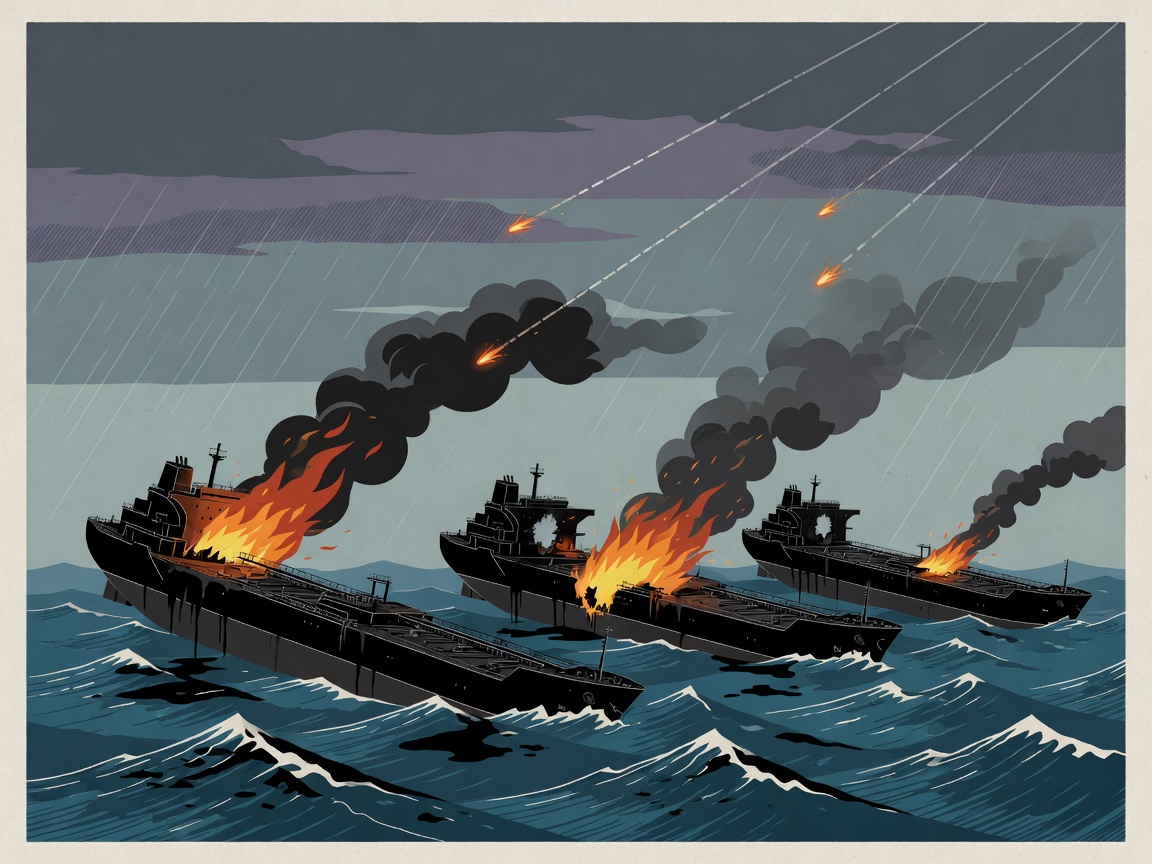
US Central Command said Saturday it struck three Iranian crude oil tankers after ballistic missiles were launched toward two American warships in the region, hitting vessels that CENTCOM said were part of a shadow network funding the Islamic Revolutionary Guard Corps.
CENTCOM said it “successfully evaded” multiple attacks from the Islamic Revolutionary Guard Corps targeting a U.S. aircraft carrier and guided-missile destroyer. The strikes “permanently disabled” one tanker near Kharg Island and another near the Strait of Hormuz, according to CENTCOM, and “completely destroyed” a third in the Gulf of Oman. No American personnel were harmed.
Admiral Brad Cooper, CENTCOM’s commander, said in a statement: “Let the message to the IRGC be clear: If you shoot at two of our ships, we will impose an even higher economic cost — taking out three of yours.” He added: “We will not hesitate to defend American forces, and if necessary, destroy Iran’s limited and exposed oil fleet.”
Strikes target Iran’s oil fleet
Iran is the third-largest producer in the Organization of the Petroleum Exporting Countries and exported 90% of its crude via Kharg Island before the war. A U.S. blockade of Iranian oil exports, which began in mid-April, has disrupted those flows. The conflict has effectively shut the Strait of Hormuz, a key waterway for the world’s oil supply before the war.
CENTCOM claimed the three tankers were “part of a multi-billion-dollar shadow network that funds the IRGC and its regional proxies.” Defense Secretary Pete Hegseth later wrote in a post on X: “It’s simple: if Iran shoots at U.S. ships, we will destroy (and sink) their oil tankers. All they have to do is stop shooting at @USNavy.”
Iranian state media earlier reported that one of its tankers had been struck off the coast of Kharg Island. Tehran did not immediately acknowledge the attacks on American ships.
Ceasefire collapse and regional fallout
The attacks come nearly a week after renewed fighting between the two countries, which followed a period of relative calm between the warring sides. A 60-day ceasefire formally expired last month, with little sign of a further diplomatic settlement on the horizon. Days after the ceasefire expired, Trump said Washington would launch tougher economic measures against Iran, as well as any country that helps or does business with it.
American forces resumed attacks on Sunday, when they said they had struck two rocket launchers to prevent them being used to lay naval mines in the Strait of Hormuz. On Tuesday, Trump said the military had launched a further “very heavy attack” but claimed the renewed fighting would not last “too long.” The strikes prompted Iran to retaliate against American targets in the region, including in the United Arab Emirates, Bahrain, Kuwait, and Jordan.
On Thursday, Vice President JD Vance addressed claims by Iran that American strikes killed at least four people, including two children, at a wedding in southern Iran. He said he was “extremely sceptical” over reports of the alleged strike but confirmed the government would investigate. The Iranian Red Crescent Society said shrapnel from a missile hit the ceremony at a home in Sirik on Tuesday, prompting Tehran to declare it a “war crime.”
The conflict has raised energy prices globally. Ahead of the midterm elections in November, Trump is facing pressure over how much the war is costing American consumers. Washington and Israel first launched wide-ranging strikes on Iran on 28 February, with Iran responding by attacking Israel, American bases, and allied states in the Gulf, and effectively closing the Strait of Hormuz to marine traffic.
A day before the tanker strikes, the Treasury Department announced sanctions against a small Turkish investment bank and two of its subsidiaries, which the government accuses of facilitating funds for an arm of Iran’s Revolutionary Guard. The Treasury alleges that Golden Global Yatirim Bankasi Anonim Sirketi and its subsidiaries were established to enable Iran’s “rahbar network” to transfer oil revenues from China to Turkey. There, the money could be converted to cash and gold by rahbar money exchangers. Golden Global Bank is the second major financial institution targeted under “Operation Economic Outcast,” an effort by the Trump administration to isolate Tehran through non-military actions by sanctioning its business partners. Trump threatened in June to seize Kharg Island as the military campaign against Iran continued. On Aug. 31, he posted an artificial intelligence-generated video of Kharg Island being blown up.
Sources & methods
- BBC News report on U.S. strikes against three Iranian oil tankers, including statements from CENTCOM, details on the collapsed ceasefire, and reports of a wedding strike in southern Iran. Archived Sep 5, 2026
- CNBC report on the same tanker strikes, adding details on Iran's oil export dependence on Kharg Island, the U.S. blockade timeline, Treasury sanctions against a Turkish bank, and Trump's AI-generated video of Kharg Island. Archived Sep 5, 2026
This article was compiled from reports by BBC News and CNBC, drawing on statements from U.S. Central Command, Iranian state media, Treasury Department announcements, and remarks by administration officials.