US launches third round of strikes on Iran as Tehran closes Strait of Hormuz and fires on American military sites
The escalation followed an IRGC attack on a Cyprus-flagged container ship, with Iran targeting American bases in Jordan and sites across multiple Gulf states.
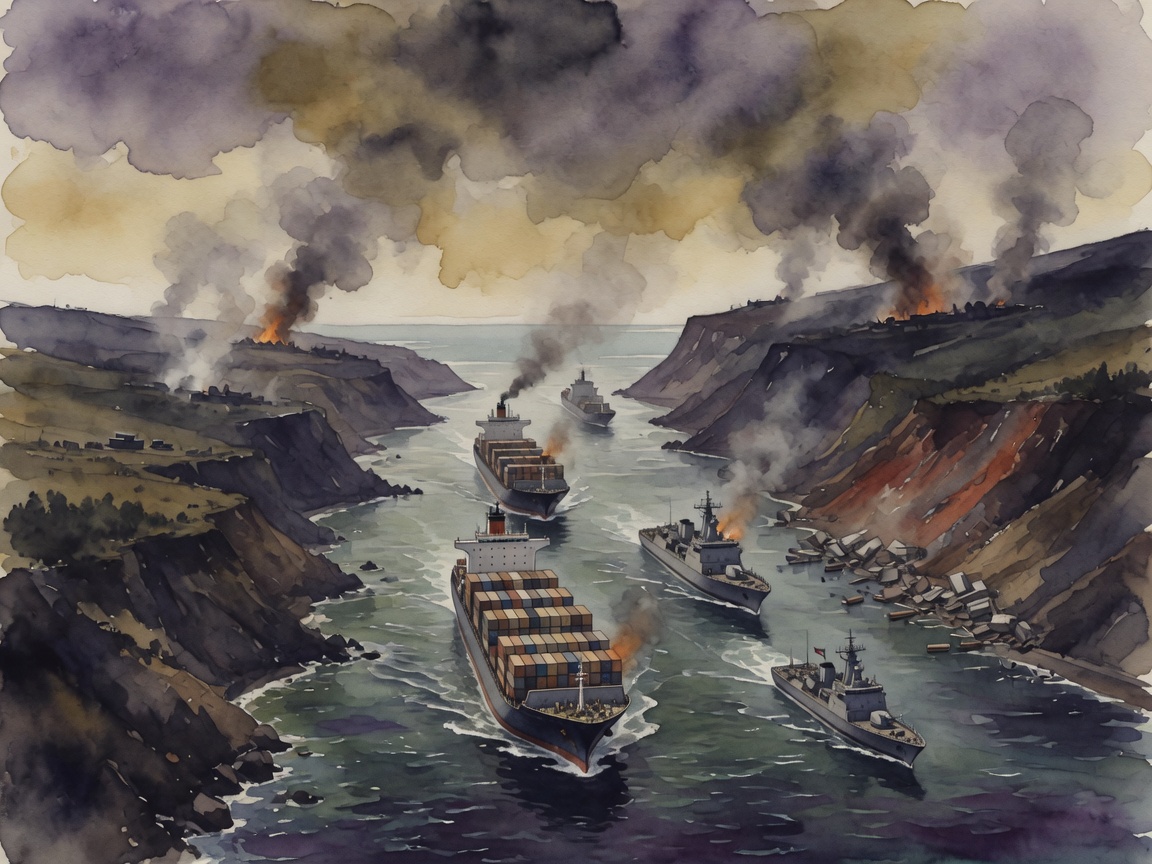
The United States launched its third round of strikes on Iran in a week on Saturday after the IRGC attacked a Cyprus-flagged container ship in the Strait of Hormuz. Iran responded by shutting the waterway and firing missiles at American military sites in Jordan and across the Gulf, drawing responses from the United Arab Emirates, Qatar, Kuwait, and Bahrain and ending the ceasefire.
US Central Command said the MV GFS Galaxy, a Cyprus-flagged container ship, suffered significant damage to its engine room from an onboard fire and could not continue its journey. One civilian crew member was missing. The UK’s Maritime Trade Operations said military authorities informed it that the crew had been forced to abandon ship into a lifeboat. Centcom said it struck 140 Iranian military targets, including missile and drone sites, communication networks, and coastal surveillance locations.
Defense Secretary Pete Hegseth shared the Centcom statement on X, writing, “Iran made a poor choice. Now they pay.” The IRGC warned that any US aggression would be met with severity and that new bases in the region would be targeted.
Iran strikes back across the region
Within hours of the US strikes, the IRGC said it had hit the Prince Hassan Air Base in Jordan, claiming it destroyed the base’s command and control center and MQ9 drone hangars. The United Arab Emirates, Qatar, Kuwait, and Bahrain were all responding to missiles and drones from Iran. It was the first phase of retaliation. The IRGC said the US had targeted coastal bases and telecommunications towers on Iran’s southern coast.
The crisis has roots in a dispute over shipping routes. Earlier this week, three commercial tankers were attacked as they tried to cross a US-recommended route through Omani waters. Iran has insisted that the only safe route is a separate passage through its territorial waters. The US and Iran signed a memorandum of understanding on June 17 to reopen the strait. The routes were left undefined. Iran promised to use its best efforts to ensure safe passage and agreed not to charge a toll for 60 days.
David Goldwyn, who served as the US State Department’s special envoy for international energy affairs under President Barack Obama, said the memorandum did not reach an understanding on managing ship traffic. “It essentially punted that issue,” Goldwyn said. Energy Secretary Chris Wright said last month that the US military would assure the flow of energy out of the Gulf with or without an agreement. “Iran will not have the ability to close the Strait of Hormuz going forward,” Wright said at a conference in New York City on June 24.
Ceasefire collapses as tensions mount
The earlier tanker attacks prompted a series of US strikes in which 17 people were killed and 115 injured, according to Iranian officials. President Donald Trump declared the Iranian attacks meant the ceasefire was over. Iran’s Foreign Minister Abbas Araghchi accused the US of violating the deal. Trump said talks would still continue. Mediators were trying to revive the process. US media reported that Iran told American officials the tanker attacks were a mistake and blamed a rogue internal group.
American officials said they conveyed through mediators the demand that Iran publicly state the strait is open and pledge to stop firing on commercial ships. Iran’s parliamentary speaker Mohammad Bagher Ghalibaf, who is also the country’s chief negotiator with the US, wrote on X that the era of one-sided deals was over. “We told you: keep your word or pay the price. Reality is knocking,” he wrote. Iranian Foreign Minister Abbas Araghchi arrived in Oman for talks with Omani Foreign Minister Sayyid Badr bin Hamad Al Busaidi. A senior Middle East diplomat told MS Now that France and the UK are studying Omani proposals that may allow charging navigational fees in the strait, so long as the tolls are not compulsory and have the support of the UN’s International Maritime Organization.
The shutdown followed a call for revenge from Iranian Supreme Leader Ayatollah Mojtaba Khamenei in his first public statement since taking leadership. His father and predecessor, Ali Khamenei, was killed in an air strike on 28 February, the first day of the US-Israeli war against Iran. He was buried in Mashhad on Friday. The new ayatollah said vengeance was the will of the nation. “We pledge to avenge the blood of the martyred leader and all the martyrs of these two wars from the criminal and disgraced killers,” he was quoted as saying.
Trump warned that any such plans would see the US “decimate and destroy all areas” of Iran in response. Iranians at funeral ceremonies over the past few days carried placards calling for the killing of the US president.
Sources & methods
- BBC News report on US strikes, the Strait of Hormuz closure, IRGC retaliation across Jordan and Gulf states, the MOU dispute, and Ayatollah Mojtaba Khamenei's call for revenge. Archived Jul 12, 2026
- CNBC report on Pentagon statements about the airstrikes, details of the MV GFS Galaxy attack, the June 17 memorandum of understanding, David Goldwyn's analysis, Chris Wright's comments, and Omani mediation efforts. Archived Jul 12, 2026
This article was compiled from two published reports on the escalation, with claims attributed to US Central Command, Iranian state media, and officials cited by each outlet.