US unveils sweeping sanctions on Iran as Tehran threatens ship seizures in Strait of Hormuz
Treasury Secretary Scott Bessent called the measures the greatest financial offensive ever marshalled against an adversary, while Iran’s security chief warned of seismic retaliation against any country that joins the campaign.
The United States formally unveiled a sweeping new round of economic sanctions against Iran on Monday, with Treasury Secretary Scott Bessent declaring the measures the ‘single greatest financial offensive ever’ marshalled against an adversary.
The announcement marks a sharp escalation in the six-month war between the United States, Israel, and Iran, coming after both sides missed a 60-day ceasefire window to reach a formal deal. Iran dismissed the sanctions as desperation. Iran threatened to seize vessels transiting the Strait of Hormuz without permission, raising the stakes for global energy markets already suffering what analysts describe as the biggest disruption in their history.
Bessent framed the measures as the endgame. ‘At dawn begins an economic D-Day,’ he wrote on social media. In a Financial Times opinion piece published Sunday, he said the objective was to ‘sever every economic lifeline that sustains the tyrannical regime until Tehran stands alone.’ He warned that any nation serving as a financial artery for Iran should expect to share in its isolation.
Iran vows retaliation
Iran’s response was swift and defiant. Mohsen Rezaei, the new secretary of Iran’s Supreme National Security Council and a longtime military commander who once led the Revolutionary Guards, said Tehran would retaliate in a ‘seismic manner’ if Washington proceeded. He warned Gulf states directly. Any country that becomes a partner in creating economic restrictions against Iran will be regarded as an enemy, he said in an interview with state broadcaster. If the countries surrounding Iran join the Americans in their economic war, not a drop of oil will leave the Persian Gulf and the Strait of Hormuz, Rezaei added.
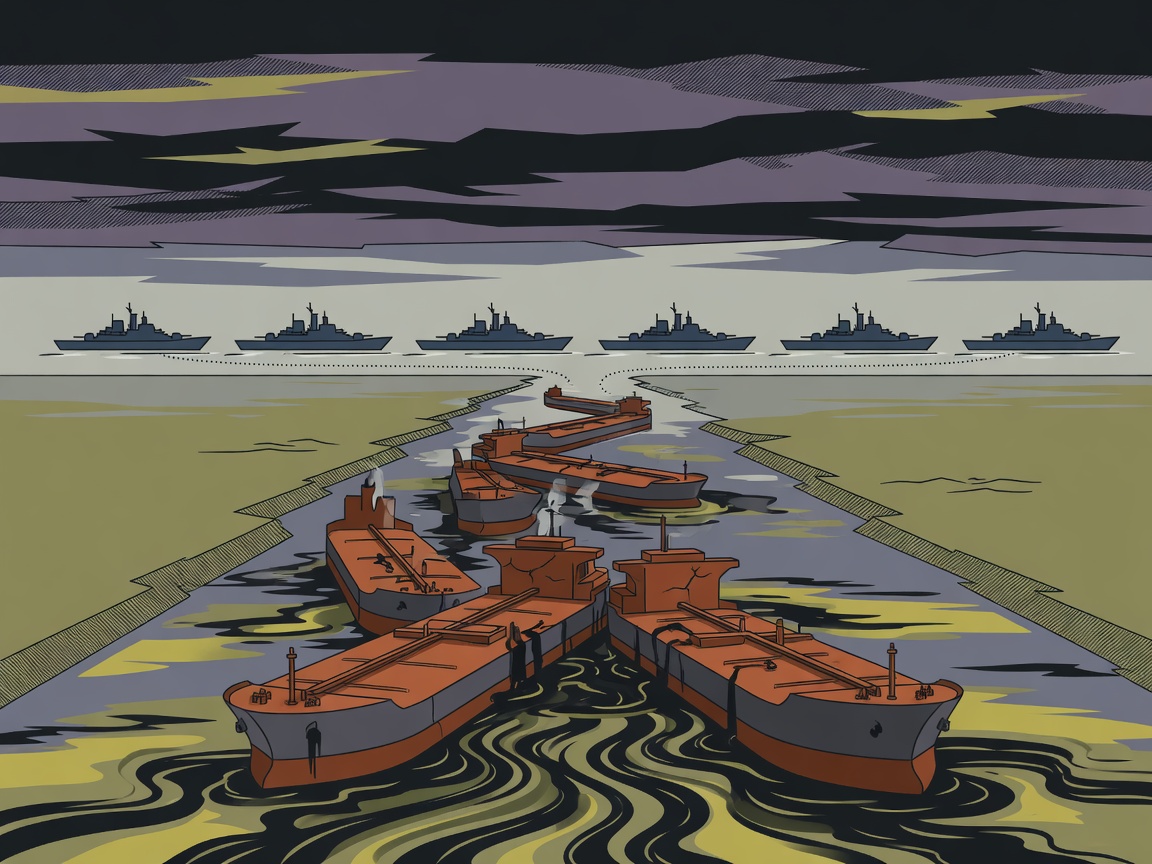
Iran’s state-controlled Persian Gulf Strait Authority warned that vessels violating its transit rules could face fines, seizure, or confiscation. Tehran’s parliament approved a provision on Sunday stipulating that ships passing through the Hormuz choke point will pay for services provided by Tehran, though the legislation still needs full parliamentary approval. The strait, through which roughly one fifth of the world’s seaborne oil passed before the war, has been effectively blocked by Iran since the conflict began at the end of February.
Economic pressure mounts
The rial plunged to record lows. It hit 2.03 million rials against the dollar in Tehran’s open market on Monday, according to Al Jazeera. The Guardian reported a rate of 1.992 million per dollar, down 4.5 percent since Trump announced what he called a ‘crushing economic operation’ last week. Inflation in Iran has reached almost 90 percent, according to the Statistical Centre of Iran. Iran’s central bank governor, Abdolnaser Hemmati, admitted that crude exports had ‘virtually stopped’ due to the US naval blockade.
The US Central Command said on Sunday that its forces have redirected 70 commercial vessels, disabled three, and boarded two as part of the blockade, which it says could last indefinitely. Trump posted on social media that Iran was ‘completely collapsing.’ The impact extends beyond Iran. In the US, gasoline prices have surpassed $4 a gallon, and Brent crude, the global benchmark, was trading around $93 a barrel on Monday.
The test of the US rhetoric rests on whether countries such as India, China, and Russia believe continued trade with Iran would lead to credible American reprisals. China has for decades been the main importer of Iranian oil and historically buys about 90 percent of Iran’s output. In May, the US threatened sanctions against Chinese refiners and their banks, but the Chinese commerce department directed firms to ignore the warnings, deploying a government statute designed to render US sanctions ineffective in Chinese jurisdictions. Washington largely backed off after Trump realized he was risking a wider trade and tariff war with China that the US was likely to lose.
The United Arab Emirates, Iran’s single biggest trading partner in the Middle East, announced it was ending all trade with Iran, a move Tehran believes was coordinated between Washington and Abu Dhabi. Omani Foreign Minister Sayyid Badr Albusaidi is scheduled to visit Tehran on Tuesday for bilateral talks on the Strait of Hormuz.
Analysts questioned whether the new sanctions would change Iran’s behavior. Alan Eyre, a former American diplomat who was part of the US negotiating team over Iran’s nuclear program until 2015, told NPR that the US has already targeted every layer of Iran’s economy and that no new sanctions would be effective.
Sources & methods
- BBC News article on Bessent's 'greatest financial offensive' comments, the Strait of Hormuz disruption, oil prices, and sanctions history Archived Aug 24, 2026
- The Guardian article on Iran's retaliation vows, UAE ending trade, China's stance, the rial's collapse, Hemmati's admission, and Rezaei's warnings Archived Aug 24, 2026
- Al Jazeera article on Iran's sanctions-evasion systems, the US naval blockade details, the rial's record low of 2.03 million, and Iranian military defiance Archived Aug 24, 2026
- NPR article on the sanctions announcement, Iran's 'seismic' retaliation threat, inflation at 90 percent, and Alan Eyre's assessment of sanctions fatigue Archived Aug 24, 2026
- CNBC article on the missed ceasefire window, Bessent's 'economic D-Day' framing, the Persian Gulf Strait Authority's warnings, parliament's provision, and the Omani foreign minister's planned visit Archived Aug 24, 2026
This article was assembled from five published news reports dated August 24, 2026, cross-referencing claims about the sanctions announcement, Iranian retaliation threats, economic data, and diplomatic movements across BBC, The Guardian, Al Jazeera, NPR, and CNBC.