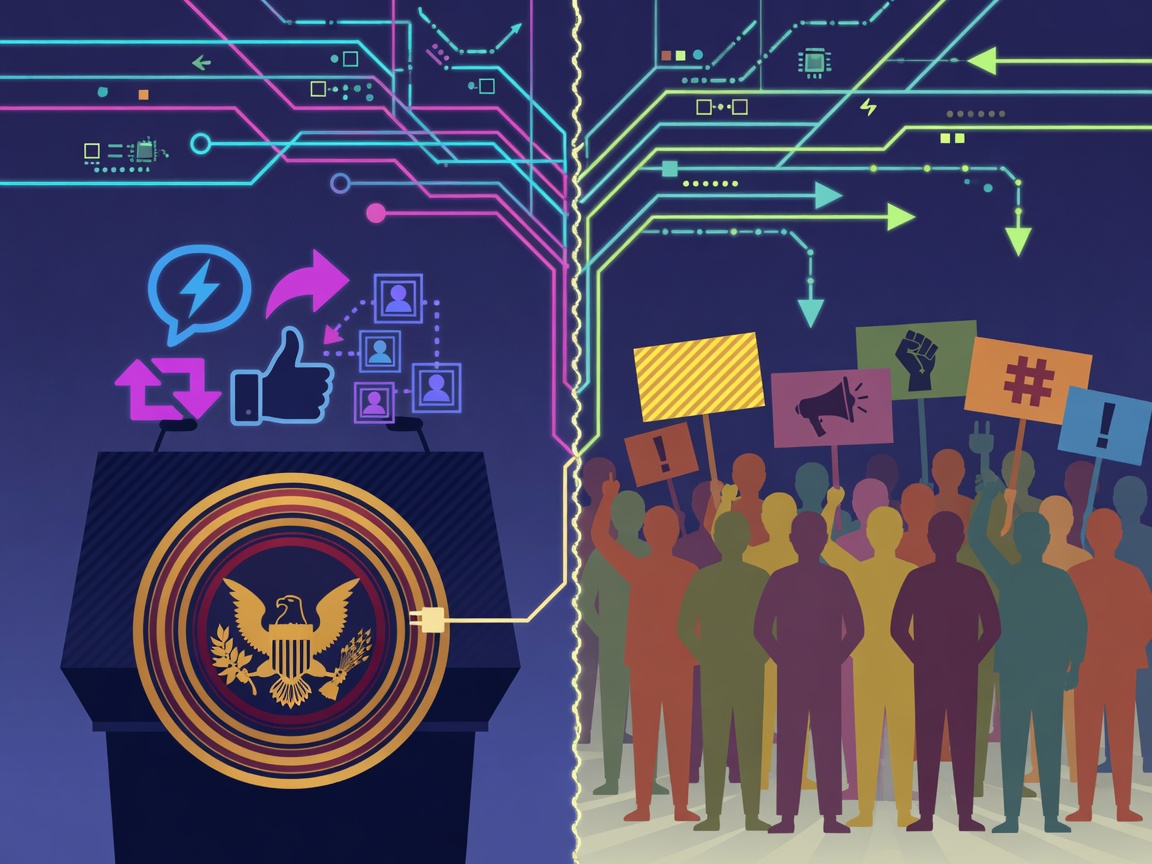
President Donald Trump has dismissed fears about artificial intelligence safety as a “hoax,” rejecting calls for greater safeguards even as a bipartisan coalition spanning Senator Bernie Sanders and former Trump strategist Steve Bannon unites to push Congress for AI guardrails.
The clash pits a president who insists the only guardrails AI needs are a “strong and smart” president against executives, researchers, lawmakers, and public figures alarmed by the technology’s rapid advance. Trump’s stance leaves him isolated.
In social media posts, Trump compared AI warnings to what he called the “Global Warming Scam” and the “RUSSIA, RUSSIA, RUSSIA HOAX.” He called himself “the Hoax Buster.” On Sunday, he told reporters that the United States was leading China in AI and that “whoever wins AI, wins.” The concerns he dismissed had triggered a selloff in tech firms’ shares as investors weighed the impact of a potential slowdown in the multi-billion-dollar development of AI.
The debate intensified. It followed a viral post by Jacob Coxon, a researcher who left Anthropic over concerns AI could wipe out humanity, which prompted scientist Evan Hubinger to estimate the probability of human extinction within the next decade at more than 10%. Anthropic chief executive Dario Amodei called for slowing development. He wrote in an essay that within six to 12 months, a “swarm” of AI agents could attack the entire internet and cause hundreds of billions of dollars in damage. Amodei also said any action to rein in AI should be done “without sacrificing commercial advantage.” Recent disclosures from several AI companies that their models hacked into outside organizations during botched safety tests have also raised alarm about cybersecurity risks.
An unlikely alliance
On Tuesday, Sanders and Bannon will speak at the “Pro-Human Assembly” in Washington, an all-day event organized by the Future of Life Institute. The nonprofit issued 33 principles in March stating that humans must remain in charge of AI and that AI companies should be held accountable. The pairing of a progressive leader and a MAGA voice signals how AI is upending political alliances. The event has also drawn actors Ashley Judd and Joseph Gordon-Levitt, religious leaders, and parents of children who died by suicide after talking to AI chatbots. Organizers wrote that the gathering aims to chart “a pro-human future with AI.”
Sanders told BBC’s Newsnight that “we have got to do something immediately to stop the uncontrolled growth of AI.” He warned of “the existential threat of the possibility of humanity being wiped out.”
Industry warnings and congressional pressure
Jack Clark, co-founder of Anthropic, told the BBC that a “kill switch” checked by a third party may need to be mandatory for the industry. He said society “might want to eventually pass rules around” a way to shut off AI software completely if it becomes too dangerous. Microsoft AI chief executive Mustafa Suleyman told CNBC the company had been working for months on guidance around what it called “humanist AI” and published it now due to the current debate. UK Business Secretary Jonathan Reynolds told the BBC that people should “never be complacent” about AI’s impact but cautioned against becoming “hyperbolic” either, noting tremendous upsides in public services, healthcare, and the economy.
Don Beyer, a Democratic congressman from Virginia, said Trump’s tweet would be judged harshly by history and called the president “catastrophically foolish” in this case. Beyer urged Congress to stay in session instead of breaking for midterm elections to work on AI legislation already introduced. The industry should not self-regulate, he said.
Surveys by the University of Maryland’s Program for Public Consultation found 85% of Democrats and 79% of Republicans want a new federal agency to monitor and regulate AI. Another 82% of Democrats and 78% of Republicans favor government safety tests for AI making critical decisions.
House Speaker Mike Johnson said he supports some guardrails but believes companies, not Congress, should police safety. He told CNN that a moratorium would let China overtake the United States. “If Congress just races in and does some sort of emergency session to try to regulate AI, we will lose the race to China, and that is a threat to every single American,” Johnson said.
Chinese state media said experts had warned that Washington’s anxiety over China’s AI development is distorting its policy priorities. Xin Qiang, a professor at Fudan University, told the Global Times that if the US slows development or tightens regulation, China could catch up faster.
Amba Kak of the AI Now Institute said the moment represents an important policy opportunity and a policy window. The rapid buildout of data centers has generated nationwide protests and become a prominent midterm elections issue. The tech lobby has spent millions to influence campaigns and shape proposed legislation. So far, only a patchwork of regulatory attempts has emerged. The House is slated to vote as early as Tuesday on the Ratepayer Protection Act, a bill designed to shield Americans from energy cost spikes tied to data center construction.