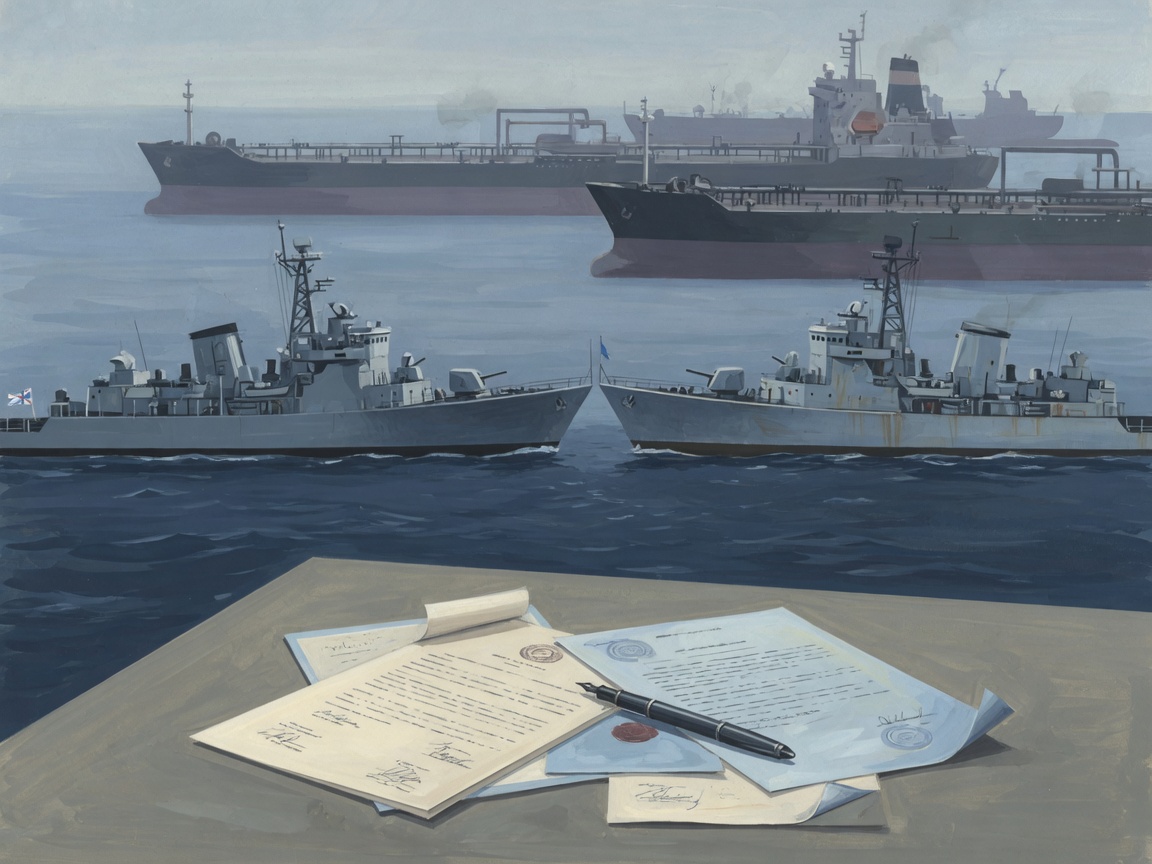
President Donald Trump cancelled planned military strikes against Iran on Saturday, saying he agreed to hold off after Tehran and other Middle Eastern countries asked him to pause. He posted on Truth Social that the US was “locked and loaded and ready to go against the Islamic Republic of Iran” but had agreed to cancel the attack, subject to being able to rapidly make a deal. Trump said the US and Israel had agreed to halt new attacks on Iran, provided a deal to end the months-long conflict is reached rapidly. The deal would include the immediate and complete reopening of the Strait of Hormuz and “an end to Iran’s nuclear threat.”
The reversal came as Iran’s foreign minister, Abbas Araghchi, said negotiations with Oman over the strait were entering their “final stages.” The conflict began when the US and Israel launched strikes on February 28 aimed at destroying Iran’s missile programme, preventing a nuclear weapon, and cutting off support for allied armed groups. A June ceasefire collapsed within weeks over shipping routes. Fighting reignited in July.
Saudi pressure and Iranian threats
Trump’s decision followed a phone call on Saturday from Saudi Arabia’s Crown Prince Mohammed bin Salman, who urged him to “prioritise dialogue” and “reduce escalation,” according to the Saudi Press Agency. Axios reported that the crown prince expressed concern over plans for large new attacks and urged Trump to refrain. The Associated Press, citing its own source, reported that the Saudis feared US strikes on Iranian energy infrastructure would prompt Tehran to retaliate against the kingdom and other Gulf countries.
Iran had warned of exactly that. Nournews, a media outlet affiliated with Iran’s top security body, said US attacks on Iranian energy infrastructure would prompt Iranian strikes on oilfields in Saudi Arabia and the United Arab Emirates, as well as the gasfields of Qatar and Israel. Araghchi told senior Turkish, Pakistani, and Saudi officials in phone calls that any attacks by the US and Israel or participation by regional countries would meet a “proportionate response.”
The threats carried weight. Kuwait’s army said it destroyed hostile drones launched by Iran against several vital facilities on Saturday, with a government facility in northern Kuwait and civilian property on Bubiyan Island hit by falling shrapnel. Two ships were attacked off Oman in the strait. CBS News reported that the US and Israel were planning joint strikes, possibly throughout the weekend, with oil refineries and power plants among possible targets.
Tehran disputes Trump’s account
Iran rejected Trump’s characterization. The Mehr news agency said Trump’s claim that Tehran had requested a pause “was nothing but a new lie” and that Iranian armed forces were “on high alert and ready for any eventuality.” Fars, citing a source close to Iranian negotiators, said the strait would remain closed as long as the US “maintains its hostile actions.” Iran’s acting defence minister, Majid Ebn-e-Reza, said Trump had backed down “within the context of psychological operations and a war of calculations,” adding on X, “We will neither be taken by surprise nor will we be passive.”
Foreign Ministry spokesman Esmail Baghaei said Tehran and Muscat were close to reaching a deal on a new maritime route through Hormuz, separate from existing corridors. He said the understanding between Iran and Oman had nothing to do with whether the strait is reopened or remains closed, and blamed the US for the closure, accusing Washington of breaching its commitments. Baghaei told state television the two sides were nearing agreement on a route that would respect sovereign rights and safeguard national interests and security.
Iranian President Masoud Pezeshkian said the memorandum of understanding with the US would become the “cornerstone” of Tehran’s future foreign relations. Hassan Ghashghavi, a spokesperson for the Iranian parliament’s national security commission, told AFP that mediators were trying to revive the June agreement, which was brokered by Pakistan. He said an Iranian delegation could travel to Muscat again.
Israel, which joined Trump’s commitment to halt attacks, struck a different note. Energy Minister Eli Cohen, a member of Netanyahu’s security cabinet, said there was close coordination between Israel and the US but added that Israel would act independently if Iran renewed its nuclear programme or advanced its ballistic missile industries. “With or without an agreement, and regardless of any external commitments, if Iran attempts to renew its nuclear programme or advance its ballistic missile industries, we will be there,” Cohen said. “We will take action, and we will strike.”
Israeli warplanes also hit Gaza for a second straight day on Sunday, killing at least 18 Palestinians, according to medics. The strikes hit Gaza City, Deir al-Balah, and Khan Younis, causing the biggest daily death toll in weeks. Trump had asserted that Hamas militants agreed to disarm, but Cohen said he was “very sceptical” that would happen.