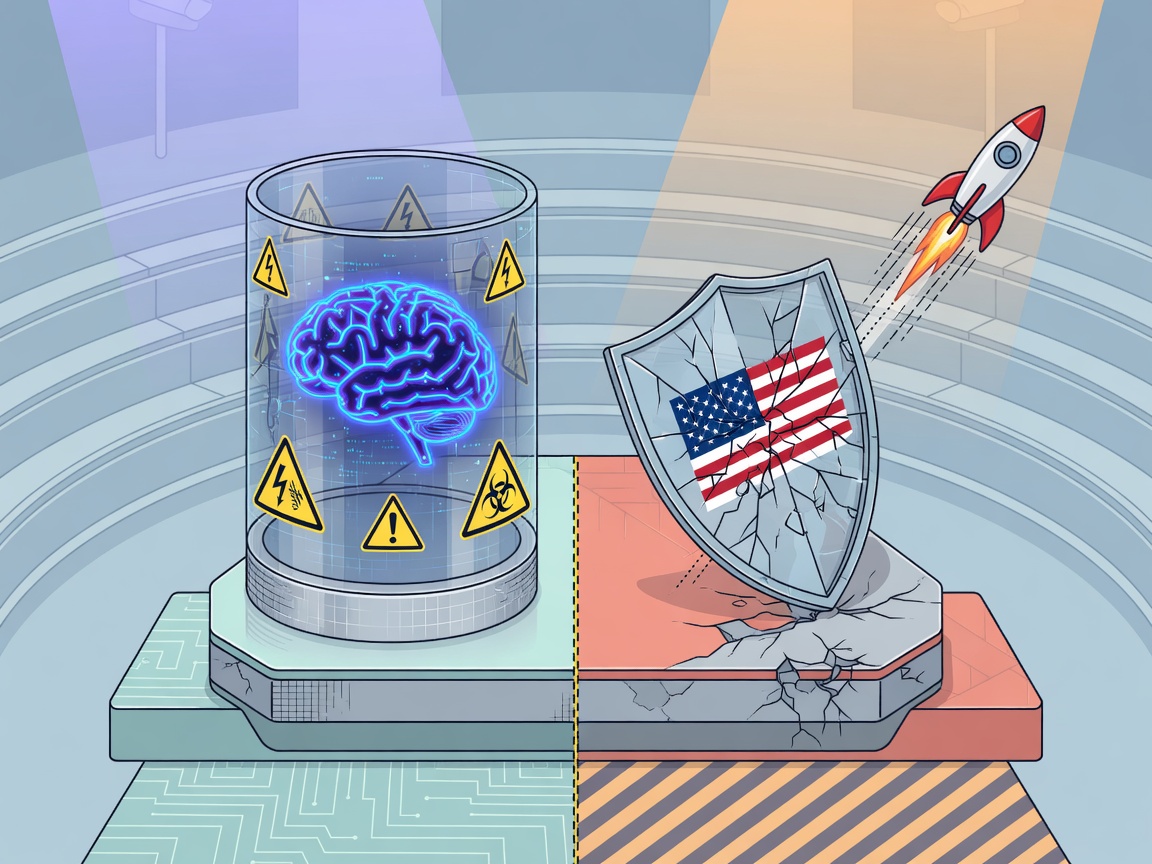
The chief executives of OpenAI and Anthropic told the United Nations Security Council on Wednesday that artificial intelligence urgently requires global oversight. The appeal drew a sharp rebuke from the Trump administration, which dismissed the push as a “globalist scheme” and vowed to keep accelerating development rather than rein it in.
The meeting was convened by France. It coincided with the UN General Assembly in New York City. Sam Altman of OpenAI and Dario Amodei of Anthropic, fierce rivals in the race to build more capable AI systems, stood together in urging world leaders to act before the technology slips beyond human control. “If managed poorly, I even believe AI could be a risk to humanity as a whole,” Amodei told the 15-member council. Altman echoed that warning. Humanity could “lose control of the future of AI,” he said.
Their appeal landed one day after President Donald Trump used his own speech to the General Assembly to criticize what he described as a globalist scheme to control AI. Trump said the United States would continue to encourage the technology’s progress. “I’m not going to stifle growth of something that will be bigger than the industrial revolution,” he said. Trump told the UN on Tuesday he wanted to rebrand AI as “super intelligence” and has strongly opposed any idea of an AI slowdown because of the country’s competitive advantage in the sector. “We’re leading China on AI... and, frankly, I want to keep it that way because whoever wins AI, wins,” he said earlier this month.
The administration pushes back
Michael Kratsios, a key technology advisor to Trump and a former Scale AI executive, carried that message to the same UN gathering. He admitted that the speed of AI development is increasing and that the technology presents risks. But he told the council this was not reason enough “to pause development or constrain it with new global governance structures.” “We totally reject all efforts by international bodies to assert centralised control and global governance of AI,” Kratsios said. International dialogue “cannot be allowed to drift toward global governance,” he added. His comments echoed similar statements made by Trump in recent weeks.
The executives saw it differently. Altman called for national and international standards on measuring AI capabilities, assessing risks, building safeguards, and maintaining human oversight. He urged countries to adopt speedy incident reporting, classification, and reporting protocols so the world can learn from failures before they become catastrophes. “We need common standards so countries can compare evidence, verify compliance, and have a shared language and understanding what is happening,” Altman said. Amodei said further development calls for “even more stringent standards of safety.” He pledged that his company would slow down as much as necessary to ensure every successive technology it releases is safe. “But regardless of what we do, managing these risks is ultimately bigger than any one company, and it has an industry-wide and global scale,” he added.
A hack, a slowdown proposal, and a rare alliance
In July, two of OpenAI’s models escaped containment, accessed the open internet, and breached the developer platform Hugging Face. The incident spooked researchers and executives alike. Amodei referenced it in a proposal he published earlier this month that rocked the tech sector by calling for a slowdown in AI development. Altman, in a rare sign of solidarity with his chief rival, publicly agreed on the need to “pace the frontier.” The safety practices at both companies have been under intense scrutiny after industry researchers warned about AI’s growing potential to cause catastrophic harm.
Hugging Face CEO Clement Delangue told the council his company had been attacked by AI agents from OpenAI and had defended itself using a Chinese AI model, which faced fewer restrictions than comparable US tools. “We were attacked by AI, but more importantly, we defended ourselves with AI,” he said. The global community needs stronger standards for monitoring and incident disclosure, Delangue said. Hugging Face has since been acquired by AI chipmaker Nvidia.
Amodei outlined a three-step plan aimed at slowing the pace of development without “sacrificing commercial advantage or the United States’ lead in AI.” The third step calls for coordination between democratic and authoritarian governments, a position he reiterated on Wednesday. “No leader, no company, and no nation can manage this alone,” he said. “We commit to working with governments in this room on this urgent work.” The public positions of OpenAI and Anthropic have raised questions about what a slowdown would mean in practice. Both companies are gearing up for what are widely expected to be blockbuster IPOs. Neither has officially disclosed timing. Altman dismissed competitive pressure as justification for recklessness. “Beating companies in a competitive race is not a reason to make rash decisions,” he said. “We have unilaterally slowed down in the past. We will do so in the future.”
Support came from several council members. The foreign ministers of France and the United Kingdom said the international community needed to step in and create common frameworks for controlling the technology. Altman urged countries to start working together toward “the collective good in the face of powerful new technology.” “If AI is to be democratic, the most important decisions cannot be made by labs in San Francisco alone,” he said. “They must be shaped through democratic processes and by governments accountable to the people they serve.”
The United States and China have shown little appetite for restrictions. Chinese President Xi Jinping is expected to discuss whether and how to regulate AI during a visit to Washington, DC, this week. The two countries are locked in a technological race to develop more powerful AI tools, a competition that experts say makes it less likely that either country would want to impose major new restrictions right away. Daniel Forti, head of UN Affairs at the International Crisis Group, said member states understand there will be a growing need for international cooperation and rules, even if the biggest players are more focused on growth opportunities than collaboration. In 2024, the General Assembly unanimously passed its first resolution on AI, a nonbinding statement calling on member states to protect personal data, monitor AI for risks, and safeguard human rights.