Death toll from Nepal-Tibet flash floods reaches at least 356 as scientists say a collapsed glacier likely caused the catastrophe
Nearly 1,400 people remain missing, most of them tourists, after a wall of water, mud, and rock tore through border towns and valleys. Scientists say a collapsed glacier, not an earthquake, likely triggered the disaster.
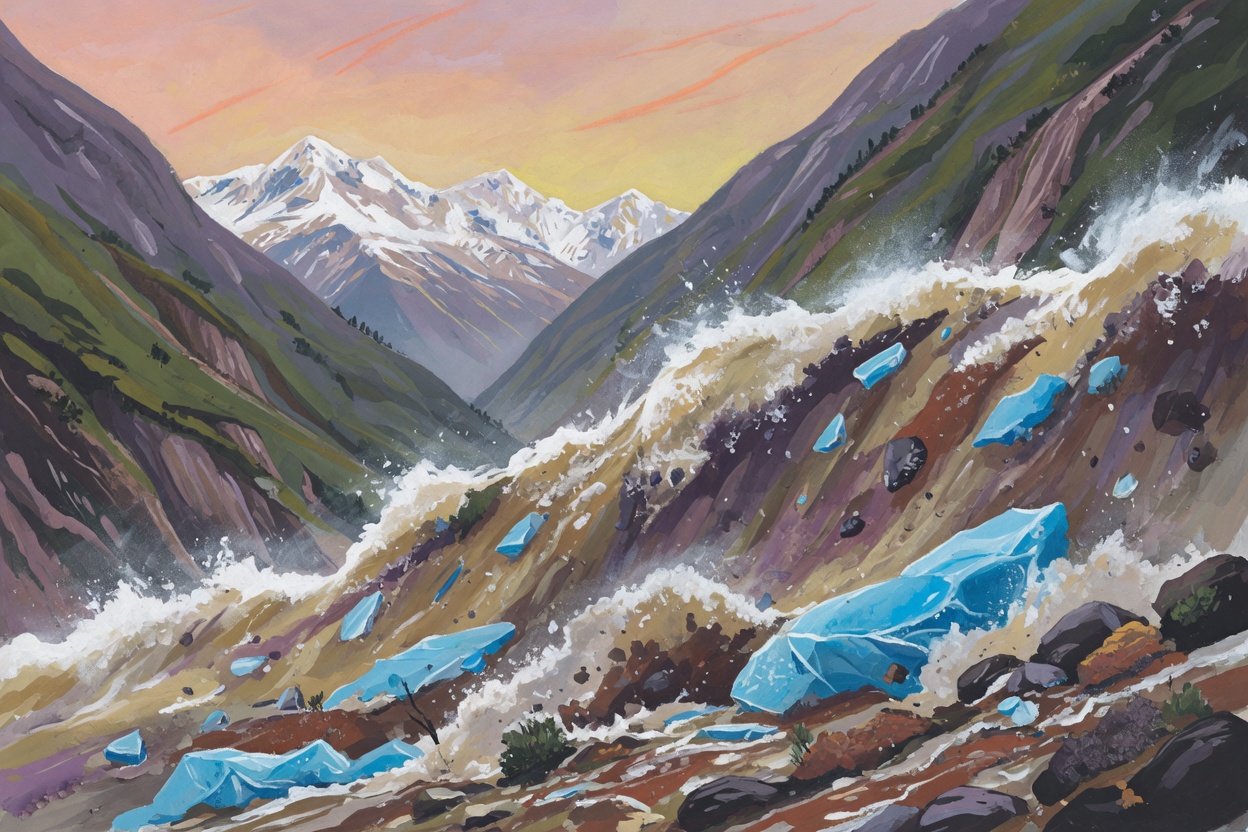
The death toll from flash floods along the Nepal-Tibet border has reached at least 356, with nearly 1,400 people still missing, after scientists said a collapsed glacier likely triggered the catastrophe that obliterated villages and swept away roads, bridges, and power plants across a region popular with trekkers and pilgrims.
The disaster struck on Wednesday morning. At about 8:40am local time, a large section of glacier broke away high above the Lhende river in Tibet, sending a wall of water, mud, and rock thundering down valleys and through settlements in Nepal’s Rasuwa district. The impact of the collapsed glacier hitting the bottom of a valley was so powerful that it registered a magnitude of 5.2, according to US Geological Survey data and scientists who analysed the event.
Initial reports had suggested an earthquake caused the flood. But the US Geological Survey later clarified that what was initially reported as a 4.4-magnitude earthquake was a seismic shock generated by glacial rock and ice collapsing. “No earthquake had occurred,” the survey said.
The search for the missing
Rescue teams are searching for survivors in terrain that is difficult to access. At least 19 bridges and about 40km of road have been destroyed, complicating efforts to locate nearly 1,400 missing people, most of them tourists, including hundreds from India, the US, UK, Australia, and Canada.
Almost 600 foreigners were among 826 people missing in Nepal, police and tourism officials said. Among those unaccounted for were 177 from India, 63 from the US, 34 from Australia, 33 from Britain, and 25 from Canada. Chinese state media said at least 558 were missing on the Tibet side, of whom at least 260 were foreign nationals. Al Jazeera reported the death toll at least 359. Nepal Police spokesperson Abi Narayan Kafle said the death toll is expected to rise further.
The Nepali army had rescued more than 100 people from flood-affected areas by helicopter by Thursday morning. Helicopters hovered overhead all day. Dozens of injured people were transported to Kathmandu for advanced medical care. Rescue teams found bodies hundreds of miles downstream in the Chitwan district of Nepal. Tibet government officials deployed nearly 800 emergency workers and 150 vehicles, along with sniffer dogs and speedboats, China’s official Xinhua news agency said.
Satellite imagery captured by Planet Labs before and after the flood shows how buildings and roads have been washed away, with large parts of Syapru Besi village submerged in mud. David Fisher, head of the Nepal delegation of the International Federation of the Red Cross, said entire villages and market areas had been wiped out. The village of Soley in Nuwakot, which had about 25 homes, was virtually wiped out, according to a Kathmandu-based journalist whose parents and other relatives live there.
What scientists found
Dr Simon Cook, a glacier expert with the University of Dundee, told the BBC his team detected that the lower part of a glacier near the Langtang Lirung peak, approximately 15km west of the flood site, had collapsed. He estimated the glacier collapsed in a northwesterly direction and then travelled westwards downstream. An analysis by the International Centre for Integrated Mountain Development found there could have been an ice-rock avalanche originating from a high-altitude area, sending a large volume of ice and rock debris into the Lende Khola, a tributary of the Bhote Koshi river.
Water levels in rivers downstream rose by between seven and nine metres within 30 minutes. Several water monitoring stations were washed away or damaged. Mike Searle, a professor of earth sciences at Oxford University, told the BBC the whole process from landslide to flood could have taken hours or even days. He said the topography of the area could have exacerbated the flood, noting that Langtang Lirung sits on the crest of the high Himalayas with incredibly steep valleys on both sides that could have funnelled the water at higher speeds.
Searle said the event likely resulted from two processes combining: tectonic uplift of the Himalayas and climate change with increasingly high temperatures and melting glaciers. He said the whole glacier appears to have collapsed in one go, which he called very unusual. An analysis by ICIMOD earlier this year found that Hindu Kush Himalaya glaciers are now losing ice at double the rate since 2000, exacerbating dangers such as flooding.
Survivors shared harrowing accounts. Bibek Kumal, a labourer working downstream from the worst-hit Rasuwa district, said from his hospital bed that the torrent swept him downstream amid mud and debris but he survived by clinging to a mango tree. Keshav Prasad Baral, a 68-year-old survivor being treated at a small hospital, said he tried to grab his wife’s hand and take her to the terrace, but she was swept away by the mud. His wife is still somewhere beneath the mud, he said. “She’s gone.”
The United Nations secretary general, António Guterres, said UN teams and partners were mobilising supplies and personnel to support affected communities. The US government said it would provide $500,000 in emergency assistance. The Chinese premier, Li Qiang, travelled to the affected area on the China-Nepal border on Thursday to oversee search efforts.
Sources & methods
- BBC report on the scientific analysis of the glacier collapse, including quotes from Dr Simon Cook of the University of Dundee, Mike Searle of Oxford University, and findings from ICIMOD and the US Geological Survey. Archived Aug 27, 2026
- The Guardian report on the death toll, missing persons, rescue operations, survivor accounts, and international response to the Nepal-Tibet flash floods. Archived Aug 27, 2026
- Al Jazeera report providing satellite imagery analysis, the timeline of the disaster, geographic details of the flood path, and the death toll figure of at least 359. Archived Aug 27, 2026
The piece was reported by synthesizing coverage from the BBC, The Guardian, and Al Jazeera on the Nepal-Tibet flash floods, drawing on scientific analysis from glaciologists and geological surveys, official rescue updates, and direct survivor testimony.