Death toll from Nepal-Tibet flash floods surpasses 600 as rescue operations resume near unstable barrier lake
A glacier collapse triggered catastrophic flooding across the Himalayan border region, leaving 2,478 missing and raising fears of a second deluge from a newly formed lake.
The death toll from catastrophic flash floods along the Nepal-Tibet border has surpassed 600, with 2,478 people missing and rescue teams racing against the threat of a second deluge from a newly formed barrier lake.
Nepal’s police reported 626 people killed on Saturday, bringing the combined toll to 633 after Chinese authorities confirmed seven deaths in Tibet. At least 2,478 people are missing. Nepal’s disaster agency reported 1,924 unaccounted for on its side, while China’s Xinhua news agency put the figure at 554 in Tibet.
The catastrophe began on Wednesday morning. Part of a glacier collapsed at roughly 5,200 metres in the Himalayas, plunging about 1,200 metres and gathering rock and debris before slamming into the Lende River. The resulting surge swept south through Nepal’s Rasuwa, Nuwakot, and Dhading districts, at one point raising the Trishuli River by nine metres in 30 minutes. The US Geological Survey revised its initial finding of an earthquake trigger, concluding the seismic signal instead came from the landslide itself.
Rescue efforts resume amid lake danger
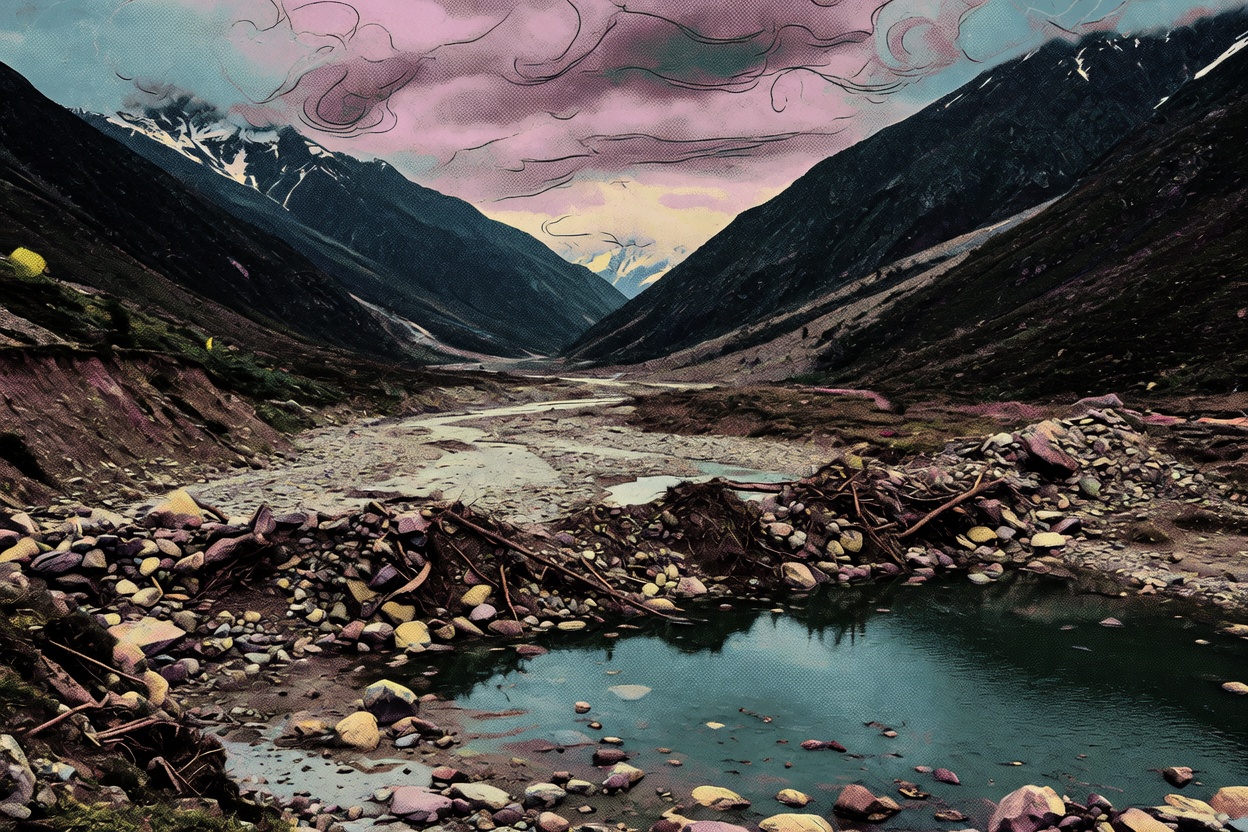
Rescue operations resumed after a brief pause. Teams had halted over fears of a second glacial flood from a new lake that formed at the collapse site. The lake’s risks were later deemed manageable. The barrier remains highly unstable.
Alton Byers, a glacial-hazards scientist at the University of Colorado Boulder, told Al Jazeera that the barrier holding back the new lake is made up of loose debris that cascaded into place two days earlier. There is “not much holding it,” he said. Byers said the safest outcome would be a natural, gradual drainage, noting that Chinese crews could also try to lower the lake manually using hand tools, a technique used in other countries prone to glacial lake outburst floods.
More than 3,700 people have been rescued in Nepal. The Red Cross estimates at least 93,000 people have been affected. The toll will likely rise. Officials warn that rescuers have yet to reach areas still cut off by mud and washed-out roads.
Nepal seeks specialised foreign help
Nepal’s foreign minister, Shisir Khanal, said the country needs foreign help in specialised and technical areas in which it does not have expertise, but not in general search and rescue. “We have already made requests for such specialised services and technical assistance in areas where we don’t have enough expertise and technical knowhow,” Khanal told Reuters late on Friday. Nepal has also asked India and China for bailey bridges to reopen transport in the disaster-hit area, where about two dozen bridges have been destroyed, according to The Guardian.
The Guardian reported that the Nepalese army has undertaken a dangerous rescue of people trapped in a tunnel of a hydropower project in Rasuwa, with rescuers crawling on thick mud towards the trapped and carrying them to safety. Specialist tunnel rescue teams from India and China were expected to arrive on Saturday. At least 777 foreigners are missing. Nepal’s disaster agency reported 517 foreigners unaccounted for, while Chinese officials put the number at 260. According to The Guardian, 90 US citizens are missing per the state department, with three rescued, and 41 Australians are reported missing. The Guardian also reported tourism board figures showing 98 people from India missing, with 85 rescued.
Scores of Hindu devotees from across the world are among those missing, as many were on a pilgrimage to Tibet’s Mount Kailash. Sivaranjani Muthunathan, 46, was travelling by bus with 56 others to the Chinese border when they became stuck in what they thought was a traffic jam. “Then there was fog, smoke, something that seemed to suddenly engulf us,” she told Agence France-Presse, showing a phone video of a torrent surging towards her. Around them, vehicles were swept away or buried under mud.
A Chinese rescue team reached the all-but-obliterated Gyirong border crossing complex for the first time on Friday, finding “nothing but ruins.” Rescue official Zou Mingqi told state media, “As far as I can see, it’s nothing but debris.” Satellite images show the area where travellers went through border control has been flattened to a muddy expanse. More than 550 remain unaccounted for in Tibet’s Gyirong County, including 260 foreigners. Chinese authorities said they had evacuated 555 stranded tourists and 499 Chinese residents from Tibet.
Chinese Premier Li Qiang visited the disaster zone in Gyirong on Thursday, a rare visit by the country’s second-most important leader so soon after a major disaster. President Xi Jinping chaired a meeting ordering officials to “scientifically formulate search-and-rescue plans” and strengthen monitoring of glacial lakes, according to state media. International aid has arrived from India, the UN, the Red Cross Federation, Australia, South Korea, and the US.
Dramatic CCTV footage of the flood tearing through Gyirong Port spread on social media and screens around the world. But the BBC reported that the video has been largely absent from China’s heavily censored internet, with only a single still-frame shot broadcast by the state-run flagship news bulletin. Foreign journalists cannot travel to Tibet without government permission. The International Campaign for Tibet, while praising the work of first responders, called on Chinese authorities to “disclose complete and verifiable information about the damage and casualties.”
Sources & methods
- BBC report on censorship of Tibet flood footage in China, limited information about victims, and the political sensitivities surrounding Tibet coverage Archived Aug 29, 2026
- The Guardian live updates on Nepal-Tibet flash floods, including death tolls, missing persons figures, rescue operations, foreign citizen tallies, and accounts from survivors Archived Aug 29, 2026
- Al Jazeera report on resumed rescue operations, the glacier collapse mechanism, barrier lake dangers, and comments from glacial-hazards scientist Alton Byers Archived Aug 29, 2026
This article was compiled from reports by the BBC, The Guardian, and Al Jazeera, drawing on official death tolls, disaster agency statements, scientist interviews, and on-the-ground reporting from the Nepal-Tibet border region.