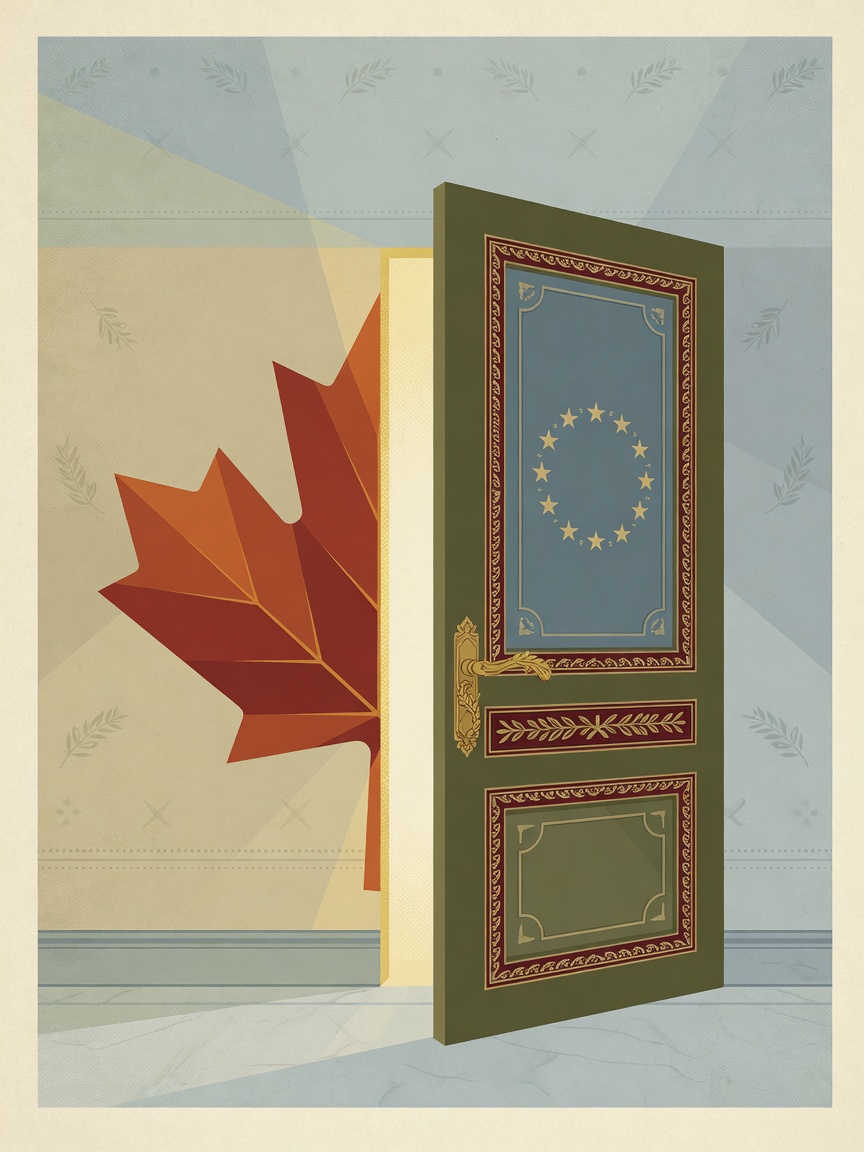
European Commission President Ursula von der Leyen told the European Parliament on Wednesday that she wants to work with Canada on becoming the European Union’s first “associate member,” a proposal that would mark a major shift in the bloc’s approach to partnership and a deepening of ties between Brussels and Ottawa at a moment of acute transatlantic strain.
Speaking in her annual State of the European Union address in Strasbourg, von der Leyen said the EU wants to bring its relationship with Canada “to the highest level possible.” She told Canadian Prime Minister Mark Carney, who was in the audience, that she would like to work with him on “opening the door for Canada to being the first associate member of the European Union.” Carney is scheduled to address EU lawmakers on Thursday.
The invitation comes as Canada remains locked in a bitter trade war with the United States. Trade talks between Ottawa and Washington collapsed last month, triggering a series of new tariff measures. Canada has pledged to match President Donald Trump’s tariffs dollar for dollar. Trump’s repeated talk of making Canada the 51st state has further inflamed tensions between the North American neighbours.
Carney had previously said Ottawa was keen to pursue a “unique security and economic alliance” with Europe, but not full membership. Last week he spoke of seeking a “unique alliance” with the EU. The concept of associate membership does not currently exist in EU law, and von der Leyen did not give specific details on how it would work. She listed manufacturing, technology, artificial intelligence, defence, energy, critical minerals and economic security as key areas for cooperation.
From CETA to a new alliance
The EU and Canada already operate under a free trade agreement known as CETA, which eliminated 99 percent of all tariff lines when it provisionally came into force in 2017. Von der Leyen framed the new proposal as an evolution of that pact. “We will move from CETA to an alliance for the future, to create a common prosperity and economic security space,” she said.
The existing agreement has not been fully ratified. 10 of the bloc’s 27 members have yet to ratify the trade deal struck with Ottawa nearly a decade ago, and some capitals would prefer to build on existing defence and trade agreements rather than create a new form of membership for Canada. The process, if agreed, could take years.
The EU has previously been reluctant to entertain flexible membership categories. Earlier this year, German Chancellor Friedrich Merz suggested that Ukraine could be granted associate membership, drawing a mixed reaction. Countries including Albania, Bosnia and Herzegovina, Montenegro, North Macedonia and Serbia are already on the long road toward full EU membership. Georgia and Moldova are also applying.
Von der Leyen was careful to frame the Canadian proposal as additive rather than adversarial. Without mentioning Trump by name, she said offering Canada some form of EU membership was “not a partnership against anyone else, but for our common strength.” She added that partnerships are a strategic choice for Europe and that they “respond to the fracture in the international rules-based system.”
She said the bloc and Canada “see the world with the same eyes,” citing shared positions on artificial intelligence, climate change and geopolitics. “We have stood together: on Ukraine, on defence, on raw materials and on supply chains,” von der Leyen said. “But above all, Europe and Canada believe in democracy.”
Middle powers seek new footing
European leaders have found a reliable ally in Carney as they grapple with similar pressures, including Trump’s aggressive use of tariffs and his threat to annex Greenland, a sovereign territory of EU member Denmark. Berenberg chief economist Holger Schmieding told CNBC that the push was a big step, saying Europe is trying to form new partnerships or deepen existing ones with like-minded countries. He said the effort is not necessarily against the United States but is clearly aimed at making Europe less dependent on the U.S. and less dependent on China.
In early June, Finnish President Alexander Stubb outlined a vision for a much larger EU, suggesting the bloc should “think big” and consider increasing its membership to 40 states. He named Canada, the United Kingdom, Turkey, Norway and Iceland as potential candidates. On June 3, Stubb remarked, “Wouldn’t it be lovely if Canada was the 28th state of the European Union rather than the 51st state of the United States?”
Bernd Lange, who chairs the European Parliament’s trade committee, told CNBC that the unpredictability of U.S. policy and China’s aggressive industrial policy make it important to strengthen ties with democratic countries. He said the EU should also push to build stronger economic ties with Brazil, Indonesia, Japan and South Korea. At the World Economic Forum in Davos earlier this year, Carney had argued that so-called middle powers must band together to counter the rise of hard power. Lange echoed that view, saying countries must be strong and sit at the table, “otherwise you will be part of the menu.”
Von der Leyen’s wide-ranging address also proposed the formation of a European Security Council that would include the United Kingdom and Ukraine, with partners such as Canada, Norway and others involved. She said the initiative was even more urgent given the nature and scale of the risks at play, amid an ongoing threat to the continent from Russia. She also raised the cost of living, the pace of technological change and its impact on jobs, plans to invite the world’s largest AI labs for talks, efforts to slash EU bureaucracy, a new emergency tool for mass migration following the deadly influx to the Spanish enclave of Ceuta in July, and plans to curb social media use among children, including banning platforms for those under 13.