A Kenyan court convicts starvation cult leader Paul Mackenzie of 191 murders
Mackenzie and dozens of associates were convicted of murder after he ordered followers to starve themselves and their children to meet Jesus in the Shakahola forest.
A Kenyan court has convicted starvation cult leader Paul Mackenzie of the murder of 191 people — 190 of them children and one an adult — after he ordered followers to starve themselves and their families to ‘meet Jesus.’ The verdict came at Mombasa high court.
Dozens of associates were convicted of murder alongside Mackenzie. Justice Diana Mochache delivered the judgment, which lasted more than eight hours. The verdict, however, covers only part of the catastrophe uncovered in the Shakahola forest: more than 400 bodies have been recovered from the site, and only 26 were able to be identified. Mackenzie is due to be sentenced on 6 November.
A doctrine of starvation
Mackenzie established Good News International Ministries in 2003. Over the next 16 years, the church drew thousands of followers across branches in Kenya and ran a television station, Times TV, which broadcast his sermons from his church in Malindi. His End Days sermons included conspiracy theories describing education as ‘evil,’ healthcare as ‘against the doctrine,’ and digital identity cards as ‘the mark of the devil.’ Peter Shukrani, 23, started going to Mackenzie’s church at age eight and described him as his ‘spiritual father.’ When in the forest, he fell ill and his mother threw away his medicine because she believed only God could heal him. He was rescued in March 2023. Authorities shut down the main church in 2019, and Mackenzie relocated to the Shakahola forest, encouraging devotees to follow. Cult members lived in makeshift homes of polythene sheeting and thatch, divided into areas with biblical names such as Jerusalem and Judea. People with direct knowledge said Mackenzie planned the mass starvation in three phases: first children, then women and young men, then the remaining men. Burials inside the forest were called ‘weddings,’ and those who died ‘were celebrated as having wedded with Jesus,’ the judge said. Justice Mochache said Mackenzie’s followers believed he was ‘Jesus’s mouthpiece.’
Bodies arranged like clothes
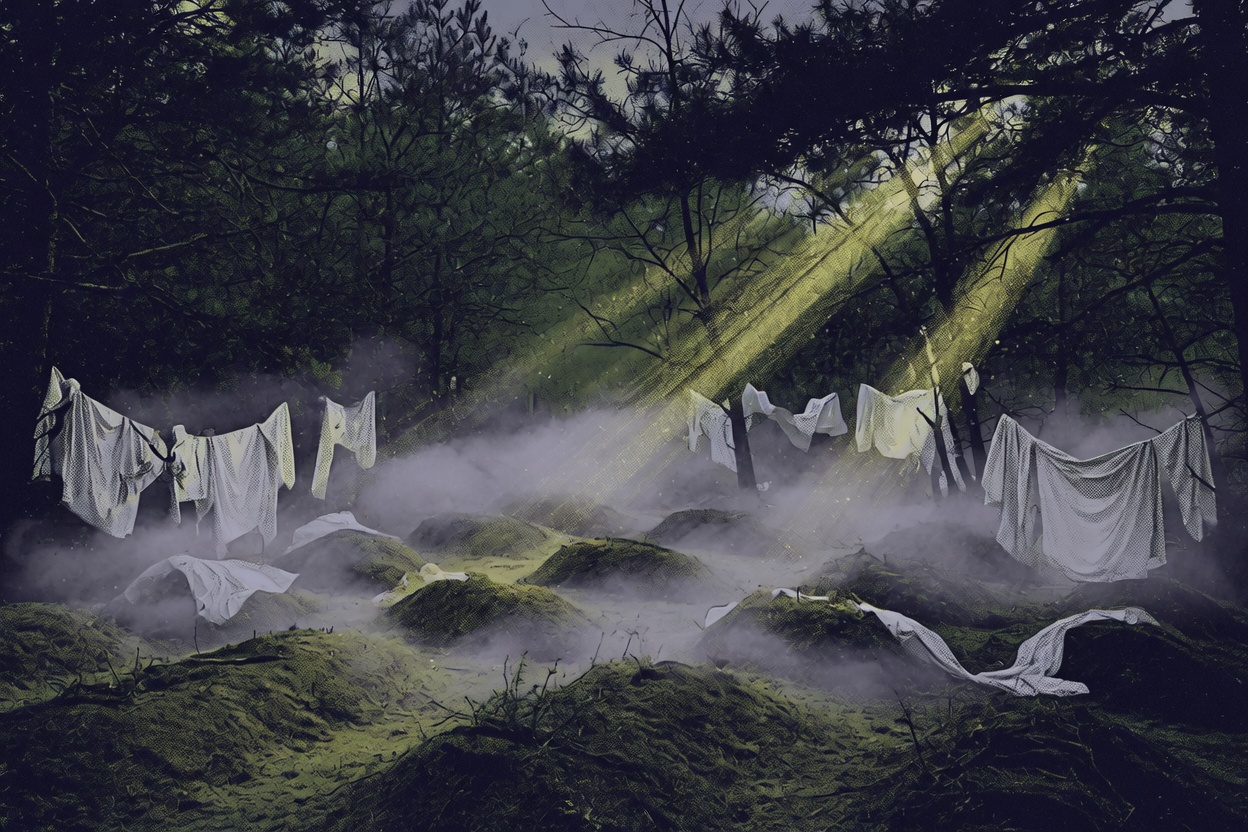
Seventeen men were hired from a nearby town to dig shallow graves, some paid just $8 (£6) a day. ‘Every grave we found had at least three bodies,’ James, one of the gravediggers, told the BBC. ‘Some of the remains were of children as young as a few weeks old.’ In one grave, he said, they found 12 bodies of children in a line. ‘It was massive, the bodies were arranged like clothes. One on top of another.’ Gravediggers described children’s bodies as having had their hands and legs tied and wrapped in bedsheets. Deaths were caused by starvation, strangulation, and bludgeoning. A witness told the court that a pregnant woman was barred from nursing her newborn baby, who died after 12 days. She was instructed to fast to death and follow her children. A co-accused said Mackenzie told followers that anyone who resisted the directive to fast must be forced to go to heaven ‘through kicks and blows.’ Salim Karisa, another gravedigger, said they would sometimes carry people on their motorbikes into the forest, but it was so planned and secretive that nobody could tell what was happening inside. Many bodies remain unidentified owing to advanced decomposition, and some are referred to in court documents as ‘unknown male child.’ Stephen Mwiti, 48, who lost all six of his children to the cult, said: ‘All six of my children died in Shakahola forest.’ He found and buried the remains of only one, his son Samuel.
Discovery and arrest
Mackenzie, a former taxi driver, had been on the radar of authorities since 2017, when his premises were searched by police. The plight of his followers began to emerge in mid-March 2023, when a local man told police his brother and wife had starved their children to death on Mackenzie’s orders. Mackenzie was arrested but released on bail. Relatives say he then brought forward the date he told followers the world would end. Police arrested him again in April 2023 and began systematically combing the forest and exhuming mass graves. President William Ruto said in 2023 that government agencies should have prevented the deaths and took responsibility as president. The case has led to calls for tougher oversight of churches and religious organisations in Kenya.
The verdict and what remains
Mackenzie and his associates pleaded not guilty and denied forcing anyone to starve. The court rejected that argument. In court, Mackenzie wore a striped polo shirt and red trousers, sitting alongside his wife, a co-accused, silent and staring into space before the ruling. Relatives of those who died gathered to hear the judgment. Francis Wanje, 62, lost eight family members including two grandchildren. Before the verdict, he said: ‘It has been really a heavy thing for us as a family, and it has really taken us very far in terms of psychological problems. I was hoping for this particular day.’ Mackenzie faces other charges including terrorism, radicalisation, and denying education to children, all of which he has denied. Prosecutors say that while in detention, Mackenzie directed the deaths of 52 people in Kwa Binzaro village, about 18 miles from Shakahola; he has pleaded not guilty in that case. Monday’s judgment covered 191 deaths, while investigations into other deaths continue.
Sources & methods
- BBC News, reporting from Mombasa on the conviction, cult history, gravedigger testimony, and survivor accounts Archived Oct 19, 2026
- The Guardian, reporting on the verdict, the scale of recovered bodies, Mackenzie's background, and government response Archived Oct 19, 2026
- Al Jazeera, reporting on the court's guilty verdict and the charges Mackenzie faces Archived Oct 19, 2026
This article draws on court proceedings at Mombasa high court, witness testimony reported by the BBC and The Guardian, and statements from Kenyan authorities and President William Ruto. Direct quotes are drawn from interviews conducted by the BBC with gravediggers and survivors, and by The Guardian with relatives of victims.