At least 44 die as overcrowded ferry capsizes on Zimbabwe’s Lake Kariba
The vessel was carrying well beyond its rated capacity when a strong wave overturned it on Tuesday. Search operations continue on the lake.
At least 44 people have died after an overcrowded ferry capsized on Lake Kariba in Zimbabwe on Tuesday, police said, as search and rescue operations continue on one of the world’s largest man-made lakes.
The vessel was overcrowded. The ferry had a rated capacity of 90 passengers and five crew but was carrying far more people than that, according to Zimbabwe’s Civil Protection Unit, which cited registered ticket sales in its initial assessment. President Emmerson Mnangagwa declared a state of disaster to mobilize resources for the rescue effort.
Conflicting accounts and eyewitness reports
Conflicting accounts have emerged. The CPU cited registered ticket sales showing 114 adult passengers, five crew, and an unknown number of children below ticketing age. A lake official had earlier reported a total of 120 people, including 12 children. A crew member told the national broadcaster ZBC the figure was 153.
Local MP Mutsa Murombedzi posted a video on X of what she said was the boat at the start of the journey, adding that residents had been travelling across the lake to Kariba town, about five hours away. She demanded transparency. “We have very hard questions that require honest answers. The officials must release the correct number of people who were onboard,” she wrote.
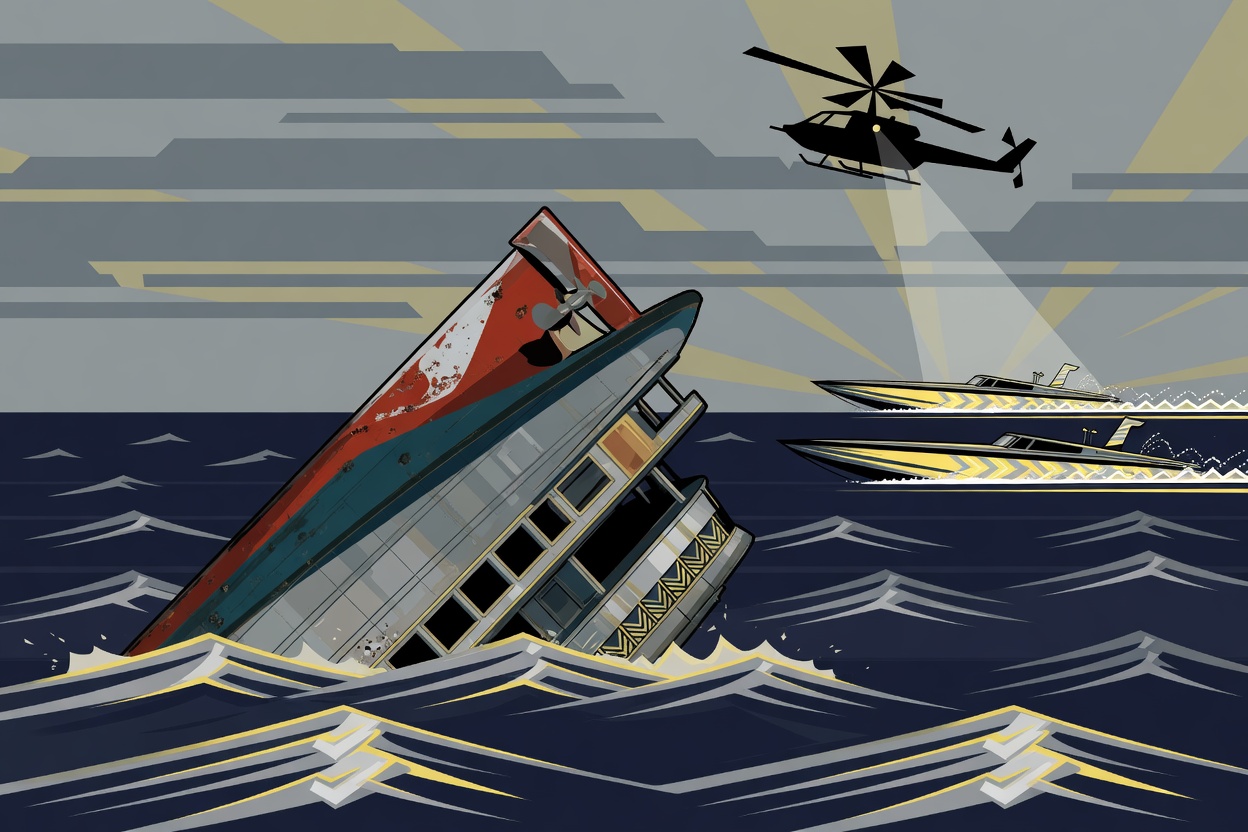
The ferry was hit by a strong wave and overturned, police said. 77 people have been rescued so far. Footage shared online showed the overturned hull floating in the water, with several people appearing to sit on the upturned ferry while at least four speedboats came to their aid and a helicopter circled overhead.
An eyewitness, Maxton Kanhema, told AFP news agency that the boat had travelled in bad weather and may have been hit by a wave, causing its engines to switch off. “People were in distress... there were bodies in the water and it was a sad situation to witness. Those that could be rescued were rescued,” he was quoted as saying. He had earlier filmed the lake from the shore, noting that it was “angry.” “A few moments later I get over 200 calls about [the ferry] sinking. A sad day indeed,” he wrote on Facebook. Kanhema, who describes himself as a media practitioner, originally posted the video that was later shared by the national broadcaster ZBC.
A passenger told the national broadcaster ZBC that the boat began taking on water about 30 minutes after it left the lakeshore town of Kariba, heading for islands and fishing camps.
Rising toll and a history of accidents
A specialised underwater team was flown to the area as search and rescue continued on Wednesday, the CPU said, with the death toll initially standing at 15 and 27 people known to be missing. Police then updated the toll in posts on X twice within 32 minutes on Wednesday afternoon. The first post raised the count from 15 to 38. The second post brought it to 44. The bodies have been retrieved from the lake, police said.
Local government minister Daniel Garwe said the disaster declaration ensured that all necessary resources were mobilised for search and rescue operations, including an army boat squadron, a police sub-aqua unit, and a privately owned helicopter. “The government extends its deepest condolences to the families and loved ones of those who have lost their lives in this tragic incident,” Garwe said in a statement.
Lake Kariba is vast. It is the world’s largest human-made lake by volume, stretching about 150 miles along Zimbabwe’s northern border with Zambia, and supporting transport, fishing, and hydroelectric power for both countries. It was created in the 1950s during British colonial rule when the Zambezi River was dammed, displacing about 57,000 people. The Kariba dam supplies at least a third of both countries’ electricity.
Boat accidents are not uncommon here. In 2014, 26 people, 24 of them children, drowned in Zambia’s part of the lake when a boat meant to transport them to independence day celebrations capsized. On the Zimbabwean side, five drowned in 2021 and three were feared dead in an October 2023 capsizing. A month before that, a police boat overturned, though no one died.
Sources & methods
- BBC News article on the Lake Kariba ferry sinking, reporting police statements, eyewitness accounts, CPU figures, and President Mnangagwa's disaster declaration. Archived Aug 12, 2026
- Guardian article providing additional details on passenger counts from a crew member, ZBC reporting, death toll updates on X, and historical context of boat accidents on Lake Kariba. Archived Aug 12, 2026
This piece was reported using two published accounts of the Lake Kariba ferry disaster, one from the BBC and one from the Guardian, cross-referencing details on passenger counts, rescue efforts, eyewitness statements, and the lake’s history of capsizing incidents.