Macron condemns nationwide riots and looting but stops short of declaring a state of emergency
The president promised increased security after Saturday’s violence left nearly 2,400 arrested and about 1,000 police injured, drawing criticism from both left and right before next year’s election.
French President Emmanuel Macron gave a national address condemning nationwide riots and looting that swept France over the weekend. He promised to increase security but stopped short of announcing a state of emergency or curfew.
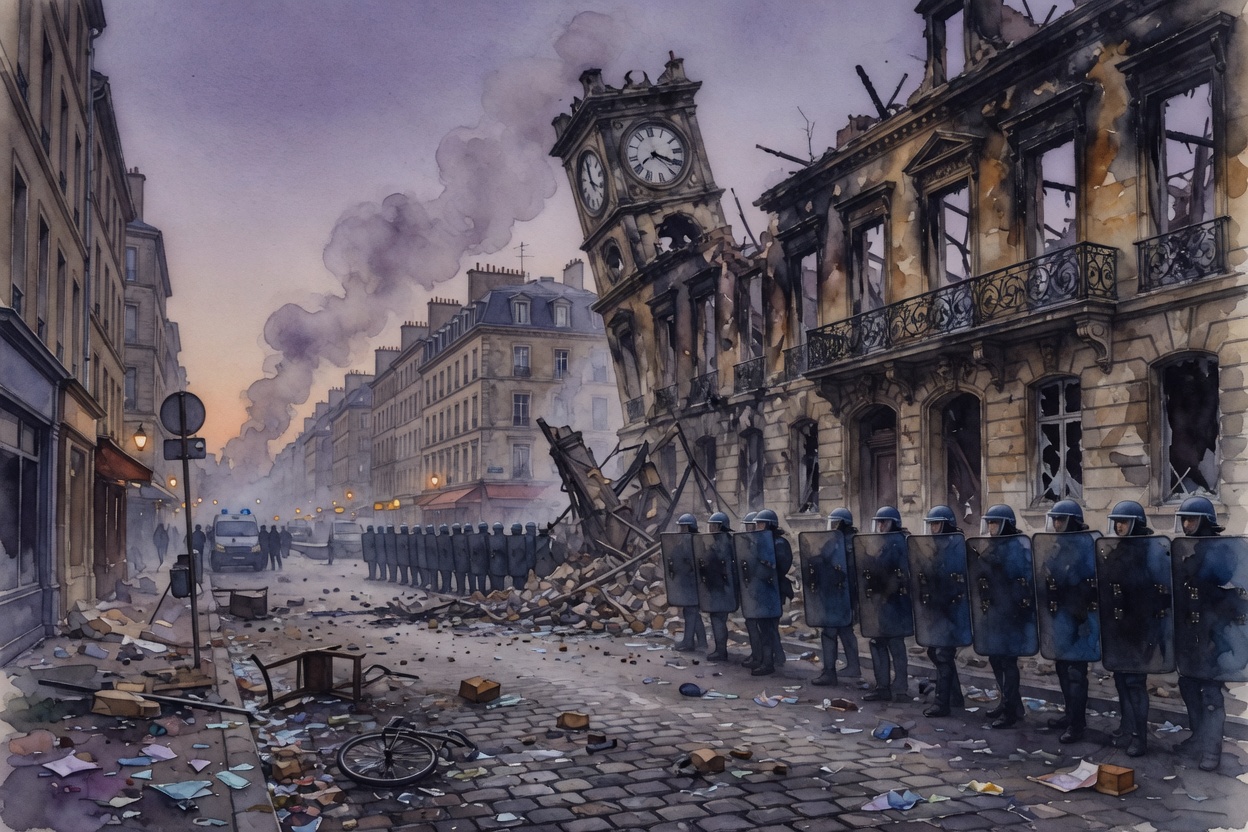
Some 550,000 demonstrators took to the streets on Saturday for largely peaceful protests against rising fuel prices, the cost of living, and deteriorating public services, including schools. Student protests that began last month escalated significantly on Saturday after being joined by trade union members and other anti-government groups. The day spiraled into some of the worst urban violence France has seen in years. Nearly 2,400 people were arrested on Saturday, according to France’s Interior Ministry, and about 1,000 police officers were injured, seven of them seriously. Groups of rioters, some dressed in black and wearing masks, set fire to cars and buildings in Paris, Marseille, and other towns and cities. Widespread looting took place across Paris, Marseille, Lille, and other areas. Tear gas and water cannon were turned on crowds over the weekend, and riot police were seen hitting people with batons in several places.
In a televised address from the Élysée Palace on Sunday, Macron called for ‘calm and order’ and expressed ‘anger and shame’ over the violence. He drew a distinction between protesters with ‘legitimate demands’ and ‘those who destroyed, smashed, and looted,’ describing violent protesters as seeking ‘to bring down the republic.’ He pledged that rioters and looters would ‘pay for their crimes’ and promised to launch a ‘crisis unit’ to provide ‘urgent aid’ for those going through difficult moments. ‘We need to be clear: yesterday, our law enforcement officers and officials, despite their professionalism, were subjected to unprecedented violence in several cities,’ he said. Macron added that ‘lessons will be learned’ and that he had asked the government to anticipate future violence, saying: ‘I’ve asked the government to provide all the lessons learned and to be able to anticipate it to make sure that this does not happen again.’ He said there would be ‘full transparency’ over the police response and that local prefects and mayors would draft measures to protect shops and civic buildings.
Heritage lost and streets ablaze
In Limoges, the ornate 19th Century city hall was gutted by a fire started by rioters on Saturday. Its clock tower and roof collapsed as the flames took hold. Speaking near the ruined building, a resident named Annèyse said: ‘This is very upsetting. Harming heritage buildings just because you are angry at the government is selfish, I think. It’s hurting everybody.’ Another resident, Gerrard, said: ‘It’s awful and unbelievable. We are very sad and I think it will be a long time to put it back as it was before.’
On Sunday, looting and clashes with police continued on a smaller scale in parts of Paris and Lyon. Tear gas and stun grenades were fired at hundreds of people in Paris, according to the AFP news agency, and bottles and rocks were hurled at police.
Political crossfire ahead of the election
The protests are quickly becoming a political flashpoint ahead of a presidential election next year, in April. Jean-Luc Mélenchon, leader of the hard-left La France Insoumise party, heavily criticised Interior Minister Laurent Nuñez and police chiefs on social media, calling them ‘specialists in organised chaos’ who had ‘shown complete incompetence’ in their handling of the demonstrations. The left-wing presidential candidate also said the French government is ‘solely responsible’ for the destruction during the protests and has ‘failed to organise the maintenance of public order.’ Marine Le Pen, leader of the hard-right National Rally party, condemned the ‘exploitation’ of anger ‘by political forces that encourage violence.’ Far-right presidential hopeful Jordan Bardella called Macron’s speech ‘lamentable’ and ‘cowardly,’ saying the government ‘cannot even protect’ the French people. Al Jazeera’s Natacha Butler, reporting from Paris, said the speech had ‘perhaps no surprises.’ She added that protesters say they are fed up of hearing such speeches by the French president.
Interior Minister Laurent Nuñez said that while demonstrating was a fundamental right, ‘outrages’ were committed by ‘several thousand far-left individuals’ determined to target public buildings and confront police. They were later joined, he said, by ‘delinquents who looted and ransacked numerous businesses in several cities in France.’
Sources & methods
- BBC News reporting on Macron's address, the scope of Saturday's protests and violence, the destruction of Limoges city hall, and political reactions from Mélenchon, Le Pen, and Nuñez. Archived Oct 18, 2026
- Al Jazeera reporting on Macron's televised address, his refusal to declare a state of emergency, his remarks on the crisis unit and lessons learned, and political reactions from Mélenchon, Bardella, and Butler. Archived Oct 18, 2026
This article draws on two published news reports, one from BBC News and one from Al Jazeera, covering President Macron’s national address and the surrounding political fallout. Where the two sources attribute quotes to different political figures or use different phrasings, each has been kept separate and attributed precisely as sourced.