Nepal flood death toll surpasses 1,200 as rescue teams race to find trapped workers and missing villagers
The disaster, triggered by a glacial collapse along the Nepal-Tibet border, has left more than 4,200 people missing and drawn criticism of the initial US aid response.
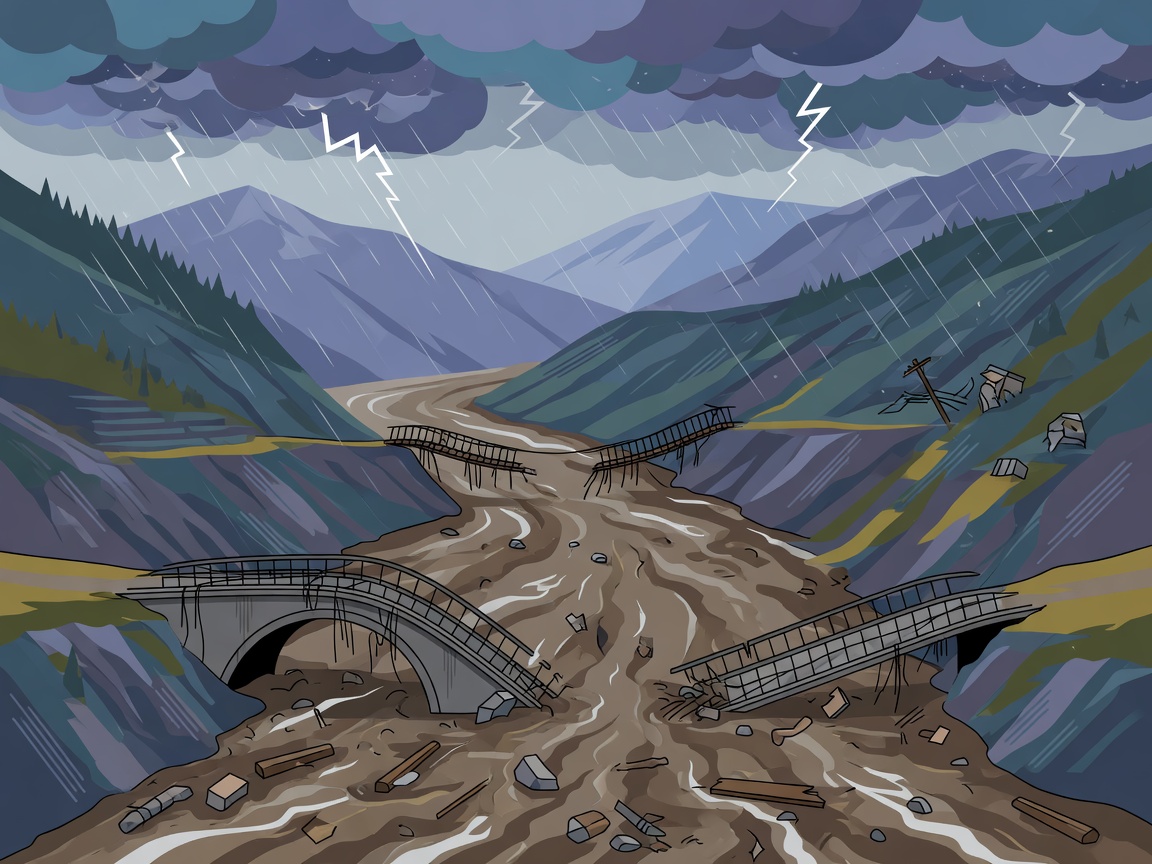
Nepal’s flood death toll has surpassed 1,200 with more than 4,200 people still missing, a week after a glacial collapse along the Nepal-Tibet border unleashed flash floods that destroyed villages and buried hydropower tunnels in mud.
Nearly 12,000 people have been rescued, according to Nepal’s disaster management agency, but hundreds of foreign nationals from India, the UK, Australia, the US, Malaysia, and elsewhere remain unaccounted for. On the Tibetan side, Chinese state media report 21 dead and more than 540 missing. Fears are growing that the death toll will only rise.
Workers believed trapped in Nepalese hydropower tunnels remain a focus of rescue operations. Experts from China and India are helping build temporary bridges. Drones scan for survivors. The UN’s Office for the Coordination of Humanitarian Affairs says more than 40 bridges have been destroyed, making access the primary obstacle to reaching remote communities that depend on army helicopter flights for supplies.
Access and displacement
Nearly 3,500 people have been left homeless and displaced across 27 sites, mostly schools, in the districts of Nuwakot and Rasuwa. Education is disrupted. Overcrowded shelters, contaminated water, and damaged health facilities are putting the population at greater risk of disease during monsoon season, OCHA said. Chinese rescue teams using heavy machinery have reopened the route to the Gyirong border crossing and cleared debris, which Chinese state media said will accelerate the search. The full impact of the flood in Tibet remains unclear. China has released information through state media showing devastation around the border but given few details about victims or the impact on local villagers.
Warnings and climate context
Nepal’s Prime Minister, Balendra Shah, told parliament the disaster “snatched away mothers, fathers, sisters, and brothers from us in an instant.” He said he received news at 08:45 local time on 26 August that a flood had hit, and 15 minutes later district offices urged riverbank residents to evacuate. Precautionary warnings reached mobile phones at 09:35. He said the disaster was “beyond predictable forecasts.”
A new report found evidence of growing instability around the glacier in the days before the collapse. Experts from the Asian Mountain Academic Alliance, the Stimson Centre, and China’s Institute of Mountain Hazards and Environment said better early-warning systems could have saved lives. Scientists have warned for years about melting ice and permafrost, centuries-old frozen soil, in the Himalayas due to climate change. Shah said the time had come to “present a strong case before the international community regarding the disasters we are suffering.”
He called climate change “a global contribution” and said managing its impacts is “a shared responsibility of the global community.” Nepal has declared a disaster in 15 affected areas for three months to provide financial assistance to families of the dead, rescue and relocate the displaced, and deploy the army. The government and the UN have agreed to launch a four-month humanitarian flash appeal.
US aid draws criticism
The US initially released $500,000 in emergency funds. Aid experts condemned the amount. Mark Ward, a former head of USAID’s disaster response team, called it “embarrassing for the United States and a bit of a slap at Nepal.” After news of the floods broke, outgoing White House press secretary Karoline Leavitt said the US embassy in Nepal was “in close contact with local authorities on the ground” and that the first priority was rescuing Americans. The contribution has since been increased to $3.6m, which state department officials say will deliver food assistance to 10,000 affected households for up to three months and pay for blankets, mosquito nets, and shelter sheets.
USAID was terminated as an independent agency in July 2025 after being dismantled by the unofficial “department of government efficiency” led by Elon Musk, and its functions were taken over by the state department. Ward said that under USAID, a disaster assistance response team would have been on the ground immediately to assess needs because of the agency’s close working relationship with Nepal. George Ingram, a senior fellow at the Brookings Institution, said he was “embarrassed for America” and that an initial offering of half a million dollars was “pitiful.” Ward, who worked on previous disasters in Nepal, said it was the country that USAID had the closest relationship with because of its susceptibility to earthquakes and other natural catastrophes.
The state department has said the initial $500,000 was “designed to get immediate assistance moving while assessments were under way” and insisted the dismantling of USAID had “not slowed the US response.” Ward argued that the US decision to skimp on foreign aid was a false economy, noting that relief efforts are now being led by Nepal’s neighbors, India and China. “Is it really in the interest of the United States to have China and India in the lead?” he said.
Sources & methods
- BBC News report on Nepal's relief and recovery efforts after deadly border floods, citing UN statements, Nepal's disaster agency, Chinese state media, and comments from Nepal's Prime Minister Balendra Shah Archived Sep 2, 2026
- Guardian report on expert criticism of the initial US aid contribution for Nepal flood victims, citing former USAID officials, Brookings Institution fellows, and state department responses Archived Sep 2, 2026
This article was compiled from two published news reports on the Nepal flood disaster and the US aid response. Death toll figures, rescue details, and official statements were cross-referenced between both sources.