Russian corvette Merkury sinks in Benghazi after suspected drone strike
Satellite imagery confirmed the sinking of the Russian warship at dawn on Sunday, while a second Russia-linked cargo vessel was struck hours later off the Libyan coast.
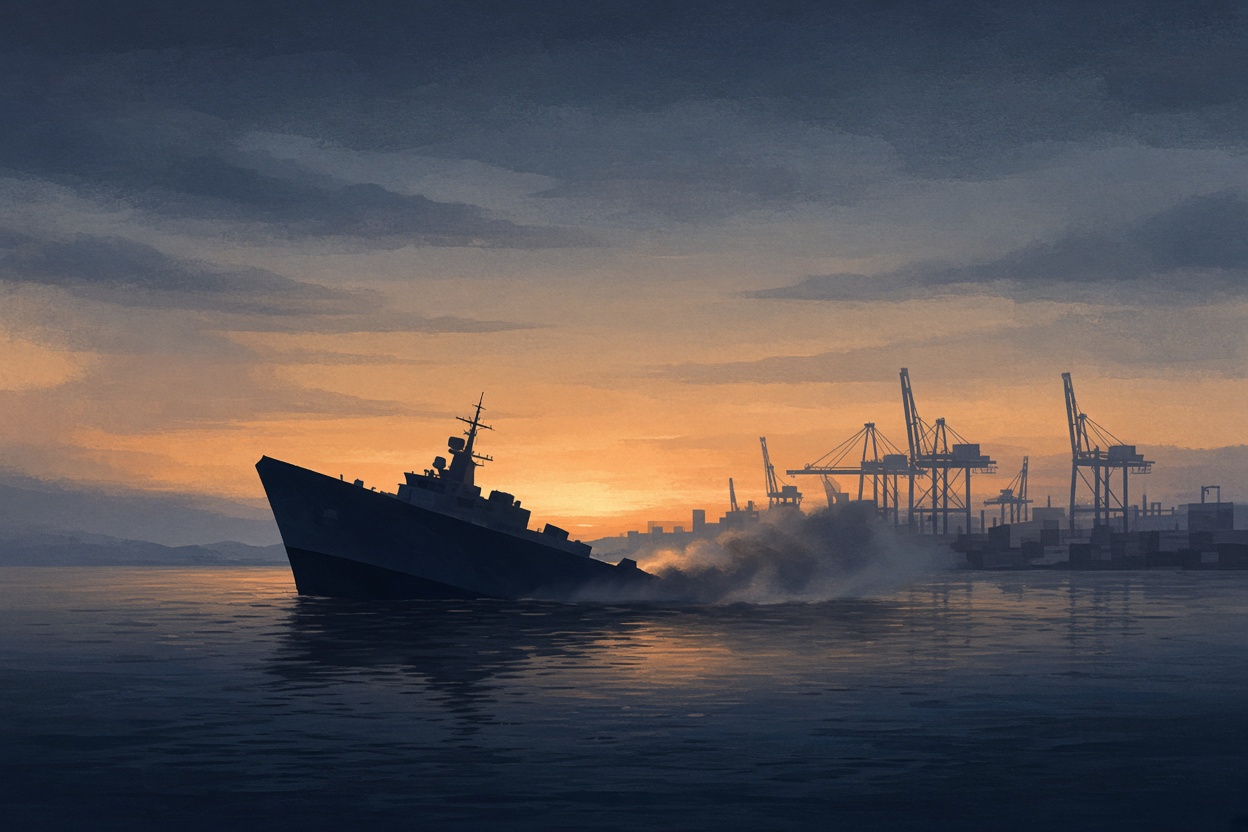
The Russian navy corvette Merkury was struck by a suspected drone attack at the port of Benghazi at dawn on Sunday, and satellite imagery showed the ship had sunk. The vessel had stopped for fuel and supplies while en route back to Russia, Libyan officials said.
Satellite imagery from Planet Labs PBC showed a boat on fire at 05:47 GMT on Sunday at the Benghazi port. High-resolution images collected by the US-based intelligence firm Vantor showed the Merkury moored in the port on Saturday, then on Sunday showed most of the ship capsized and sunk with only the forward bow still visible. The Merkury was identified as a Project 20380 Steregushchiy-class corvette. The specialist website Naval News earlier identified the ship as the Merkury and said it had almost certainly been destroyed, while naval analyst HI Sutton said the attack was probably conducted by sea drones, after a photograph of one emerged apparently taken off the Libyan coast. Libyan officials told the Associated Press that at least four drones were intercepted and destroyed, and two hit the warship, triggering the explosion. The eastern government said there were no casualties from the attack on the warship.
Second vessel struck hours later
Hours later, a second vessel was targeted by a sea drone off the coast of Benghazi. The ship was named the Ascalon, a Russia-linked cargo vessel said to be carrying military supplies. Libyan naval forces rescued the crew of the Ascalon. The health ministry said the injured had minor injuries and were in stable condition. The exact number of injured and their nationalities are not known.
Libyan reactions and the sovereignty question
The eastern-based Government of National Stability condemned the attack as a violation of Libya’s sovereignty and a threat to maritime safety. The GNS said the Russian ship was using the Benghazi port within the framework of an existing maritime agreement, and that Libya was not party to the Russia-Ukraine war or any other conflict beyond its borders. Authorities are coordinating with Russian counterparts to determine the source of the suspected attack, the GNS said, and would take legal and diplomatic measures against anyone found responsible. The eastern-based authority said Libyan ports, territory, and territorial waters would not be turned into an arena for settling scores or exporting international conflicts. The Tripoli-based Government of National Unity warned against hosting foreign forces and allowing them to use facilities, saying such activity raises serious fears about risks from involving ports and civilian facilities in external conflicts. The UN mission in Libya expressed serious concern over the attacks and called for an immediate, independent, and transparent investigation, writing on X that Libya cannot afford, and must not become, a battleground for foreign conflicts.
Why Benghazi, and who is believed behind it
Benghazi is controlled by forces aligned with Khalifa Haftar, commander of the Libyan National Army, which is aligned with Russia. Russian ships regularly use the port of Benghazi to supply Russian mercenary forces in Africa and as a base in the Mediterranean since Russia lost its bases in Syria. A small unit of Ukrainian special forces operatives has been based at Misrata in western Libya, and is believed to have coordinated drone attacks on Russian tankers and transport ships in the past year. In March, Russia accused Ukraine of targeting the Russian tanker Arctic Metagaz in the Mediterranean between Libya and Malta with uncrewed sea drones launched from the Libyan coast. No claim of responsibility has been made for Sunday’s attack. There was no immediate comment from Russian authorities.
Jalel Harchaoui, a Libya specialist at the Royal United Services Institute, said Ukraine is the only actor brazen enough to pull something like that off. “If I were to bet my own money, I would bet that it was the Ukrainians,” he told the BBC. He added that there would be a response by the Haftar family, and that they would ask questions about who is hosting the Ukrainians. Libya fractured into violence and instability after Muammar Gaddafi was overthrown in 2011, leading to the opposing eastern and Tripoli governments that exist today.
Parallel strike in the Baltic
Separately, a Russian cargo ship, the Sparta II, was struck by drones in the Baltic Sea on Saturday, an attack the Finnish military said was probably carried out by Ukraine. The 16 crew members were evacuated onto a nearby Russian ship, and one crew member was slightly injured. The vessel, bound for the Russian exclave of Kaliningrad, was damaged in international waters west of Russia’s Gogland Island and drifted into Finnish waters, where it remained at anchor. A fire onboard continued to smoulder on Sunday, according to Finland’s border guard. Estonian navy commander Ivo Värk told the public broadcaster ERR that the risk of further attacks in the Gulf of Finland could not be ruled out. Finland’s military said last week it had detected a strike on a Russian warship in the same area during Ukrainian drone attacks.
Whether the Baltic and Benghazi attacks are connected is not established.
Sources & methods
- BBC News, reporting on the Benghazi port explosion, satellite imagery, Libyan government statements, and analysis by Jalel Harchaoui of RUSI Archived Nov 23, 2026
- The Guardian, reporting on the sinking of the Merkury, the Ascalon cargo ship strike, Libyan official accounts via the Associated Press, analysis by Naval News and HI Sutton, and the Baltic Sea Sparta II incident Archived Nov 23, 2026
Reporting drew on satellite imagery from Planet Labs PBC and Vantor, social media video geolocated by BBC Verify, statements from Libyan officials cited by state media and the Associated Press, analysis from Naval News and naval analyst HI Sutton, remarks by Jalel Harchaoui of RUSI, and accounts from Finnish and Estonian military authorities.