Russian strikes across Ukraine killed at least six people overnight as Moscow reported intercepting hundreds of Ukrainian drones over its territory and the annexed Crimean Peninsula, marking a sharp escalation in attacks on Black Sea shipping and border regions.
The overnight attacks hit hard. Three people died in Balakliya, in the eastern Kharkiv region, after Russian strikes on homes, according to Vitalii Karabanov, head of the military administration in the front-line city, who said the victims were two women and a man. Three more were killed and at least 19 wounded in the northern region of Sumy, where 12 people were wounded in the city of Sumy following an attack with guided aerial bombs, according to Ukrainian police. Two people were wounded in a Russian attack in the Dnipropetrovsk region, said Oleksandr Ganzha, head of the regional military administration. A drone attack on a van wounded six in the southern region of Kherson, the regional administration said on Telegram.
Russia’s Ministry of Defence said its forces shot down 605 Ukrainian aerial drones overnight. “During the night … air defence systems intercepted and destroyed 605 Ukrainian aerial drones,” the ministry said in a statement. Local authorities reported that a logistics centre belonging to Russian e-commerce giant Wildberries had been slightly damaged, days after another Wildberries warehouse was struck in the Tver region northwest of Moscow. At least 20 warehouses owned by the company have been attacked since July 18. Kyiv alleges the online retailer, Russia’s largest, plays a crucial role in Moscow’s war effort by supplying dual-use items that can be used for military purposes. Later on Thursday, President Volodymyr Zelenskyy said the military hit two oil refineries deep inside Russia: the Bashneft-Novoil refinery in the republic of Bashkortostan and the Slavnet-Yanos refinery in the Yaroslavl region. Mikhail Evrayev, the regional governor in Yaroslavl, said the refinery was on fire after a Ukrainian drone attack, with emergency services working to extinguish the blaze after falling debris struck the storage tanks.
Black Sea under siege
The violence on land is mirrored at sea. In Ukraine’s Black Sea area, a Russian attack damaged a foreign-flagged ship loaded with wheat, killing a crew member and causing a fire, said Oleh Kiper, Odesa’s regional governor. Ukraine’s seaport administration said the vessel Mera Queen, under the flag of Guinea-Bissau, was hit late on Wednesday. For more than a month, Russia has been ramping up attacks on Ukraine’s Black Sea ports, launching near-daily strikes along the country’s coastline in an effort to strangle Ukraine’s commercial links to the outside world. According to Ukraine’s port administration, July saw 57 Russian attacks on civilian vessels, 22 of them at sea, and a further 67 hits on port infrastructure. While there have been Russian attacks on international vessels before, they have never been so numerous or so deadly.
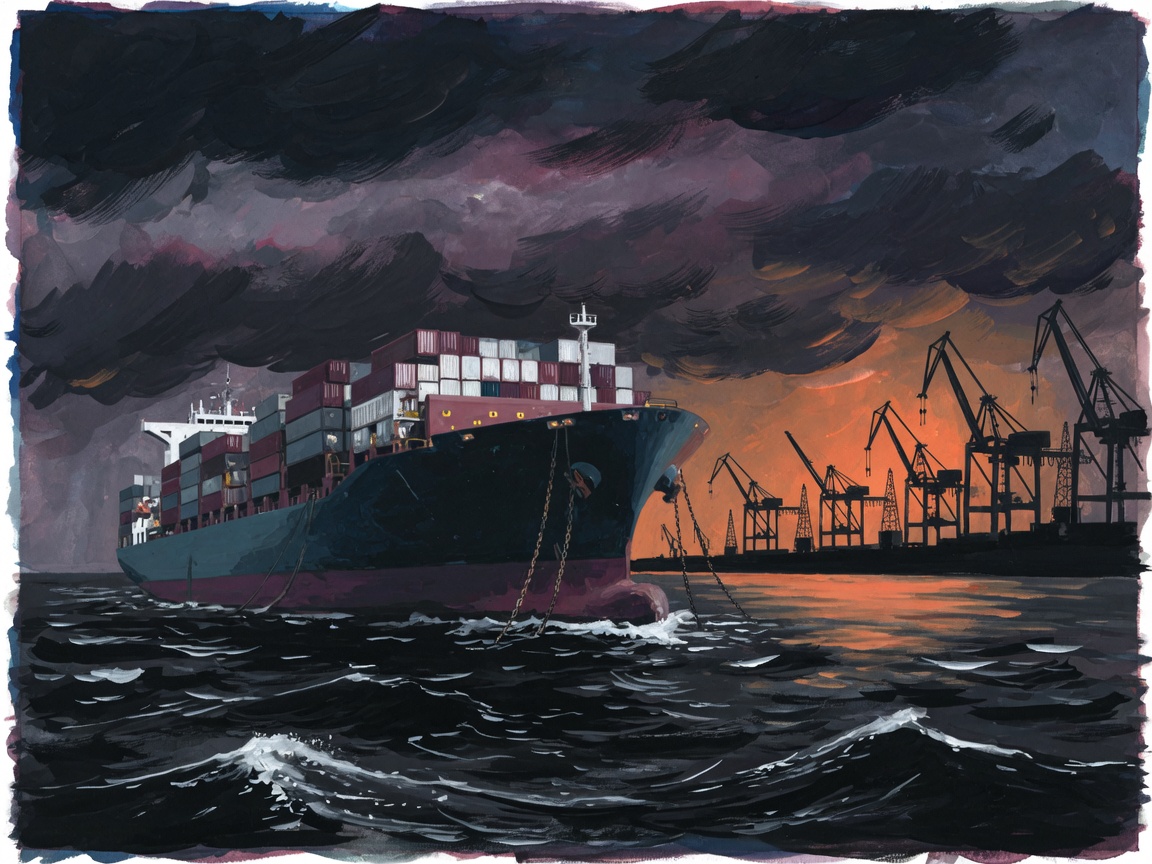
On July 19, a Turkish-owned cargo vessel, Golden Leo, was struck by three Russian missiles, killing nine Indian and Syrian crew members and a Ukrainian pilot. The ship, carrying Ukrainian corn, sank off Odesa a week later. According to the global shipping journal Lloyd’s List, the Black Sea may now be the most dangerous place for shipping in the world, with July the deadliest month for merchant seamen since Russia’s full-scale invasion of Ukraine began. In Odesa, the evidence is everywhere. From damaged port infrastructure to listing ships with bridges blackened and containers still smouldering, the approaches to Ukraine’s once bustling ports, Odesa, Chornomorsk, and Pivdennyi, are almost devoid of ships. The ports stand empty.
On a rare visit to one of the area’s main ports, reporters saw almost no sign of movement, with hundreds of metres of berths sitting empty and towering gantry cranes standing idle as a skeleton crew conducted maintenance. Two damaged cargo vessels were moored nearby, both having suffered severe damage to the superstructure where the bridge and crew quarters are located. Odesa’s proximity to Russian-occupied territory means workers often have little time to react. “A missile flies from Crimea within a minute,” said Oleg Grygoriuk, Chairman of the Marine Transport Workers Union of Ukraine. “If you are sitting in a crane, you need three and a half minutes to get down and go to the shelter. There’s literally no time to do that.”
A senior port manager, who spoke on condition of anonymity, said recent alerts have forced the port to shut down for 15 out of 24 hours. He referenced the UN-brokered 2022 Black Sea Grain Initiative, which had established safe maritime corridors to Odesa’s main ports before Russia withdrew in mid-2023, noting that systematic attacks on the ports began only recently. Technically, the port remains open, and there is no prohibition on commercial ships attempting to use it. But the risks are too great for most shipowners. “There is barely anybody who wants to call because there is a huge problem with people getting killed,” said Andrey Stavnitser, co-owner and CEO of one of the largest ports in the area. “We can see that the whole supply chain is on hold.” Stavnitser said Russia is almost certainly retaliating for Ukraine’s recent attacks on Russian shipping, including sanctioned vessels carrying oil and other ships involved in ferrying supplies to Russian-occupied Crimea. Using its own drones, Ukraine’s Operation MoLoChKa, which roughly translates as “Moscow will fall through Crimea,” has struck around 200 Russian vessels, bringing traffic in the strategic Sea of Azov to a virtual standstill.
Ukrainians bristle at the suggestion that Russia and Ukraine are playing the same game. Kyiv is attempting to loosen Moscow’s grip on occupied territory, they point out, while Russia is preventing Ukraine from exporting badly needed grain to the international market. With Ukraine’s summer grain harvest under way, the timing could hardly be worse. “It’s the most sensitive period,” said Volodymyr Slavinskyi, trading director for Nibulon, one of the country’s leading grain exporters. “Farmers need to quickly harvest grains from the fields, not to lose the crop. They need to be able to sell the crop they harvested and reinvest money in the next production cycle.”
Ukraine is one of the world’s largest producers of grain and oilseeds, supplying around six percent of global wheat exports before Russia’s full-scale invasion and 10 percent of corn exports. But its export capacity has dropped by at least a third since the invasion began. Last year, the Greater Odesa ports accounted for more than 73 million tonnes of Ukraine’s maritime exports, with grain accounting for 38 million tonnes. With almost no vessels currently moving on Ukraine’s Black Sea shipping corridor, traders are already counting the cost. “I would say we’ve already lost the ability to deliver to global customers around half a million or 700,000 metric tons of Ukrainian grains and oilseeds,” Slavinskyi said.