Thieves steal 673-diamond necklace from Vienna museum in daytime raid
Two men bought exhibition tickets before smashing a display case and fleeing with a platinum necklace once worn by Egyptian royalty, as European museums face a wave of violent heists.
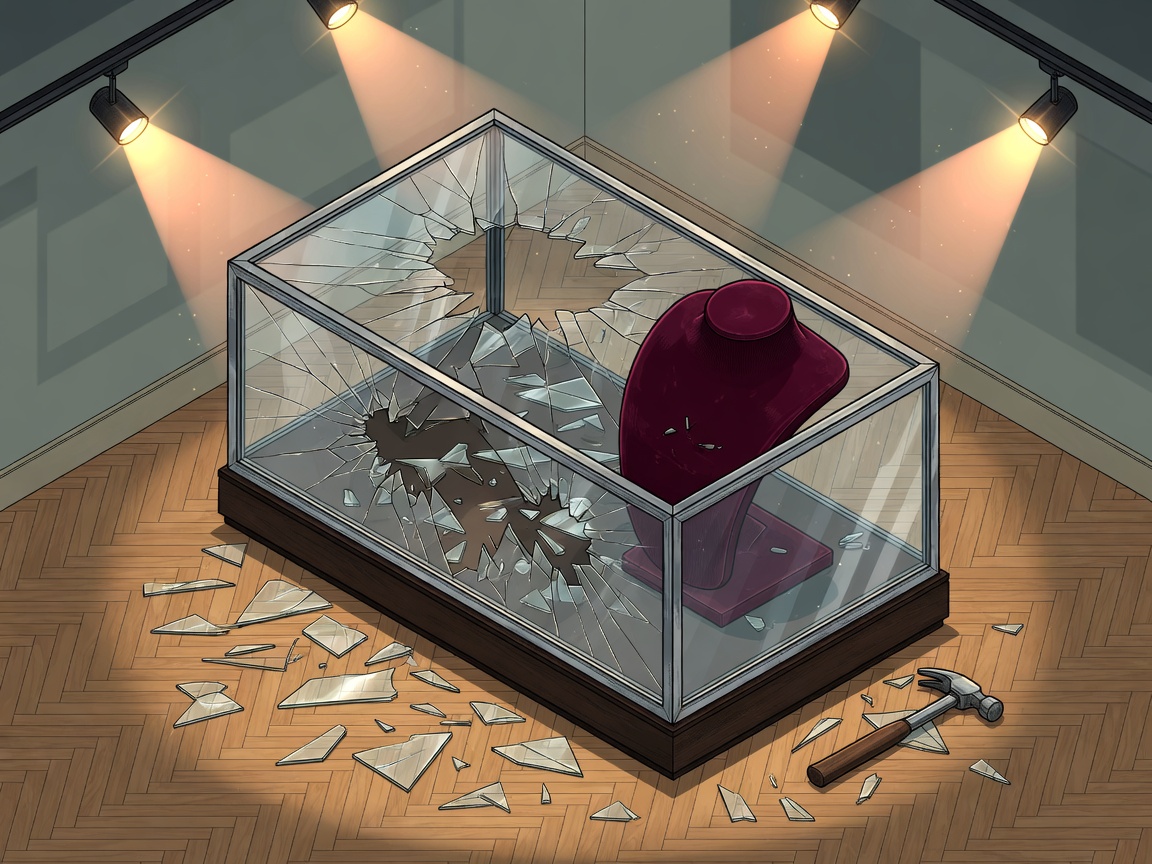
Two unmasked men bought exhibition tickets at Vienna’s Museum of Applied Arts on Thursday afternoon, then shattered a glass display case with a hammer and seized a platinum necklace encrusted with 673 diamonds that once belonged to Egyptian royalty.
The brazen daytime theft has triggered an international manhunt. Austrian police released security-camera photographs of the two suspects, who were captured unmasked, and appealed to the public to come forward with information. Officers fanned out through the city centre and deployed a police tracking dog to search for the men. Forensic experts analysed evidence and CCTV footage, and police dog units were deployed across Vienna and the neighbouring province of Lower Austria in the search. The theft occurred during opening hours. One of the perpetrators was believed to have been carrying what was thought to be a real firearm. They fled toward the Vienna Stadtpark, just south of the museum. The Kronen newspaper reported that investigators believe the men were probably carrying out a “contract job” on behalf of a criminal gang. The search continues.
A jewel with a royal past
The necklace was designed for the former Egyptian royal family and was part of an exhibition on the jewellers Van Cleef & Arpels that had been on display at MAK since June. The necklace was on loan to the museum. Queen Consort Nazli of Egypt wore the necklace at the 1939 wedding of her daughter Fawzia to Iran’s then crown prince, Mohammad Reza Pahlavi, who later became shah, according to documentation for the show. Van Cleef & Arpels has described the piece as a “triumph of white jewellery.” The diamonds on the necklace weigh in excess of 200 carats. Sotheby’s sold the necklace in New York in 2015 for $4.3m. When it was auctioned a decade ago, it had an estimated worth of $3.6m to $4.6m. The platinum and diamond necklace is believed to be worth more than $4m.
A wave of European museum heists
The Vienna raid is the latest in a series of spectacular heists of artefacts at European museums. The string of thefts has raised questions about the security of European cultural institutions. European museums have been hit by a string of high-profile heists since thieves broke into the Louvre museum in Paris during the day last October and escaped within minutes with crown jewels worth €88m. On the same day as the Vienna theft, raiders struck in Spain. Thieves stole the Treasure of Villena, a collection of bronze age gold artefacts described as one of Europe’s most important prehistoric hoards. Earlier this month, four Renaissance paintings by the 15th-century master Antonello da Messina were stolen during a national holiday from a museum in the Sicilian port city of Messina. Two days earlier, Italian police said they had recovered three paintings by Cézanne, Renoir, and Matisse that were taken earlier this year from a private museum near the northern city of Parma.
Europol said museum thefts were becoming increasingly aggressive, with a shift towards violent and forceful methods. A report by the agency this month found that robbers at European museums sometimes brandish guns, assault staff, and use sledgehammers, axes, and even explosives to smash their way to targeted loot. The agency added that the trend may indicate the involvement of new criminal networks.
MAK general director Lilli Hollein said in a statement that the theft of a highly valuable piece of jewellery had hit the museum hard. She said that MAK had developed a security plan with Van Cleef & Arpels specifically for the exhibition, and that security issues were taken very seriously and all measures were carefully prepared. She added that MAK had thoroughly reviewed its security measures ahead of the exhibition, particularly in light of the incidents at major museums in recent years. Hollein said staff had reacted calmly and followed the established procedures when the “armed incident” occurred. No one was injured in the raid. There were several witnesses in the room at the time.
The exhibition, which opened in June and was due to end on 27 September, brought together about 200 “unique and rarely seen objects” from the museum’s own collection and pieces spanning the 120-year history of the Parisian jewellery house, from the Van Cleef & Arpels patrimonial collection. It featured more than 300 works by the French designers Van Cleef & Arpels. A guided tour planned for Friday afternoon was listed as cancelled on the museum website. The exhibition was temporarily closed. The exhibition has now reopened.
Sources & methods
- BBC News report on the theft of a 600-plus diamond necklace from Vienna's Museum of Applied Arts, including police statements, museum director comments, and context on European museum heists. Archived Aug 28, 2026
- The Guardian report on the 673-diamond necklace theft in Vienna, with details on the suspects, the necklace's royal provenance, the Sotheby's sale, and a wave of smash-and-grab raids across European museums. Archived Aug 28, 2026
This article was assembled from reporting by the BBC and The Guardian on the Vienna museum theft and the broader pattern of European museum heists. No additional reporting or sourcing was used.