Thousands rally in Prague against government plan to replace licence fee with state-budget funding for public media
Critics say the proposal by Prime Minister Andrej Babis’s government would hand politicians control over broadcasters, as organisers claim the largest public gathering in Czech history.
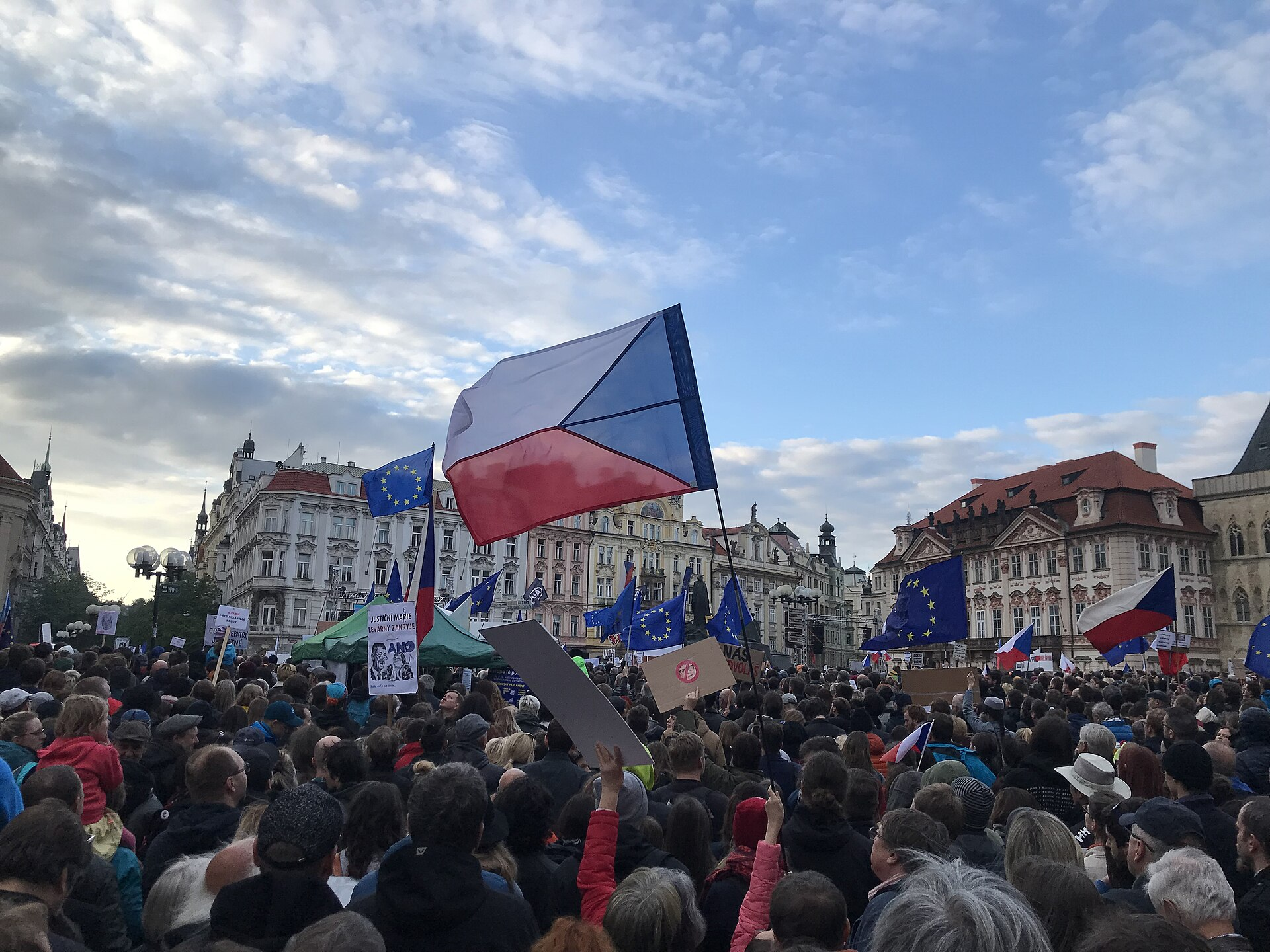
Thousands rallied in Prague on Sunday against a government plan to replace the household licence fee with state-budget funding for public media, as critics warned the change would give politicians more control over the country’s broadcasters.
The protest was organised by Million Moments for Democracy, which said roughly 400,000 people attended and called it possibly the largest public gathering in Czech history. Organisers had expected between 400,000 and 600,000 demonstrators. Many assembled in Letna Park on Sunday afternoon, days before the November 17 holiday commemorating the 1989 Velvet Revolution against Communist rule, which propelled dissident playwright Vaclav Havel to power. Some protesters wore pointed hats folded from newspapers as a tribute to an animated character who has introduced Czech Television’s nightly children’s bedtime stories for decades.
What the proposal would do
Czech households currently pay 205 crowns ($9.44) a month for television and radio. The coalition government, led by billionaire Prime Minister Andrej Babis’s populist ANO party alongside two right-wing Eurosceptic parties, wants to replace that fee with funding drawn from the state budget and has said broadcasters must cut costs. Babis was appointed in December 2025 and has faced criticism over his coalition’s attacks on Czech media. Parliament passed a preliminary vote on the bill last month, and it now awaits further debate.
Babis insists the plan will not affect editorial independence. “The funding system is changing, no one wants to control public media, no one wants to dictate to them what they should say and do, no one wants to nationalise them,” he told the Czech News Agency. He said the existing system was outdated and that most of Europe was moving the same way.
Strikes and international criticism
Broadcast workers have been striking against the proposal since June. Earlier this month, public media employees staged a one-day strike that prompted boycotts of state media by artists and students. The European Broadcasting Union, the European Federation of Journalists, Reporters Without Borders, and the International Press Institute have all criticised the reform. Pavol Szalai, Prague Bureau director of Reporters Without Borders, said in June that political attacks against private and public media had become one of the hallmarks of Babis’s premiership. Critics have compared the bill to changes in Hungary under Viktor Orbán, who tightly controlled state media when he was in power.
European context and media trust
France removed its licence fee in 2022 and now funds public media through a portion of VAT income; its public broadcasters also carry advertising. Norway abolished its licence fee in 2020 and moved its public broadcaster’s funding into the national budget. Trust in the media in the Czech Republic is low, at 30 to 33 percent according to the latest Reuters Institute Digital News Report, though public service journalism ranks among the most trusted news sources and Czech Television is the most-watched broadcaster across several age groups. Million Moments for Democracy said Babis and his government “obviously think they will get away with anything… that they can ignore experts, silence critics and treat democratic institutions like their property.”
Milana Rudolfova, a 72-year-old pensioner, told Reuters that Czech Television is a guarantee of truth and objectivity. “If we do not have public television and radio then unfortunately we will not be able to believe anything anymore,” she said.
Sources & methods
- BBC News, reporting from Prague on the rally, the government proposal, and European comparisons
- Al Jazeera, reporting on the Prague demonstration, strike actions, and international criticism of the reform Archived Nov 15, 2026
This article draws on two published news reports, one from BBC News and one from Al Jazeera, covering the Prague rally, the government’s media funding proposal, and the surrounding controversy. Crowd-size figures are attributed to the organising group, Million Moments for Democracy, as the two source reports differ in their descriptions and no independently verified attendance figure was established.