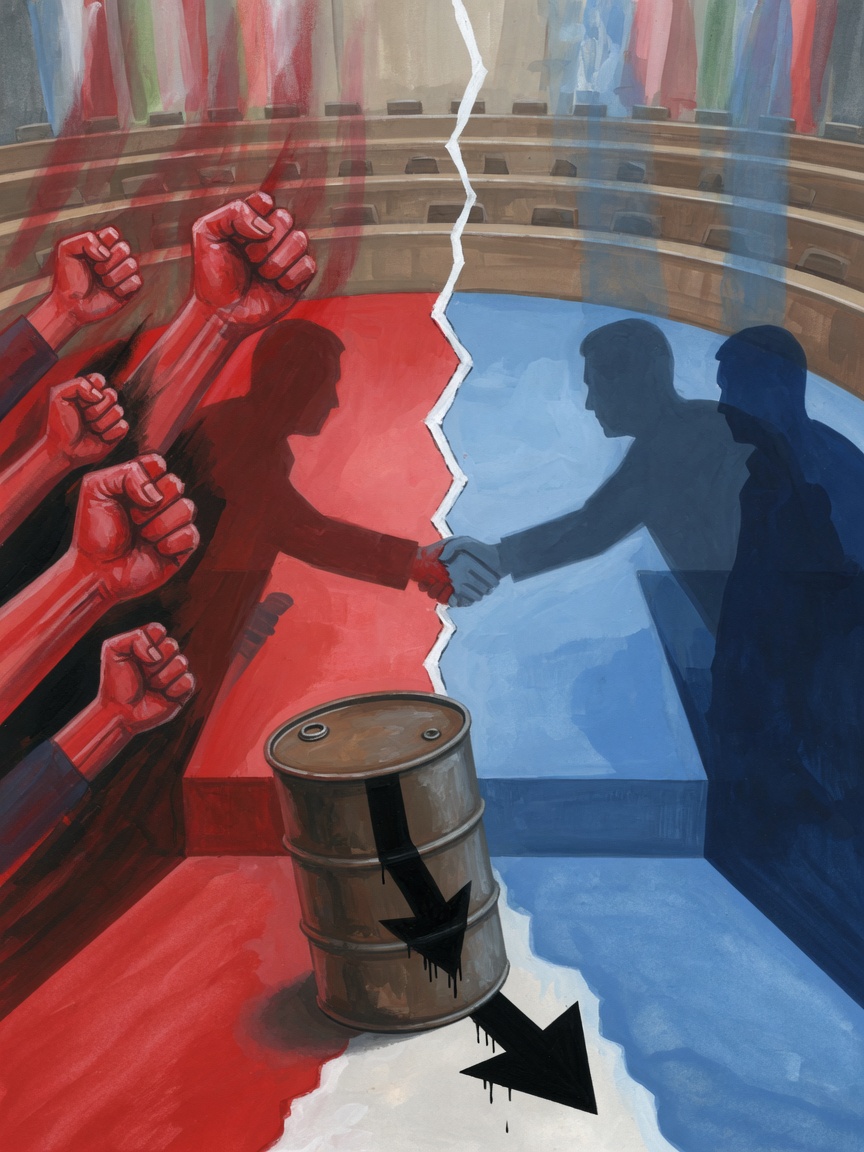
President Donald Trump told the United Nations General Assembly on Tuesday that he could “annihilate” Iran if their conflict remained unresolved, even as American and Iranian officials held a three-hour meeting on the sidelines in New York. The juxtaposition of bellicose rhetoric and concurrent negotiations illustrated what the BBC described as Trump’s foreign-policy strategy of coercive diplomacy, threatening overwhelming military force while keeping talks open.
Before a standing-room-only audience, Trump said he faced a “big decision” between reaching a deal with Tehran and destroying it. “Will a deal be made with Iran that lets them rebuild and create a far greater country than it ever was before?” he said. “Or do I annihilate the Islamic Republic and do it quickly, never giving them a chance to kill and destroy people and countries again?” “Do I drive them into hell?” One Iranian delegate watched.
The war with Iran, which began when the U.S. and Israel launched military action in February, has spiked global oil prices and dragged down Trump’s approval ratings. He spent much of his address justifying the conflict. He argued it had prevented Tehran from obtaining a nuclear weapon and demonstrated the value of what he described as peace through strength, ultimatums rather than deal-making or compromise. Trump predicted an Iran deal would come after November’s elections. His remarks sounded more pitched to voters in those midterms than to the diplomats in Manhattan. He began his speech by touting his accomplishments on the economy, immigration, the border, and tackling violent crime.
On the sidelines, American and Iranian officials held what Trump told reporters was a “very good” three-hour meeting, according to Al Jazeera. The BBC reported he called it “very productive.” Iran state TV confirmed that Foreign Minister Abbas Araghchi had met U.S. Special Envoy to the Middle East Steve Witkoff. Iranian foreign ministry spokesman Esmail Baghaei, quoted by state broadcaster IRNA, said negotiations took place through a Qatari mediator who communicated Tehran’s conditions, including an end to the war on all fronts and to U.S. “acts of aggression.” Witkoff confirmed the format on X. “They successfully completed a round of discussions that we hope will prove constructive and promising,” he wrote. “The mediators will continue their work.” As he was leaving the UN building, Witkoff gave a thumbs up when the BBC asked how the meetings had gone.
Oil markets respond
Oil fell on Wednesday. Optimism grew that supply disruptions would ease following the U.S.-Iran talks, which raised hopes of a diplomatic solution to the conflict in the Middle East. Futures for international benchmark Brent crude for November delivery dropped 0.75 percent to $98.51 a barrel. U.S. West Texas Intermediate futures for November fell 1.03 percent to $89.59 per barrel.
Paolo Broccardo, chief executive officer at private digital bank BankPro, said Pakistan’s mediation efforts with Tehran could also reduce the risk of a broader escalation, and that oil prices were unlikely to see a huge jump for now. “Over the past five consecutive sessions, the price has fallen by almost 12%, retreating once again from the ‘intervention zone’ above $100, where we have repeatedly seen intensified peace-building efforts from both sides,” Broccardo told CNBC.
Contrasts and broader diplomacy at the UN
Trump’s tone contrasted with remarks from UN Secretary General António Guterres, who warned that global divisions were deepening. Trump rejected what he termed “global government” and criticized international institutions, emphasizing national sovereignty and what he called “unmatched” American military power. He warned that the U.S. would not allow threats to establish themselves in the Western hemisphere. “If necessary, we will use our unmatched military might to secure the vital national interests of the United States,” he said.
Qatar’s Emir Sheikh Tamim bin Hamad Al Thani told the assembly that the Gulf was experiencing one of its most dangerous phases due to the U.S.-Israel war on Iran, while urging diplomacy as a lasting solution. Iranian media reported the sound of an explosion near Iran’s Qeshm Island in the Strait of Hormuz. The cause remained unclear. Trump also predicted his diplomacy would end Russia’s war in Ukraine. “We’re working very closely with the leaders of Russia and Ukraine, and we will get that one done,” he said. “It’s going to happen, I think, more quickly than people understand.” U.S. Secretary of State Marco Rubio will meet Russian Foreign Minister Sergei Lavrov in New York on Wednesday, according to the State Department.
Trump has been meeting more than a dozen world leaders as wars in the Middle East and Ukraine test his foreign policy agenda. A meeting with leaders from Saudi Arabia, the United Arab Emirates, Qatar, Kuwait, Bahrain, Oman, and other Arab and Islamic countries discussed current regional developments and the situation in the Middle East. The UAE’s foreign minister said the gathering also addressed ways to consolidate security and stability. He accused Cuba’s communist government of cultivating ties to left-wing groups in the US, including the Communist Party USA, Antifa, and the Democratic Socialists of America. The Cuban delegation appeared to walk out of the assembly chamber as Trump turned his sights on them, referring to the island as a “failed state.” Trump also played down fears about artificial intelligence, vowing that the U.S. would not surrender its lead to China because of alarmism or what he described as a “globalist scheme” to control the technology.