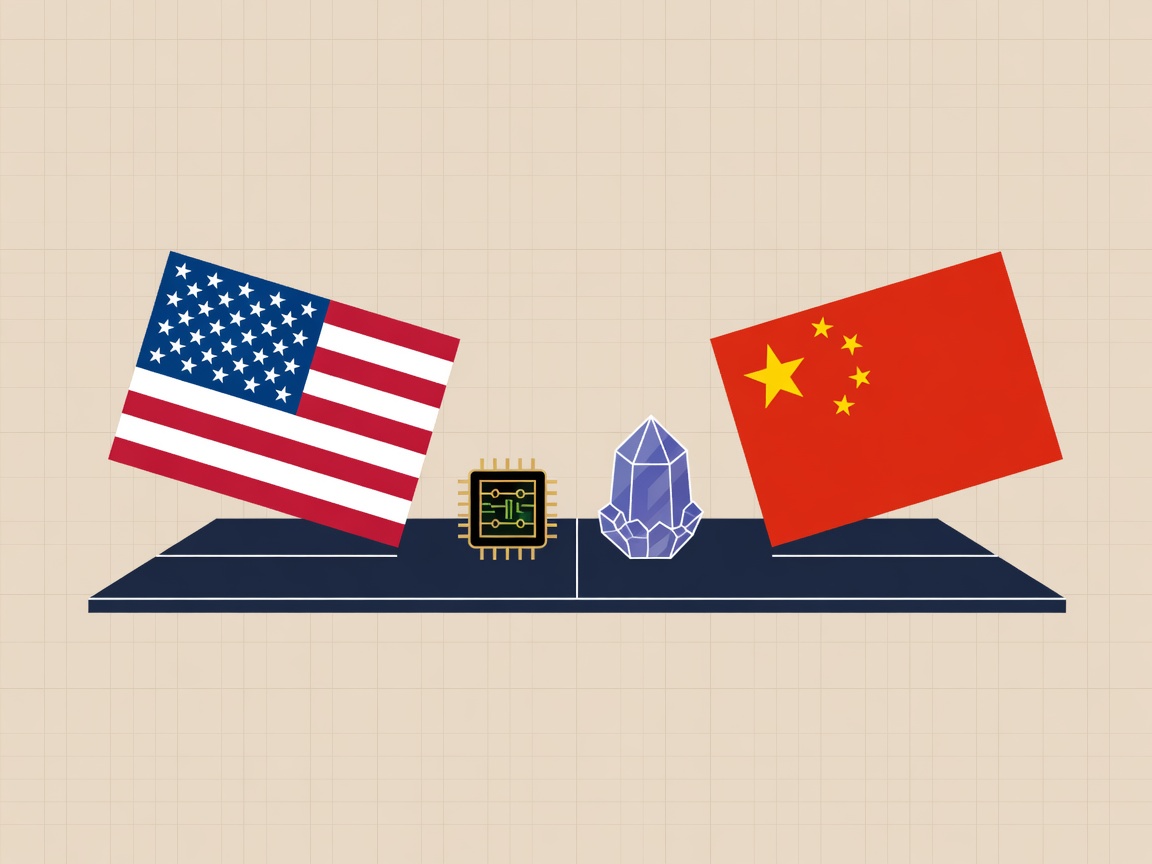
Top economic officials from the United States and China opened high-level trade talks in New York on Sunday, four days before President Donald Trump hosts Chinese President Xi Jinping at the White House. The negotiations aim to clear the way for agreements on trade, artificial intelligence, and critical minerals, as both sides seek to ease tensions between the world’s two largest economies. The summit falls on September 24.
Treasury Secretary Scott Bessent and Chinese Vice Premier He Lifeng began talks at JPMorgan Chase’s Manhattan headquarters on Sunday morning. US Trade Representative Jamieson Greer is also participating. “I’m looking forward to having focused, fulsome and constructive talks today that will set the stage for our leaders’ meeting,” Bessent told reporters as he arrived. He later said in a post on X that he and He Lifeng were continuing their discussions on the US-China economic and trade relationship ahead of Trump’s summit with Xi in Washington. “These talks help lay the groundwork for President Trump to advance America’s economic interests and deliver results for the American people,” he added.
A fragile truce and its expiration
At the top of the agenda is a US-China trade truce due to expire on November 10. The agreement, reached in Busan, South Korea, last November, capped US tariffs on Chinese goods at about 20 percent after a tit-for-tat trade fight briefly pushed tariffs into the triple digits. The current truce includes Chinese commitments on rare-earth exports and US agricultural purchases, while the Trump administration reduced some tariffs and suspended higher reciprocal tariffs on Chinese goods. Washington is also pressuring Beijing over its supply of rare-earth magnets and other critical minerals, crucial to industries ranging from cars to advanced semiconductors. China promised to restore the flow of critical minerals under last year’s truce, but a senior US official said on Friday that Beijing’s performance had not been up to par.
AI guardrails and Iran
Artificial intelligence is expected to feature prominently, adding a relatively new issue to negotiations long dominated by trade. Bessent has said the two countries could discuss AI guardrails aimed at addressing shared risks, including preventing powerful models from falling into the hands of malign non-state actors. The talks are expected to cover both open- and closed-weight AI models. Chinese open-weight models have increasingly attracted US companies, in part because they can be cheaper than closed systems developed by US firms such as OpenAI and Anthropic. “The United States remains the leader in AI,” Bessent said. “And we are open to discussions on avoiding shared risks and avoiding bifurcation of our two systems.”
The AI discussions come amid intensifying debate in Washington over the safety of the technology and national security. Top AI executives have recently warned that the technology could quickly become out of control and poses sweeping new threats, urging Washington to set guardrails and regulations on the industry, something Trump himself has recently derided. The Trump administration has favored voluntary and national-security-focused safeguards over broad mandatory rules for AI developers. The issue is expected to be part of discussions between Xi and Trump during the Chinese president’s visit.
Iran is also on the agenda. China remains one of Tehran’s most important economic partners and buys much of its oil, making Beijing an important target of Washington’s efforts to increase economic pressure on Iran as the US-Israel war on Iran enters its seventh month.
Low expectations for a breakthrough
Despite the packed agenda, analysts are not expecting a sweeping breakthrough. Expectations remain low. “I think there will be some show of deliverables because of the fact that it’s a presidential summit coming,” Anna Ashton told Reuters. “But I don’t feel like we’re on the verge of some sort of breakthrough,” added Ashton, a China trade analyst and founder of Ashton Intelligence. “I think status quo is probably both sides’ general best expectation,” she said. Former US Deputy Secretary of State Kurt Campbell similarly said the immediate goal may simply be keeping tensions contained. “One of the only things we can hope for in the short term is a truce, and that this will likely continue through the remainder of this year,” Campbell said.
Sunday’s negotiations are part of a series of meetings between Bessent, He, and Greer over the past 16 months aimed at hammering out areas of agreement before Trump and Xi meet face to face. Xi’s visit to Washington this week is his first during Trump’s second term. Trump visited Beijing earlier this year amid escalating tensions between the world’s largest economies.
The summit is expected to include high-stakes economic dialogue. JPMorgan CEO Jamie Dimon and Citigroup chief Jane Fraser are expected at a state dinner during Xi’s visit. OpenAI CEO Sam Altman and Nvidia chief Jensen Huang are also set to attend.