US destroys five Iranian oil tankers after IRGC missile attacks on American warship
Iran retaliated with ballistic missile strikes on a US base in Jordan, and Brent crude climbed toward $100 a barrel as the six-month conflict intensified.
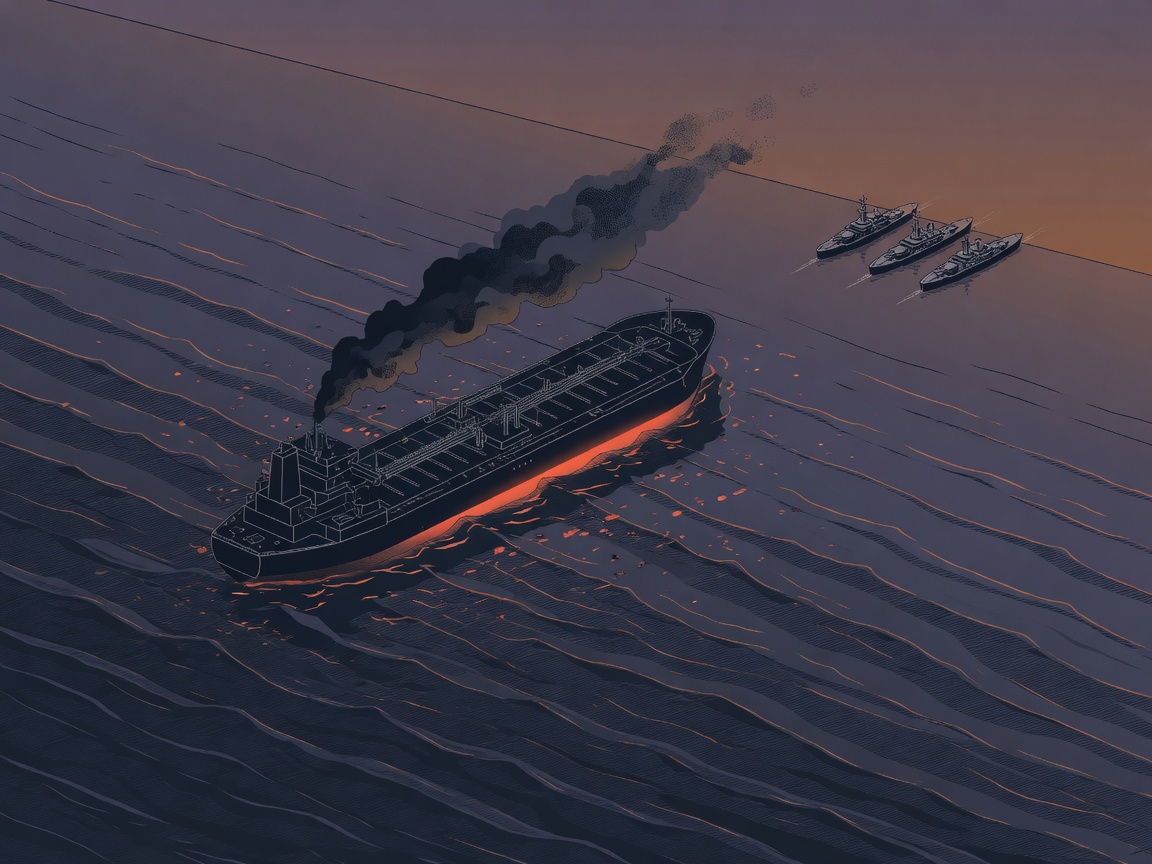
The United States military destroyed five Iranian oil tankers on Tuesday in retaliation for ballistic missile attacks by Iran’s Islamic Revolutionary Guard Corps against a US Navy warship, marking a sharp escalation in a conflict now entering its seventh month.
US Central Command said the IRGC had sought to target a US warship twice over the past two days. The vessel successfully evaded both attempts. No American personnel were harmed. CENTCOM said it retaliated by striking and destroying four tankers in the Gulf of Oman, the M/T Kaviz, M/T Charminar, M/T Horizon 1, and M/T Riesco, as well as the M/T Derya near Iran’s Kharg Island, which handled some 90 percent of the country’s oil exports before the war.
American forces directed the crews to abandon ship before the vessels were struck and rendered inoperable, CENTCOM added. Iran’s IRIB state broadcaster confirmed the attack near Kharg Island and reported that the crew was evacuated, adding that a second tanker was hit near the southern port of Jask in the Gulf of Oman. The IRGC said that several Iranian commercial ships were hit in total.
Iran responded to the tanker strikes by firing more missiles at US warships and at American forces stationed at the Al Azraq base in Jordan. Jordan’s Armed Forces said its air defences engaged 20 ballistic missiles, successfully intercepting and destroying 18 of them. Two missiles fell in unpopulated areas. There were no casualties, and specialised teams began securing the locations where debris and shrapnel fell, the military said in a statement.
The IRGC claimed that its ballistic missile attacks on the US Navy DDG-119 and DDG-53 destroyers caused significant damage to those vessels, and that hangars used by US fighter jets at Al Azraq were destroyed in the attacks on Jordan. There was no US comment on the Iranian claims. The IRGC also threatened to target oil tankers in Kuwaiti and Bahraini ports, warning crews there to evacuate immediately.
Oil prices surge as shipping attacks intensify
The hostilities briefly drove oil prices to $99.46 earlier on Tuesday, according to Al Jazeera. On Wednesday, US benchmark West Texas Intermediate futures for October delivery jumped 1.75 percent to $94.66 a barrel, while Brent crude, the international benchmark, added 1.55 percent to $99.44 a barrel, CNBC reported. The escalation is raising the risk of oil prices surging above $120 a barrel as attacks on shipping intensify, according to Daan Struyven, co-head of global commodities research at Goldman Sachs.
Struyven told CNBC’s Squawk Box Asia that it is definitely plausible for oil to reach $120 a barrel, and that the developments over the last few days suggest the probability of that upside scenario is going up as the shipping attacks intensify and broaden. Goldman’s base case remains for Persian Gulf exports to gradually recover as producers adapt to disruptions through alternative shipping routes and additional pipeline capacity. But the recent escalation has increased the chances that exports fail to recover in the coming months.
The exchange of fire comes amid escalating tensions in the Gulf six months into the US and Israel’s war on Iran. Tehran has maintained the closure of the Strait of Hormuz, which normally carries about one-fifth of global oil and gas shipments, since the outbreak of the war. Washington is enforcing a naval blockade on Iranian ports. US-Iran military action had been on pause for about a month, with Washington pivoting to economic pressure on Tehran, only to resume strikes toward the end of last month.
Diplomatic fallout and prior exchanges
Iran’s Ministry of Foreign Affairs condemned the latest US attacks on Iranian commercial vessels as a violation of the United Nations charter, describing them as a war crime and warning that Washington and its partners bear full responsibility for the consequences. Iran’s Foreign Minister Abbas Araghchi, in a post on X late Tuesday, dismissed US sanctions as a rehash of a failed strategy. After failing to achieve its aims through sanctions or war, Washington’s novel solution is more sanctions, Araghchi wrote, adding, Seriously?
US Secretary of State Marco Rubio defended the strikes during a visit to Colombia. Iran continues to try to hit US naval ships, and for every time they do that or try to do that, they’re going to lose tankers, Rubio told reporters. The US had previously attacked three Iranian oil tankers on September 5, causing one of them to sink. Tehran said it attacked three commercial ships and three US-linked ships in retaliation for that earlier round.
Earlier, the chief of staff of Iran’s Armed Forces, Ali Abdollahi, warned on state television that any attack on Iranian oil tankers would result in the targeting of US bases in the region. Al Jazeera’s Mike Hanna, reporting from Washington, DC, said the attacks mark an escalation in the conflict, noting that the US is now finding different targets in its response to Iranian attacks and that the tanker strikes fit into the administration’s declared strategy of bringing economic strangulation to Iran.
The war has claimed the lives of 18 US service members, according to The Guardian. Iranian authorities have put the overall death toll from US and Israeli strikes in the thousands, figures that outside observers, including US-based monitoring groups, have broadly corroborated. On Tuesday, Yemen’s Iran-backed Houthis attacked four cities in Saudi Arabia, wounding more than 70 people and setting oil installations ablaze in what appeared to be a significant expansion of the Middle East war. Saudi Arabia said it would retaliate.
Sources & methods
- Al Jazeera report on US destruction of five Iranian tankers, Iran's retaliation on Jordan, and statements from CENTCOM, IRGC, Jordan's Armed Forces, and US Secretary of State Marco Rubio Archived Sep 9, 2026
- The Guardian report on the tanker strikes, oil price movements, Houthi attacks on Saudi Arabia, the underwater drone dispute, and South Korean-French discussions on Strait of Hormuz security Archived Sep 9, 2026
- CNBC report on CENTCOM's announcement of the five tanker destructions, the underwater drone seizure claims, Iran's Foreign Minister Araghchi's response on X, and prior US tanker strikes on September 5 Archived Sep 9, 2026
- CNBC report on oil price movements with WTI and Brent futures data, and Goldman Sachs analyst Daan Struyven's assessment of the $120-per-barrel upside scenario Archived Sep 9, 2026
This article was assembled from four wire and news outlet reports published between September 8 and 9, 2026, cross-referencing CENTCOM statements, Iranian state media claims, Jordanian military announcements, oil market data, and analyst commentary for consistency.