US strikes Iran for 10th night as Tehran hits Gulf states and tankers burn in Strait of Hormuz
The conflict has entered a dangerous new phase with Iran declaring a full-scale war and commercial traffic through the world’s most important energy corridor collapsing.
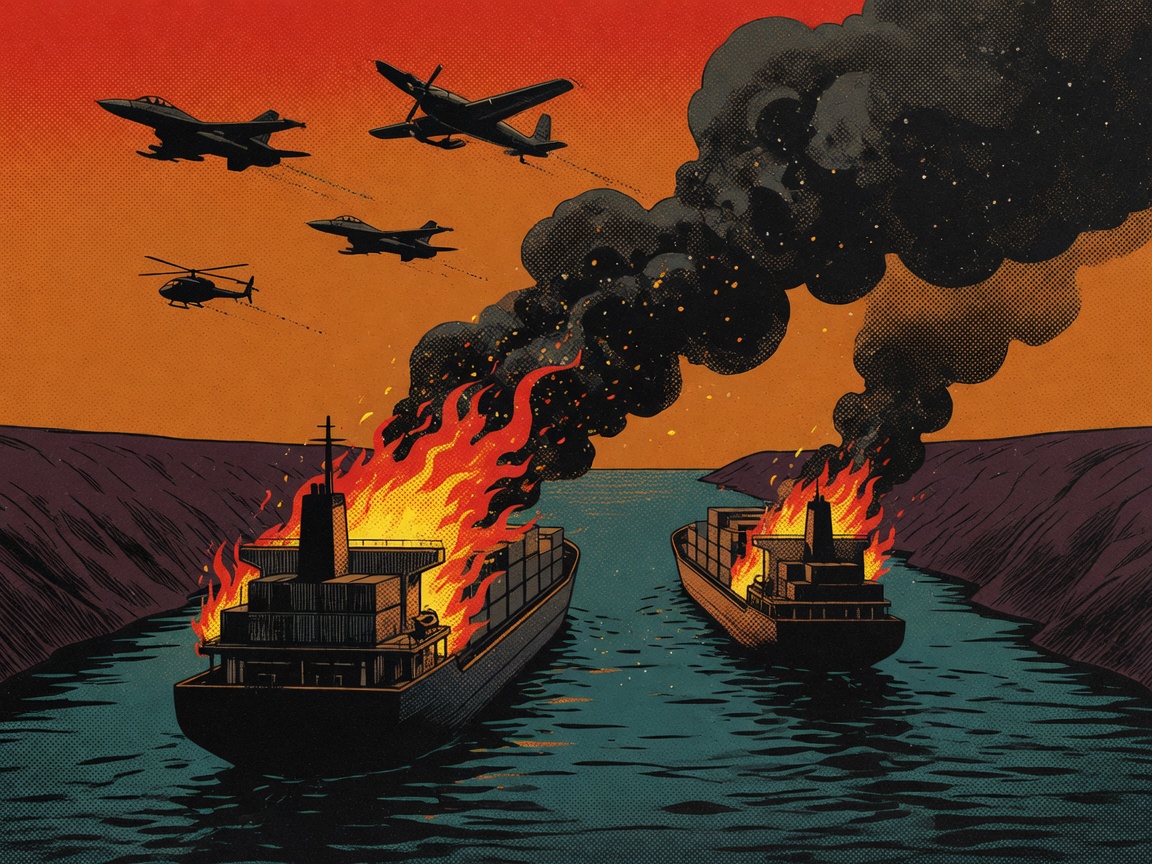
The United States bombed Iran for a 10th consecutive night, and Tehran retaliated by striking two oil tankers in the Strait of Hormuz and targeting American military assets across the Gulf.
The attacks mark a sharp escalation of a conflict that has nearly emptied one of the world’s most critical shipping lanes. US Central Command said the latest strikes hit Iranian military command centres, maritime capabilities, missile and drone launch sites, and air defense systems. The attacks followed a vow by President Donald Trump to punish Iran for the deaths of three American soldiers, two killed in Jordan and one in Iraq. The Pentagon identified two of the dead as Pte Isabella Gonzales, 19, from Texas, and Lt Tyler James Feehan, 25, from Hawaii, who were killed in an Iranian strike on the Muwaffaq Salti base in Jordan over the weekend. Centcom said a third service member went missing in action after the attack. Unidentified remains were later found.
Iran responded on multiple fronts. State news agency IRNA reported that Iranian forces struck two oil tankers in the strait and hit US military assets in Bahrain and Kuwait. President Masoud Pezeshkian said Iran was now fighting a “full-scale war” with the United States. The Islamic Revolutionary Guard Corps said the tankers had been traveling what it called an “unsafe and hazardous southern route” of the strait and exploded and were brought to a halt. Centcom disputed the claims.
The United Kingdom Maritime Trade Operations agency said a tanker in the Strait of Hormuz reported being struck by an unknown projectile, forcing its crew to abandon the vessel and board a lifeboat. Iran said rescue teams were removing the crews from the two oil tankers it had struck while attempting to transit through the vital waterway. It was not clear whether the tanker reported by the UK agency was among those cited by Iran.
Traffic collapses in the strait
The fighting has devastated shipping through the Strait of Hormuz, which carries roughly a fifth of global oil consumption. Lloyd’s List Intelligence recorded just 53 vessel transits in the week through July 20, down 66 percent from 157 the previous week, while tanker and gas carrier movements dropped to 30 crossings from 90. Kpler data showed daily crossings falling from more than 20 vessels before July 15 to 16 that day, then dropping to single digits on July 16. S&P Global recorded 40 vessels transiting between July 17 and July 19, averaging roughly 13 crossings a day.
The latest slowdown reverses weeks of gradual normalization after a mid-June ceasefire had encouraged some shipowners to resume Gulf voyages. Commercial ships still accounted for more than 70 percent of traffic over the period, although only about one-third were assessed as compliant with maritime restrictions. Iran-linked and sanctioned vessels continued to dominate many movements, suggesting mainstream international shipowners remain reluctant to return.
“Things have slowed down significantly since tensions reignited,” said Bridget Diakun, senior risk and compliance analyst at Lloyd’s List Intelligence. She noted that people pull back and reassess, as expected, but added that tankers were still crossing in and out and traffic had not ground to a complete halt. Vessel movements are likely to continue in ebbs and flows, she said, as shipowners seize brief windows of perceived safety before pulling back when tensions escalate.
Saul Kavonic, head of energy research at MST Marquee, said expectations of a rapid opening of the strait were premature. The hostilities and reimposed blockade set the conflict back on an escalatory trajectory, he said, and flows through Hormuz had dropped to around 15 percent of pre-war levels. “Oil could retest $100 a barrel if the current intensity of fighting persists for several weeks or if regional energy infrastructure comes under attack,” he told CNBC.
Strikes spread across the region
The scope of the fighting extended well beyond Iran and the strait. Jordan’s military said it shot down three Iranian missiles as sirens sounded across the country. Kuwait’s armed forces intercepted Iranian drones. Bahrain said drones launched by Iran had targeted its air navigation systems, though traffic remained unaffected. Iran’s semi-official Tasnim news agency reported that several Iranian cities had been hit, including Tabriz, Chabahar, Konarak, Bandar Mahshahr, and Bandar Imam Khomeini. Al Jazeera reported explosions near Sirik, Bandar Abbas, and Qeshm Island.
Despite the collapse of a ceasefire, Tehran said diplomatic messages were still being exchanged by both sides through intermediaries. Commercial vessels have continued to pass through the strait, Centcom said.
Sources & methods
- BBC News article on US strikes against Iran, Iranian retaliation, and the identification of killed US soldiers Archived Jul 21, 2026
- Al Jazeera live blog reporting explosions in Iranian cities and Iranian attacks on Gulf states Archived Jul 21, 2026
- CNBC report on Strait of Hormuz shipping traffic data from Lloyd's List Intelligence, Kpler, and S&P Global, with analyst commentary Archived Jul 21, 2026
This piece was assembled from three source texts: a BBC News article, an Al Jazeera live blog, and a CNBC report on shipping data. All claims, figures, and quotations are drawn exclusively from these sources.