House passes $1.15 trillion Pentagon bill and Iran war budget blueprint, sending the package to an uncertain Senate
The twin votes advance President Donald Trump’s military spending priorities and a $95 billion reconciliation framework, but Senate Democrats have already blocked one version of the defense bill.
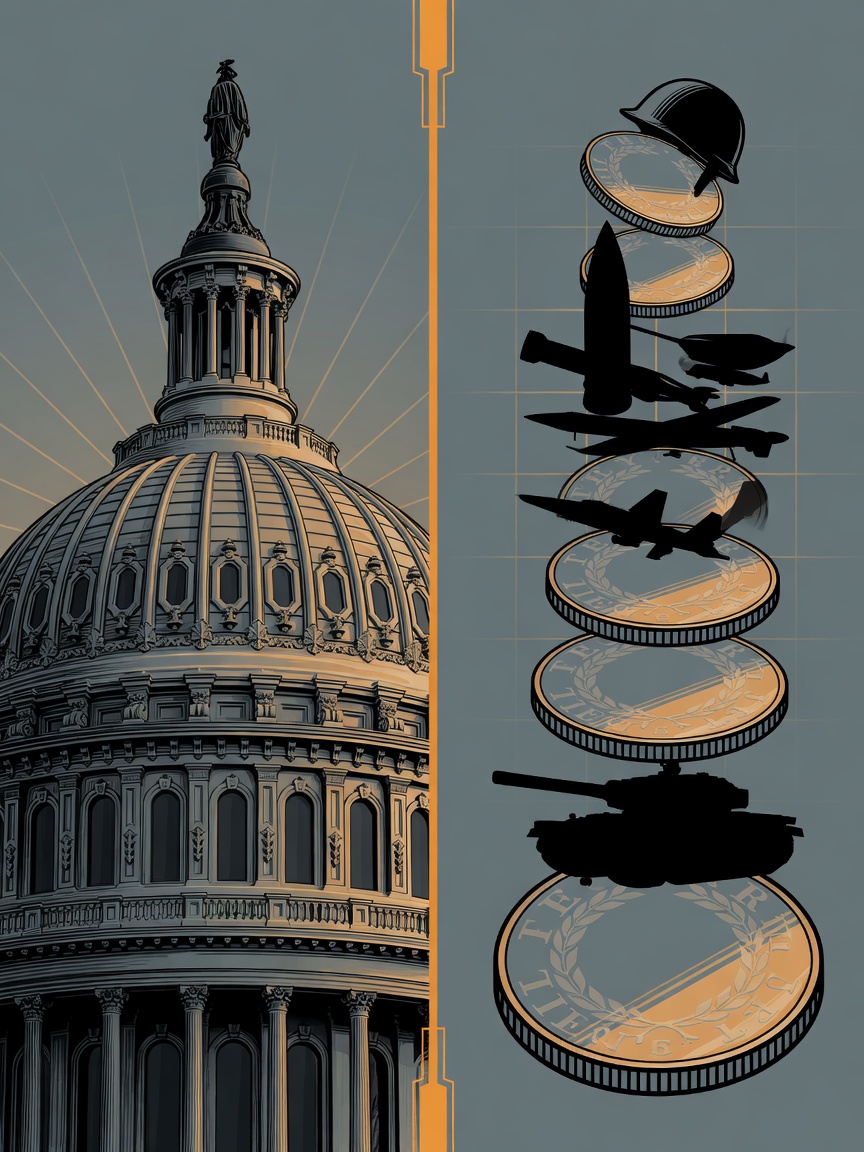
The House of Representatives approved a $1.15 trillion military funding bill and a separate $95 billion budget blueprint on Wednesday, advancing President Donald Trump’s defense priorities and financing for the Iran war before a recess lasting more than a month.
The votes send both measures to a Senate where the path forward is unclear. Senate Democrats blocked debate on the defense bill just last week, demanding concessions that would curb Trump’s war effort in Iran. The National Defense Authorization Act, typically passed with broad bipartisan support, has become a party-line effort this year.
The defense bill passed 216 to 212. Six Democrats joined Republicans in support. Seven Republicans broke ranks to oppose it. The narrow margin reflects deep divisions over the cost of the legislation and its expansion of military technology cooperation with Israel, a provision that has drawn scrutiny as voter support for arming Israel declines.
A generational investment or a permission slip
Republicans describe the bill as “a generational investment in America’s national defense” that “builds the fighting force of the future by prioritizing innovation, lethality, and readiness.” The 2027 NDAA reflects Trump’s request to boost military spending from $900 billion last year to $1.5 trillion. Trump has said the increase is necessary as the United States fights a war on Iran that was launched jointly with Israel in late February.
Democrats reject that framing. Representative Adam Smith of Washington state, the top Democrat on the House Armed Services Committee, said in a statement: “The problem with this year’s defense authorization bill is that it comes with the inclusion of $1.15 trillion in discretionary spending.” He added: “I cannot and do not support meeting these needs by making massive cuts to critically important domestic programs and slashing taxes.”
Republican Representative Thomas Massie, a vocal critic of the war on Iran who has clashed with the White House, opposed the bill over Section 219, which merges American military technology and supply chains with Israel’s. “Let’s hope this version fails in the Senate because Section 219 is a betrayal of our sovereignty,” Massie wrote on social media.
A second track for war funding
Separately, House Republicans advanced a $95 billion budget blueprint by a vote of 216 to 214. The framework outlines more than $70 billion for the Iran war, $12 billion in assistance for farmers, and money to implement the SAVE America Act. Trump’s signature election overhaul bill would impose new restrictions on voting to counter what he has falsely portrayed as widespread fraud.
GOP fiscal hardliners objected that none of the spending would be offset by reductions elsewhere. Other lawmakers raised concerns about appropriating more funds for a war that is rapidly escalating and remains unpopular with the public. Speaker of the House Mike Johnson of Louisiana persuaded enough members to set aside those concerns to advance the legislation.
The blueprint was advanced through reconciliation, a parliamentary procedure that bypasses the Senate’s 60-vote threshold and could allow passage on a party-line vote. The timeline for Senate action on the reconciliation framework remains an open question. Senate Majority Leader John Thune of South Dakota said Tuesday that he wants to prioritize negotiations to extend government funding beyond the midterm elections, with current funding set to lapse at the end of September. Thune said he would try to negotiate a deal with Democrats, but if he cannot reach one he would consider revamping the budget framework to extend government funding on a strictly party-line basis. The House passed its own bill to extend government funding through December on Tuesday, but Thune said the plan does not include several funding requests sought by the White House.
The war’s toll continues to mount. Defense Secretary Pete Hegseth has said the conflict has already cost taxpayers $37.5 billion. At least four service members have been killed in recent days, bringing the total American death toll to 18. Nearly 500 have been injured. The average price for a gallon of gas is back above four dollars in the United States, according to AAA.
Senate Minority Leader Chuck Schumer has called the NDAA a “permission slip” for the government’s war on Iran. The package also includes aid for Ukraine and the SAVE America Act, adding further complications to a bill usually treated as must-pass legislation.
Sources & methods
- Al Jazeera report on the House passage of the $1.15 trillion NDAA, including vote count, Massie and Schumer quotes, Israel cooperation provisions, and Senate uncertainty Archived Jul 23, 2026
- NPR report on the House votes for the NDAA and the $95 billion reconciliation blueprint, including Republican and Democratic quotes, war cost figures, casualty numbers, Thune's funding negotiations, and the Stop Insider Trading Act Archived Jul 23, 2026
This article was assembled from two source reports covering the July 22-23, 2026 House votes. Direct quotes were verified against the source texts; all figures and vote totals are drawn from the reporting of Al Jazeera and NPR.