Trump signs new executive orders targeting birthright citizenship after Supreme Court rejection
The president’s second attempt to restrict the constitutional guarantee faces immediate legal challenges from the ACLU, which calls the orders doomed to fail.
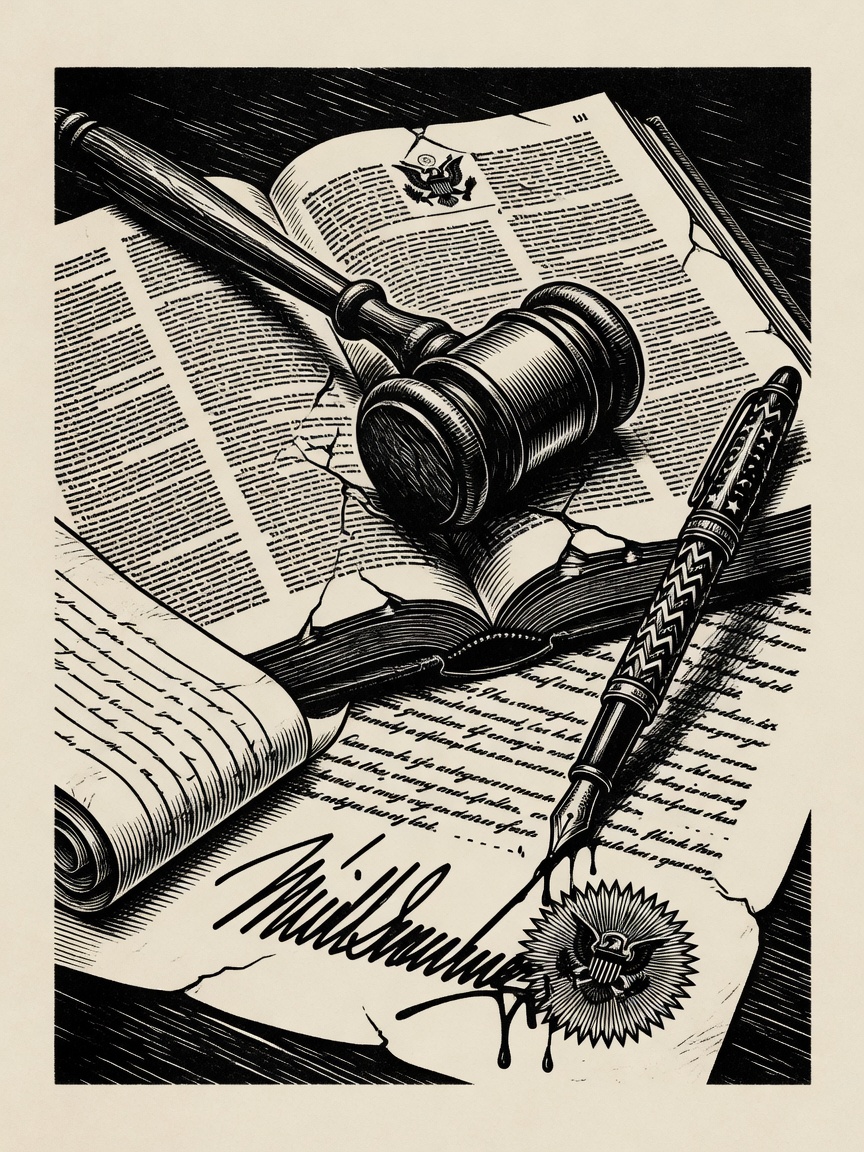
President Donald Trump signed two executive orders on Thursday seeking to restrict birthright citizenship, weeks after the Supreme Court rejected his first attempt to eliminate the 150-year-old right. The move drew an immediate challenge from the American Civil Liberties Union. The orders represent Trump’s second bid to scale back a constitutional guarantee that the high court reaffirmed in June.
The first order expands existing definitions of non-citizens whose children are not eligible for birthright citizenship. It prohibits automatic citizenship for babies born to two non-citizen parents where one parent falls into one of several expanded categories. Those categories include members of foreign terrorist groups, foreign government employees, people who attempted to gain citizenship through fraud, and residents of US territories where citizenship is not conferred by federal statute. At present, that territorial exception applies only to American Samoa. Birthright citizenship for people born in territories such as Puerto Rico is codified by federal statute.
The second order bans so-called birth tourism. That is the practice of pregnant mothers traveling to the US to give birth so their babies become citizens. Trump claimed that hundreds of thousands of babies have been born through birth tourism. He offered no evidence for that figure. “They’ve taken birthright citizenship and they’ve made a joke out of it,” Trump told reporters. “People are building businesses around it. That’s not the way it’s supposed to work. It’s a disgrace. They’re buying their way in, and we’re not going to let it happen.”
Legal fight ahead
The ACLU blasted the orders as an unconstitutional attempt to undo birthright citizenship after the administration’s defeat at the Supreme Court in June. Cody Wofsy, deputy director of the ACLU’s Immigrants’ Rights Project, said the issue was already settled. “The Supreme Court already decided this issue: Birthright citizenship is guaranteed by the Constitution. No additional executive order can change the meaning of the Constitution,” Wofsy said. “Any executive order that tries to rewrite birthright citizenship will meet the same fate as the last one.” The Supreme Court voided Trump’s Day One executive order in June, ruling that his first order violated the 14th Amendment. Trump called the ruling “a bad decision, very unfair decision” and said the country “suffers because of it.” He told reporters the new orders were an attempt to end the policy “in a different way.”
Stephen Miller, the White House deputy chief of staff and homeland security advisor, said the president has the authority to ban birth tourism under a section of the Immigration and Nationality Act. That law grants the president power to set exceptions and limitations on who can enter the country. “The idea (is) that people come here pretending to be a tourist, pretending to be a visitor,” Miller said while standing beside the president. “But the real reason they’re here is to have a child, to make that child an automatic citizen, (to) leave our country and then have a US citizen child.” Miller said those children then gain access to welfare benefits, the voting booth, and other rights and privileges that belong solely to Americans.
Trump’s estimate of hundreds of thousands of birth tourism cases diverges sharply from available data. The Migration Policy Institute, a nonpartisan research group, said the most expansive census-based estimate accounts for about 22,000 to 26,000 babies born through birth tourism annually. Government data showed 9,600 births to mothers with foreign addresses in 2024. That figure represents less than one percent of all babies born in the United States each year.
The practice is already illegal. Traveling to the US under the guise of tourism while intending to give birth so a child obtains citizenship constitutes visa fraud under existing law. That raises questions about the practical implications of the new order beyond current statutes. The second order directs federal agencies to target birth tourism operators who arrange such travel.
A decade-long campaign
Trump’s effort to restrict birthright citizenship spans more than a decade. At a Republican primary campaign event in Orlando, Florida, in November 2015, Trump said he would end what he called the scourge of “anchor babies,” a derogatory term for US-citizen children of undocumented immigrants. “You can’t come into the country, you’re illegal, you come down, you sit down, you have your baby, and we take care of the baby for the next 85 years!” Trump said then. He promised the crowd that “the anchor baby, birthright citizenship, it’s over.”
In a 2018 interview with Jonathan Swan, Trump called birthright citizenship “ridiculous” and falsely asserted that the US is “the only country in the world where a person comes in and has a baby, and the baby is essentially a citizen.” In fact, 32 other nations grant citizenship this way. Trump’s claim that he could undo the 14th Amendment guarantee with an executive order was a minority view among legal scholars. It was supported by John Eastman, a former law clerk to Supreme Court Justice Clarence Thomas, who argued for decades that the amendment should exclude children of non-citizens. Eastman later claimed in a 2020 Newsweek op-ed that Kamala Harris was ineligible for the vice-presidency because she was born in California to non-citizen parents from India and Jamaica. Trump called the question Eastman raised about Harris’s citizenship “very serious” and praised Eastman as “a very highly qualified, very talented lawyer.”
Gabriel Chin, a professor at the University of California Davis School of Law, told the BBC that while parts of the order might hold up, other aspects raise serious constitutional questions. Chin said the president does have some power to restrict people coming into the US specifically to have a child. “But once it does happen, once a child is born in the United States, I don’t think the president has any power to decide that that child is not a citizen,” he said. Chin called birth tourism “a drop in the bucket” against the millions of births in the US. “It’s an unusual phenomenon,” he said.
Sources & methods
- BBC News report on Trump signing two executive orders targeting birthright citizenship, including details on order provisions, Stephen Miller's comments, and legal expert Gabriel Chin's analysis Archived Aug 7, 2026
- The Guardian live coverage of August 6, 2026, including the ACLU's response to the new executive orders and background on Trump's decade-long campaign against birthright citizenship Archived Aug 7, 2026
- The Guardian analysis piece tracing Trump's campaign against birthright citizenship from 2015 to the present, including John Eastman's role and the Supreme Court's June ruling Archived Aug 7, 2026
- The Guardian report on the two new executive orders, their specific provisions, the ACLU's legal challenge, and the Migration Policy Institute's birth tourism data Archived Aug 7, 2026
This article was assembled from four source texts, one from BBC News and three from The Guardian, covering the executive orders, legal expert commentary, ACLU statements, and historical context of Trump’s birthright citizenship campaign.