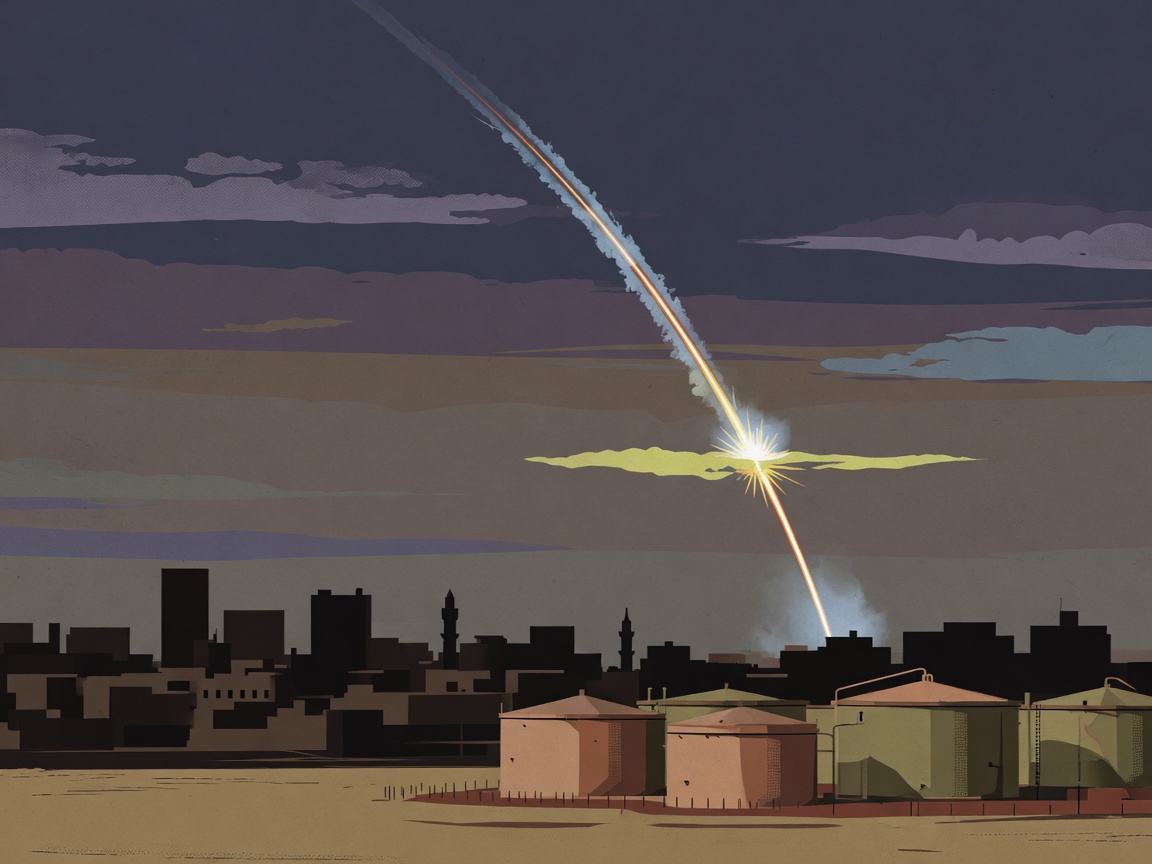
Saudi-led coalition forces said they intercepted and destroyed a ballistic missile fired at Riyadh at dawn on Saturday, as Iran-backed Houthi militants in Yemen launched a coordinated barrage of drones, cruise missiles, and ballistic weapons against the Saudi capital and energy facilities on the Red Sea coast.
The strike prompted air raid alerts across Riyadh for the first time since the Houthis increased their attacks on Saudi Arabia in July. Explosions echoed through the city. A column of black smoke rose from fuel tanks near King Khalid International Airport, where flights were temporarily disrupted with delays and cancellations reported by the tracking website FlightRadar24. Saudi authorities reported no casualties or damage.
An AFP journalist reported that firefighters could be seen working to extinguish flames from a burnt-out fuel tank belonging to Aramco. Residents near the airport described seeing a large plume of black smoke later in the morning. The Saudi Civil Defence had sent phone alerts overnight warning of potential danger in Riyadh and other regions before issuing an all-clear on Saturday morning.
One resident of northern Riyadh, a 27-year-old who spoke to AFP on condition of anonymity, described the moment the alerts gave way to impact. “I heard the alarm, then my windows shook,” the resident said. “It was definitely scary. I was not expecting this.”
Houthi military spokesman Yahya al-Sarea said in a statement posted online that a “large number of ballistic and cruise missiles and drones” had been used to attack “sensitive sites” in Riyadh and Aramco state oil and gas company facilities in Yanbu, a city on the Red Sea coast. He said the attacks were “in response to the Saudi enemy’s criminal attempts” to target the Yemeni capital Sanaa, which is controlled by the Houthis. Sarea had earlier accused Saudi Arabia of carrying out 300 strikes across Yemen during the past week.
Broader barrage and ground fighting
Saudi air defences also stopped what coalition spokesperson Major-General Turki al-Maliki described as hostile attempts to target civilians in the cities of Bisha, Taif, Farasan, and Yanbu. Al-Maliki wrote on X that the attacks were thwarted by the Gulf monarchy’s air defences and affirmed the coalition command’s right to take “appropriate” action to deter the Houthis in accordance with international humanitarian law. He said the Houthis are escalating their attempts to target civilians and civilian infrastructure in the capital.
On the ground in Yemen, fighting between the Houthis and Saudi-backed government forces claimed 48 lives on Saturday, according to an unconfirmed AFP report quoting military sources on both sides. The Houthis said 31 of their fighters had been killed. Government sources said their side lost 17 soldiers. The Saudi-backed internationally recognised government said its fighters thwarted a Houthi infiltration attempt in the al-Fuliahan sector in southern Marib, killing 12 Houthi fighters. The army also said 13 Yemeni soldiers were killed in two days of clashes in the southwestern provinces of Taiz and Lahj.
Renewed clashes are taking place across Marib, Taiz, Lahj, al-Jawf, and al-Bayda as part of a military escalation that began in early July, described as the most intense since the relative calm following an April 2022 truce. The International Organization for Migration, a UN body, reported on Friday that the number of people displaced as a result of recent fighting had passed 104,796.
Yasmeen al-Eryani, executive director for knowledge production at the Sana’a Center think tank, told Al Jazeera that the Houthis are dictating the pace of the conflict. “You could see that the Houthis are determining the timelines and the levels of the escalation,” she said. “So, depending on the current situation, it seems that the Houthis are the ones in control.” She added that military options against the group are currently limited because much of the fighting is taking place in mountainous terrain difficult for opposing forces to access and hold, and that containing the group may be more realistic than defeating it militarily.
Regional alarm and diplomatic fallout
The US State Department urged Americans in the Middle East to “exercise vigilance and be prepared for potential flight cancellations and other travel disruptions,” warning that the conflict has the potential to escalate rapidly. Americans “should seriously reconsider travel to and through the region,” the department said in a statement. The Houthis recently seized control of the strategic port city of Mokha and Perim Island, a gateway to a key shipping route used by the Gulf state to export to Asia and Europe. The group said the naval blockade was in retaliation for a Saudi blockade of ports and airports in Houthi-controlled northwestern Yemen.
Turkey and Pakistan have both signaled willingness to defend Saudi Arabia under a trilateral defence pact signed on August 7 in Mecca by Saudi Crown Prince Mohammed bin Salman, Turkish President Recep Tayyip Erdogan, and Pakistani Prime Minister Shehbaz Sharif. Turkish Foreign Minister Hakan Fidan told Turkish broadcaster NTV on Friday that Saudi Arabia may have unmet military needs and that Turkey would consider how to support the kingdom, adding it was unacceptable for Saudi Arabia to be dragged into the US-Iran war. Pakistan’s military spokesperson told Arab News that Islamabad would defend Saudi Arabia “to any extent,” including “physically,” though Pakistan’s Foreign Office said no military response is currently under discussion.
Iran’s top security official Mohsen Rezaei told Al Jazeera that Tehran has conveyed its conditions for ending the war to the White House through Qatari mediators, demanding an end to the war on all fronts, the release of frozen Iranian assets, and the lifting of the US naval blockade on Iranian ports. Jordan, the United Nations, and the Gulf Cooperation Council condemned the Houthi attacks. UN Secretary-General Antonio Guterres and GCC Secretary-General Jassim al-Budaiwi, speaking on the sidelines of the UN General Assembly in New York on Saturday, condemned the targeting of civilian objects and the threat to security and stability in the region.